When USACO Silver problems ask you to maximize the number of tasks completed, minimize the total cost, or select a subset under a constraint, the greedy approach often feels right. The challenge is proving it. The exchange argument is the standard proof technique: assume an optimal solution exists, then show you can swap one of its choices for your greedy choice without making the solution worse. If you can always perform this exchange, your greedy choice is safe. This article walks through a verified worked case where the exchange succeeds, a contrasting case where a similar-looking greedy fails, and a short diagnostic to test whether your own greedy intuition holds.
What Makes a Greedy Algorithm Valid in USACO Silver
A greedy algorithm builds a solution step by step, making the locally best choice at each stage. For this to produce a globally optimal solution, the problem must have two properties: optimal substructure (an optimal solution contains optimal solutions to subproblems) and the greedy-choice property (a locally optimal choice leads to a globally optimal solution). USACO Silver problems that reward greedy solutions typically encode these properties in constraints like “each item has a deadline” or “choose as many as possible without overlap.”
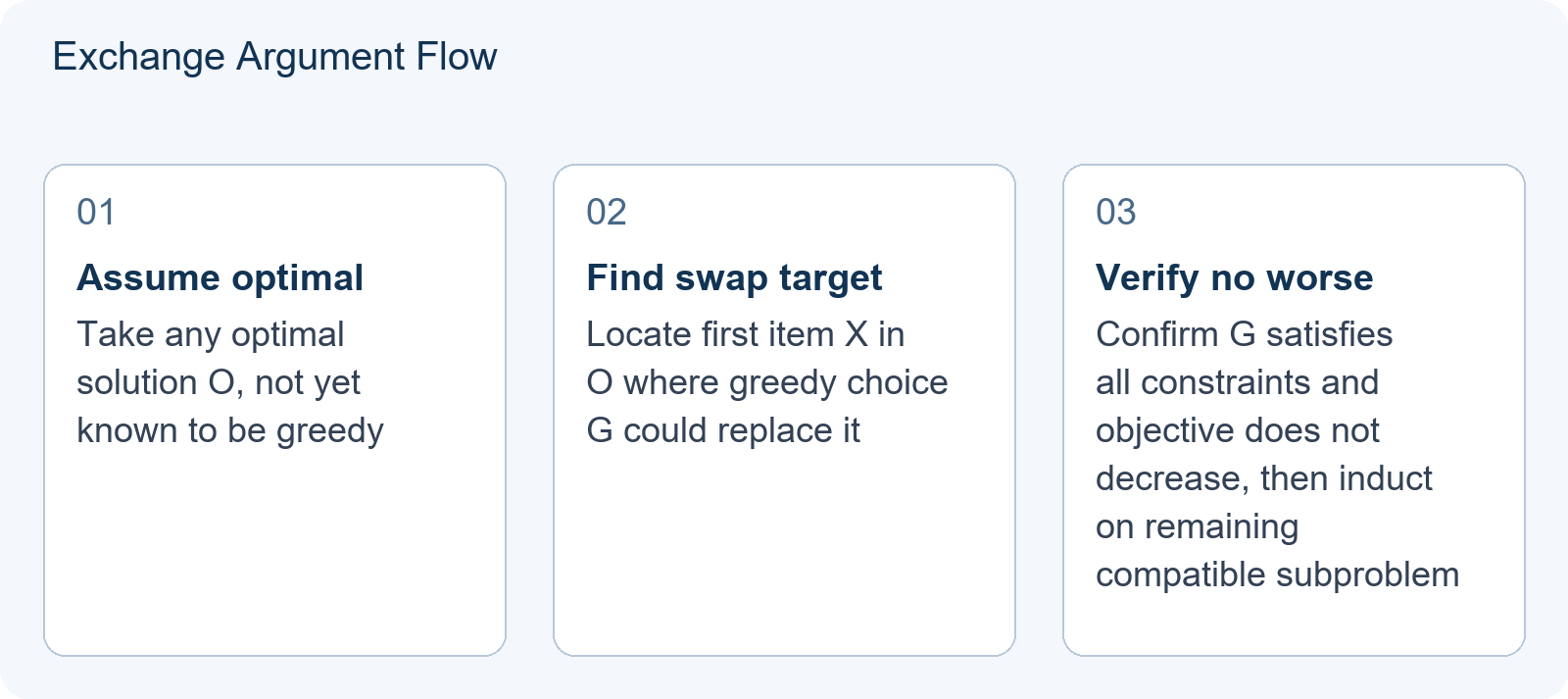
The exchange argument proves the greedy-choice property directly. Suppose your greedy algorithm selects item G first. Consider any optimal solution O. If G is already in O, you are done. If not, you show there exists some item X in O that you can replace with G without violating constraints or decreasing the objective. This establishes that some optimal solution contains G. To complete the proof, you must then argue that the remaining problem—after selecting G and removing all items incompatible with G—has the same structure as the original, so the same greedy rule applies inductively. The iterative scan that implements this (sort by finish, then sweep once) naturally handles the residual subproblem without explicit recursion.
Worked Case 1: Activity Selection With the Earliest-Finish-Time Greedy
Consider the classic interval scheduling problem: given N activities with start and end times, select the maximum number of non-overlapping activities. The greedy choice is to always pick the available activity with the earliest finish time.
Claim: Let G be the activity with earliest finish time. There exists an optimal solution that includes G.
Exchange proof (first step): Take any optimal solution O. If O contains G, we are done. If not, let X be the activity in O with the earliest finish time. Since G finishes no later than X, and all other activities in O start no earlier than X’s finish time (because O is a valid schedule and X finishes before any other activity in O can start), all other activities in O also start no earlier than G’s finish time. Therefore G does not overlap with any other activity in O. Replace X with G. The schedule remains valid and has the same size. Thus an optimal solution containing G exists.
Induction on the remaining subproblem: After selecting G, discard G and all activities that overlap with G. The remaining activities form a smaller instance of the same problem. Apply the same argument: the greedy choice on this reduced set is also safe. The iterative scan—maintaining the finish time of the last selected activity and accepting any activity that starts at or after that finish time—implements this residual choice automatically. No explicit recursion is needed in the code.
Verification of every step: (1) G’s finish time ≤ X’s finish time by greedy selection. (2) X has the earliest finish time in O, so all other activities in O start after X finishes. (3) Since G finishes ≤ X finishes, all other activities in O start after G finishes as well. (4) Therefore G is compatible with O \ {X}. (5) The new schedule O \ {X} ∪ {G} has the same cardinality as O and is valid. (6) After removing G and its overlaps, the remaining instance preserves the original problem structure. Conclusion: the exchange plus induction is valid.
This is the standard proof behind many USACO Silver scheduling problems. The key insight is that earliest-finish-time leaves maximum remaining time for other activities, and the exchange explicitly constructs the modified optimal solution.
Contrasting Case: Weighted Interval Scheduling Where Greedy Fails
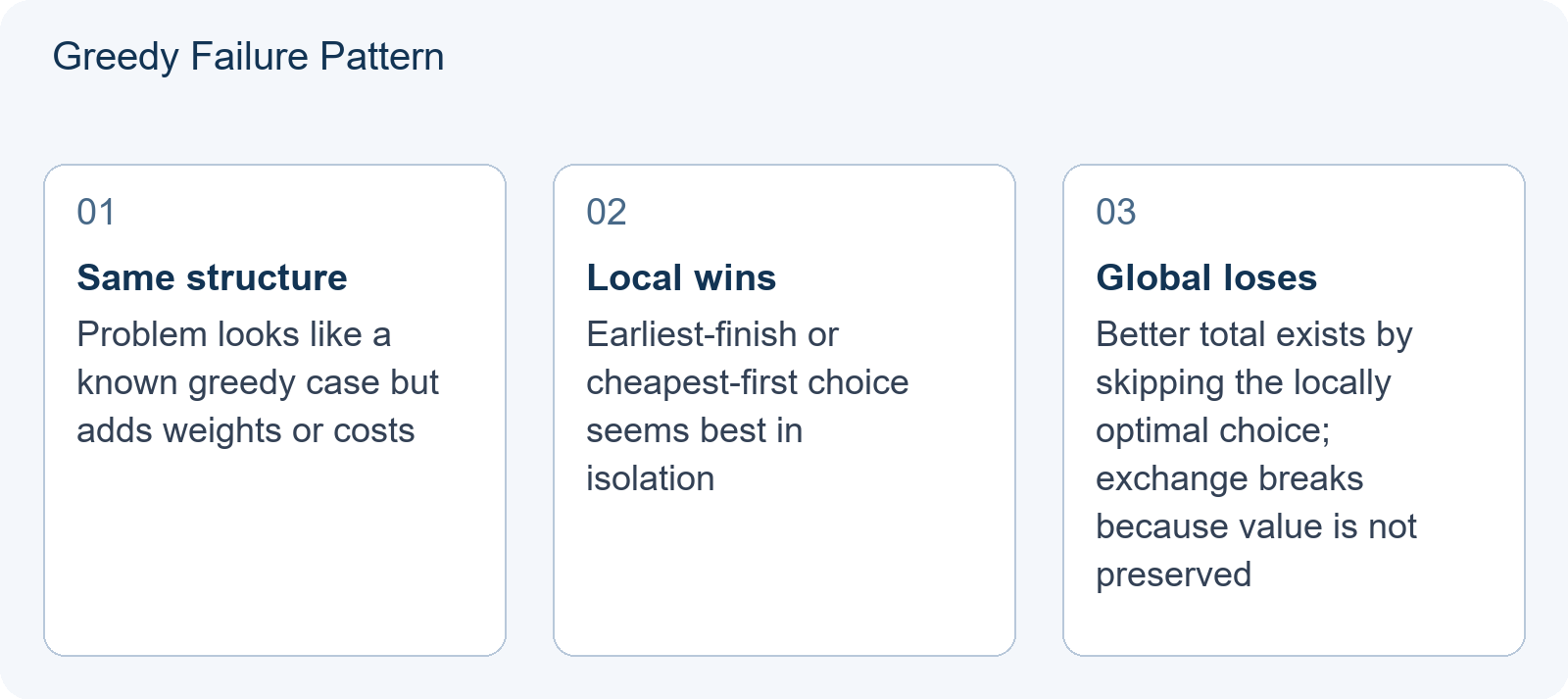
Now modify the problem: each activity has a weight (profit), and the goal is to maximize total weight of selected non-overlapping activities. Applying the unweighted earliest-finish-time greedy to this weighted variant can produce suboptimal results.
Teaching illustration (verified): Consider three activities with positive-duration half-open intervals: A = [0, 10) with weight 21, B = [0, 6) with weight 10, and C = [6, 10) with weight 10. Intervals that touch at endpoints are compatible: B ends at 6 and C starts at 6, so they do not overlap. The greedy algorithm sorts by finish time and selects B first (finishes at 6), then finds C compatible (starts at 6, finishes at 10), for total weight 20. However, the optimal solution selects A alone with weight 21. The greedy algorithm fails because the locally optimal choice (earliest finish) does not account for the higher weight of a longer interval.
Why the exchange argument breaks: In the unweighted case, replacing X with G preserved the solution size because all activities had equal value, and the remaining subproblem had identical structure. In the weighted case, G (earliest finish) does not have sufficient weight to compensate for what it displaces. The greedy-choice property fails—locally optimal (earliest finish) is not globally optimal (maximum weight).
Diagnostic: Three Questions to Test Your Greedy Intuition
Before coding a greedy solution for a USACO Silver problem, verify these three conditions:
- Can you define the greedy choice unambiguously? “Pick the best one” is not a rule. “Pick the interval with earliest finish time” or “Pick the cow with smallest weight that fits in the remaining space” are specific, implementable rules.
- Can you state the exchange argument in the problem’s terms, including the induction on the remaining subproblem? If you cannot identify what to swap and why the swap doesn’t make things worse, and why the smaller problem has the same structure, you do not have a complete proof.
- Can you construct a case where your greedy fails? If you can, your greedy rule is refuted for that problem type. If you cannot, this neither proves nor refutes the greedy approach—you may lack imagination, or the greedy may actually be correct but require a different proof technique.
Note that inability to supply this particular exchange argument does not establish that greedy is false; other proof techniques may exist. Many USACO Silver problems are intentionally structured with the weighted/unweighted distinction in mind—students who recognize when greedy applies save crucial contest time.
From Proof to Code: Implementing the Verified Greedy
Once the exchange argument checks out, implementation is straightforward. For the activity selection problem: sort by finish time (O(N log N)), then scan once maintaining the finish time of the last selected activity. The proof guarantees this is optimal; the code executes the verified strategy. The iterative scan naturally handles the residual subproblem: each time you select an activity, you implicitly solve the smaller instance of compatible remaining activities.
Common implementation errors that still pass samples but fail hidden tests: (1) sorting by start time instead of finish time—this breaks the exchange; (2) using strict inequality when non-strict is required for edge cases where one activity ends exactly when another starts (half-open intervals make this explicit: [0,6) and [6,10) are compatible); (3) forgetting that after the first greedy choice, the same logic applies to the remaining compatible set—the iterative scan implements this without needing explicit recursion.
Connecting to Broader USACO Silver Strategy
The exchange argument appears across USACO Silver topics. In problems about minimizing the number of intervals to cover a range, the greedy choice is the interval that extends farthest right while still covering the current point. The exchange shows any optimal solution can be modified to include this farthest-reaching interval, and induction on the remaining uncovered portion completes the proof. In problems about assigning tasks to workers, sorting by difficulty and using a greedy match with a multiset relies on a similar exchange.
Understanding when greedy works and when it fails is part of the algorithmic maturity that separates Silver from Gold. For a broader view of the algorithm families that dominate Silver and the transition to Gold, see Silver to Gold: The Four Algorithm Families That Decide Whether You Get Promoted. For practice on another Silver technique with its own proof structure, see USACO Silver Binary Search: Proving That the Feasibility Check Is Monotone. And for the foundational Bronze skills that support greedy intuition, see USACO Bronze Simulation: Choosing State Variables That Prevent Hidden Bugs.
Preparing Your Next Consultation or Self-Study Session
If you are deciding whether to work with a coach or study independently for USACO Silver, the exchange argument is a good litmus test. Can the student independently construct the proof for activity selection, including the induction step? If not, targeted practice on proof techniques may be more valuable than more coding problems. When evaluating preparation resources, look for whether they explain why the greedy works, not just what code to write.
For a structured approach to building this skill, consider what feedback would actually help: not just “wrong answer” but “your greedy fails on this case because…” This diagnostic specificity is what converts failed attempts into learning. Whether through self-study with careful upsolving or guided practice with explicit proof requirements, the goal is the same: replace hopeful guessing with verifiable reasoning. The official USACO contest instructions state that during contests students work individually without generative AI or outside consultation; this is a competition rule, not a statement about what training methods are effective. Effective training, whether independent or coached, should develop the reasoning skills that allow you to verify your own solutions under contest conditions.
Frequently Asked Questions
Can I ever use a greedy approach without a formal proof in contest?
You can try, but unverified greedy attempts risk wrong answers. The exchange argument can often be sketched mentally in under a minute once practiced. Investing in this verification prevents wasted submissions on incorrect greedy solutions. Note that contest rules do not require you to submit proofs—only correct code—but understanding the proof is what lets you trust your code.
How do I know if a problem is greedy or requires dynamic programming?
Attempt the exchange argument including the induction step. If you cannot construct it, try to build a small counterexample where greedy fails. Finding a valid counterexample refutes the greedy approach for that problem type. Failing to find a counterexample neither proves nor refutes greedy validity—you may need a different proof technique, or the problem may indeed require dynamic programming. Many Silver problems are intentionally structured to look greedy when they are not.
Does the exchange argument work for all optimization problems?
No. It only works when the greedy-choice property holds. The technique is specific to problems where a local choice can be shown to lead to global optimality through explicit replacement, and where the remaining subproblem preserves the original structure. It is a proof tool, not a universal algorithm. Other proof techniques exist for verifying greedy solutions, and inability to construct this particular proof does not mean greedy is incorrect.