For many students entering the USA Computing Olympiad (USACO), the transition from classroom programming to competitive problem-solving is marked by a specific hurdle: exhaustive search. In the Bronze division, problems are often designed to be solvable by checking every possible scenario. However, a common misconception is that “brute force” means simply nesting loops until the code runs. In reality, successful Bronze solutions require you to bound the work before you write a single line of code. If your nested loops execute too many iterations, your solution will fail with a Time Limit Exceeded (TLE) error, regardless of its logical correctness.
The Hidden Cost of Nested Loops
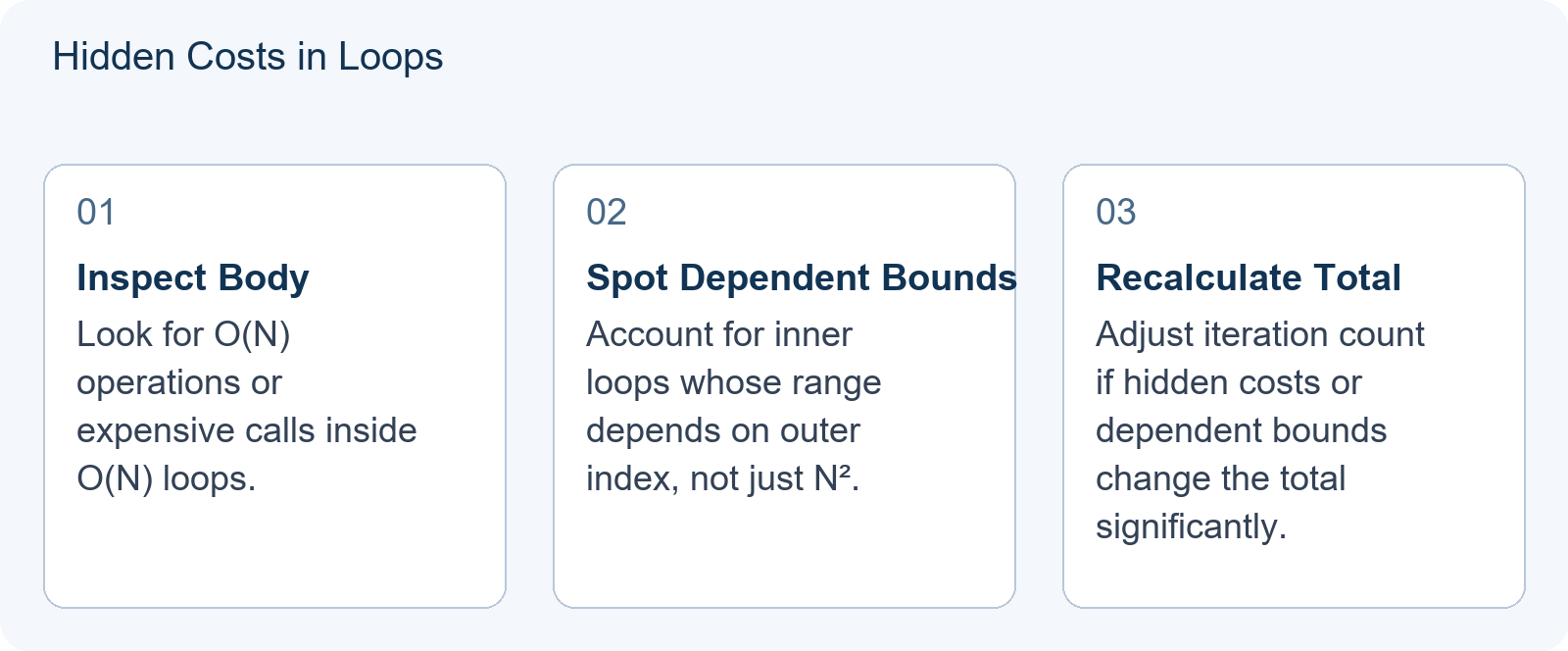
Exhaustive search, or brute force, involves iterating through all potential candidates for a solution. In USACO Bronze, this usually takes the form of nested loops. The critical skill is not knowing how to write the syntax, but calculating the total number of iterations. A single loop over N items performs N iterations. Two nested loops where each iterates up to N perform up to N × N iterations, which is O(N²) complexity. Three nested loops with similar bounds perform up to N³ iterations.
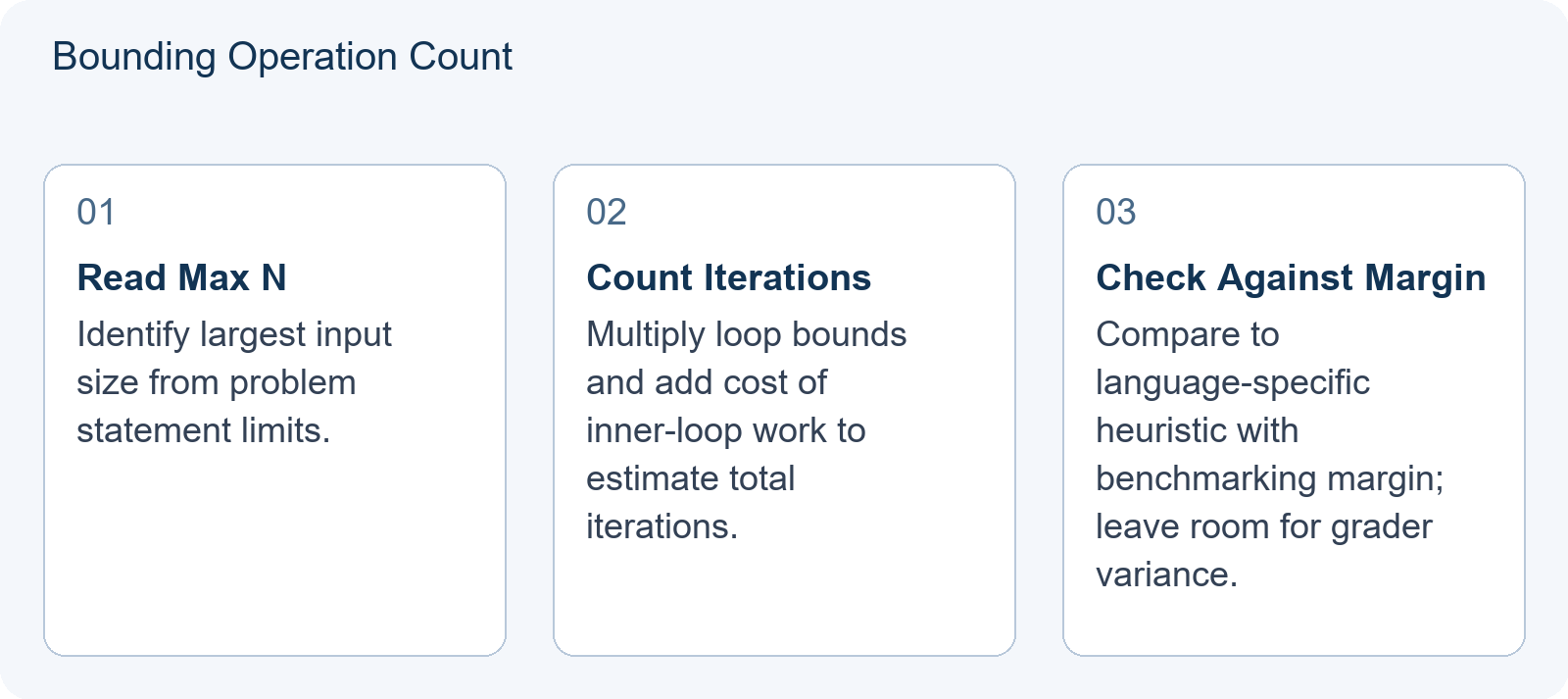
The actual runtime depends on multiple factors: the specific time limit for that contest (typically several seconds), the speed of the judging machine, the programming language used, and the cost of operations inside the loop body. Python, being interpreted, carries a larger constant factor than compiled languages like C++. Rather than guaranteeing a fixed number of iterations will pass, experienced competitors benchmark locally and leave a substantial margin. A common planning heuristic treats roughly 10⁷ simple iterations as a cautious ceiling in Python and 10⁸ in C++, but these are rules of thumb, not official limits or promises of passing. The practical threshold varies with the factors above, and no universal safe limit exists across all contests. If your bounded calculation shows 5 × 10⁷ iterations in Python with nontrivial work inside the loop, you are at genuine risk of TLE and should seek a more efficient approach.
Reading Constraints as a Map
Every USACO problem statement includes numerical limits on input sizes. These numbers are not administrative details; they are the map to the intended solution. For example, if a problem states that N ≤ 100, an O(N³) solution is likely acceptable because 100³ = 1,000,000 iterations. However, if N ≤ 10,000, an O(N²) solution might be borderline, and an O(N³) solution would definitely fail.
A frequent error among beginners is ignoring the constraints and assuming their code will run fast enough. You must always ask: “What is the maximum value of my input variables?” and “How many times does my innermost loop run?” By multiplying the bounds of your loop variables and accounting for dependent loop bounds, you get the worst-case iteration count. If this number exceeds your language’s practical threshold with appropriate margin, you need to optimize or choose a different approach.
Worked Teaching Illustration: The Pair Sum Problem
Note: This is a hypothetical teaching illustration, not an official USACO contest problem.
Consider a problem where you are given N integers and asked to determine whether any two distinct elements sum to a target value K. The input format is:
N K
a_1 a_2 ... a_N
The constraints are N ≤ 1000.
Naive Approach: Use two nested loops. The outer loop iterates i from 0 to N-1. The inner loop iterates j from i+1 to N-1. For each pair (i, j), check if a[i] + a[j] == K.
Bounding the Work: The outer loop runs N times. The inner loop runs N - i - 1 times for each i. The total number of iterations is the sum from i=0 to N-1 of (N - i - 1), which equals N(N-1)/2. For N = 1000, this is 1000 × 999 / 2 = 499,500 iterations. At approximately 5 × 10⁵ iterations with simple integer arithmetic inside, this is well below typical cautious thresholds for both Python and C++. The brute-force approach is safe.
Complete Solution (Python):
def solve():
    data = input().split()
    n = int(data[0])
    k = int(data[1])
    arr = list(map(int, input().split()))

    # Bounded by N <= 1000 -> ~499,500 iterations maximum
    for i in range(n):
        for j in range(i + 1, n):
            if arr[i] + arr[j] == k:
                print("YES")
                return
    print("NO")

solve()
Verification of the bound: Even with Python’s interpreter overhead, 5 × 10⁵ simple iterations complete in well under a second on modern hardware. The solution will likely pass, though actual runtime depends on the specific grader environment.
Contrasting Case: When Brute Force Fails
Now, imagine the same problem but with constraints N ≤ 100,000. Using the same nested loop structure, the iterations would be 100,000 × 99,999 / 2 = 4,999,950,000 ≈ 5 × 10⁹. This far exceeds typical practical thresholds for any language on standard contest time limits.
Your code will timeout. The brute-force approach is invalid for this constraint.
What changes: You must abandon exhaustive search. An efficient approach uses a hash set: for each element a[i], check if K - a[i] has been seen before; if not, add a[i] to the set and continue. This runs in expected O(N) time with O(N) memory—approximately 10⁵ hash operations, easily passing. Note that hash tables have worst-case O(N) per operation if many collisions occur, though this is unlikely with standard hashing. This demonstrates why bounding the work is crucial: it tells you when to stop coding the obvious solution and start thinking about optimization.
Note: Hash sets are not typically required for Bronze; this contrast illustrates why Silver-level techniques become necessary when constraints grow.
Simulation vs. Pure Search
Many Bronze problems involve simulating a process rather than searching for a combination. For instance, moving a character on a grid based on a sequence of commands. Here, the “work” is proportional to the length of the command string, M. If M ≤ 1000, a simple loop executing each command is fine.
However, if the simulation involves updating a large state space repeatedly, you must ensure your state updates are efficient. For example, if you are tracking the position of K cows, and each command affects all K cows, the cost is M × K. If both M and K are 1000, the cost is 10⁶, which is acceptable. If K is 100,000, it fails. Always multiply the dimensions of your loops and include the cost of work inside the loop body.
Language Matters: Python vs. C++
USACO supports Java, Python, C++, and C. While the algorithmic complexity remains the same, the constant factor differs significantly. Python is interpreted and generally slower than compiled languages like C++. A practical heuristic: if you are writing in Python and your bounded calculation shows more than roughly 10⁷ simple iterations, you are at risk. For C++, the comparable threshold is roughly 10⁸ iterations. These are not official guarantees—actual pass/fail depends on the specific time limit, grader hardware, and operations inside the loop.
If your bounded calculation shows 5 × 10⁷ iterations in Python, do not rely on optimization tricks. You should look for algorithmic improvements—reducing the complexity class itself—rather than micro-optimizations. Constants and limits matter: even with correct algorithmic complexity, large constants or expensive inner-loop operations can still cause TLE.
Diagnostic Application: Test Your Bound
Before writing code, apply this annotated self-test to any Bronze problem:
Problem: You must check all pairs of N points to find the pair with maximum Manhattan distance. Constraints: N ≤ 5000.
Question 1: What is the worst-case iteration count for nested loops checking all pairs?
Answer: N(N-1)/2 = 5000 × 4999 / 2 = 12,497,500 ≈ 1.25 × 10⁷ iterations.
Question 2: Will this pass in Python?
Answer: It is above the conservative 10⁷ heuristic but below 10⁸. With simple integer arithmetic inside the loop, it may pass in Python, but the margin is thin. The outcome depends on the grader environment, time limit, and whether the inner operation stays cheap. In C++, it is safer. If the inner operation were more expensive (e.g., string concatenation or list operations), Python would more likely TLE.
Question 3: If constraints were N ≤ 50,000, what would you do?
Answer: 50,000 × 49,999 / 2 ≈ 1.25 × 10⁹, far exceeding any practical threshold. Abandon brute force. For Manhattan distance maximum in 2D, the maximum is max(max(x+y) - min(x+y), max(x-y) - min(x-y)). This requires only a single pass over the points, giving O(N) time. Note that simply checking the four bounding-box corners may not work—those corners might not correspond to actual input points.
What Your Diagnostic Result Means
If your bounded calculation is below threshold with margin: write the brute-force solution. Focus on correctness, not optimization.
If your bounded calculation is above threshold or in the risky zone: you have a decision to make. In Bronze, this usually means you have misidentified the problem type—perhaps it is not exhaustive search but a simulation with a trick, or perhaps you need to preprocess data to reduce the search space. The next learning task is to study the specific Bronze patterns that replace brute force: prefix sums for range queries, coordinate compression for large grids, or greedy observations that reduce O(N²) to O(N).
Useful feedback at this stage: submit your bounded calculation to a mentor or peer. If they agree with your math but the approach still fails, the issue is likely in your implementation of the inner logic or hidden constant factors, not necessarily your complexity analysis. If they disagree with your bound, trace through the loop variables carefully—off-by-one errors in bound calculation are common, and the cost of work inside loops can be underestimated.
Further Reading
For deeper understanding of how to handle edge cases in Bronze simulations, see USACO Bronze Simulation: Choosing State Variables That Prevent Hidden Bugs. To understand why correct solutions fail due to performance after you have coded them, read Why Your Correct Solution Scores Zero: Complexity Budgeting for USACO Bronze and Silver. For season planning, refer to The 2026-27 USACO Season: Contest Windows, Divisions and Promotion, Explained.
Frequently Asked Questions
Is exhaustive search always allowed in USACO Bronze?
No. It is only viable if the total number of iterations stays within practical time limits, which depend on the language, grader hardware, time limit, and cost of inner-loop work. You must calculate the worst-case scenario based on the problem’s constraints before deciding to use brute force. If the bound exceeds the cautious planning range of roughly 10^7 iterations in Python or 10^8 in C++, or if the inner work is expensive, you need a more efficient approach. These figures are rules of thumb, not guarantees—actual pass/fail depends on the specific time limit, grader hardware, and operations inside the loop.
Does Python have a stricter effective time limit than C++?
The official time limit is the same for all languages, but Python executes iterations more slowly due to interpretation overhead. Therefore, Python solutions need fewer total iterations to pass compared to C++ solutions. Use 10^7 as a cautious planning heuristic for Python, versus approximately 10^8 for C++, but these are not guarantees—actual pass/fail depends on the specific contest environment and operations inside the loop.
What happens if I ignore the constraints?
Your solution may produce the correct output for small test cases but will fail with a Time Limit Exceeded (TLE) error on larger hidden test cases, resulting in a low or zero score. Always bound your work before writing nested loops, accounting for dependent loop bounds and the cost of operations inside the loop body.