Simulation problems at the USACO Bronze level often appear straightforward: model the rules, step through the process, output the result. Yet many submissions fail on hidden test cases not because the algorithm is wrong, but because the state variables do not faithfully represent what changes and what stays constant during each step. This article works through the specific reasoning failure of choosing state variables poorly, with two hypothetical cases and a practical diagnostic.
What “State Variables” Mean in Bronze Simulations
In a simulation, state variables are the data you update at each time step to reflect the current condition of the system. Poor choices lead to bugs that are invisible on small samples but explode on full test data. The goal is to pick variables that:
- Capture every condition the problem asks you to track
- Do not conflate independent quantities
- Are updated in an order that preserves logical dependencies
For broader context on identifying which problem type you are facing, see The Five Shapes of a USACO Bronze Problem: How to Tell Which One You Are Looking At in Two Minutes. If you are unsure whether your practice is translating into progress, USACO Coaching for Bronze Students: Why Practice May Not Be Producing Progress examines common training traps. This article assumes you know basic loops and conditionals and are ready to debug your simulation logic.
Worked Hypothetical Case 1: The Correct Decomposition
Problem sketch (hypothetical teaching illustration): A farmer moves between N fenced fields arranged in a line. Each minute, she moves to an adjacent field. Some fields have cows that move independently each minute according to their own rules. Count how many times the farmer and any cow occupy the same field after each complete minute.
State choice:
| Variable | What it tracks | Update rule |
|---|---|---|
farmer_pos |
Farmer’s current field index | After reading move, before cow updates |
cow_pos[i] |
Each cow’s current field index | Simultaneous or ordered by problem statement |
encounter_count |
Running total of matches | Checked after all positions updated for the minute |
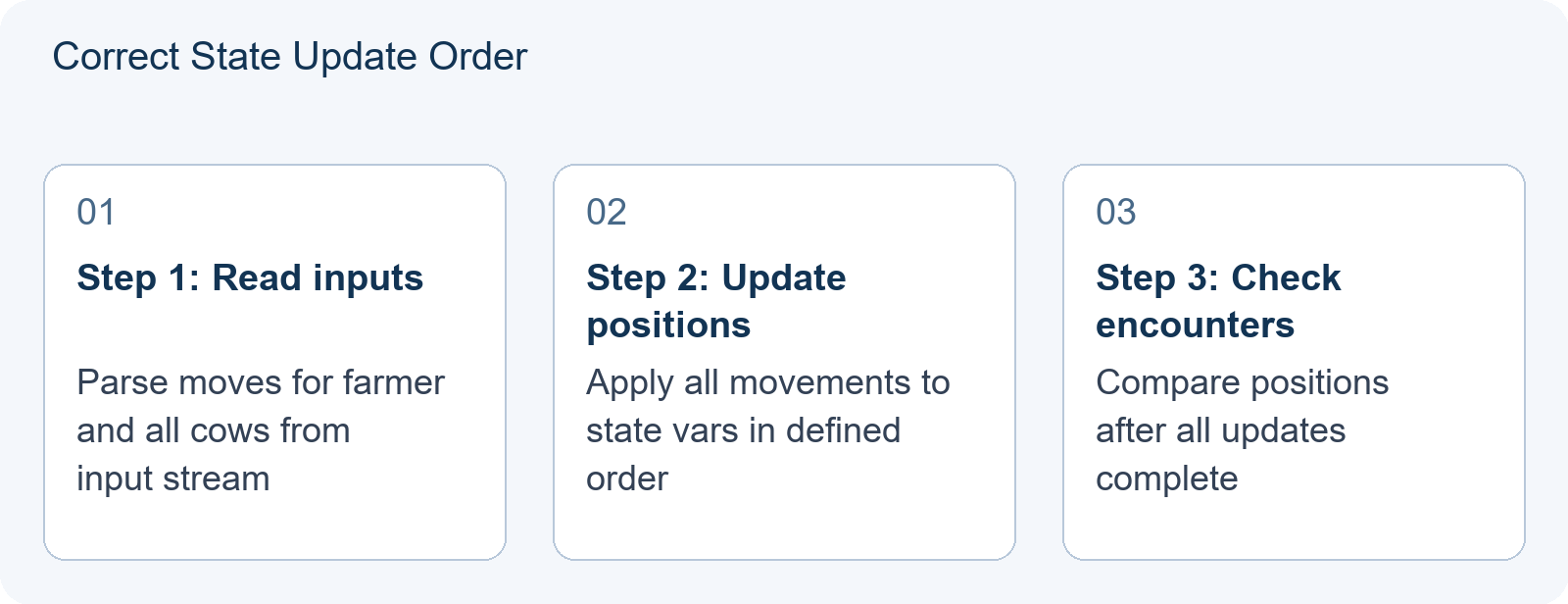
Why this works: The farmer’s position and each cow’s position are independent state machines. By updating the farmer first, then all cows, then checking for encounters, we avoid double-counting or missing a meeting that happens mid-step. The key discipline is that encounter_count is never updated during intermediate movement—it only reflects the state after the complete minute.
Consider a concrete trace with three fields (0, 1, 2), farmer starting at 0, one cow starting at 2. Rules: farmer moves right if possible; cow moves left if possible. Minute 1: farmer moves to 1, cow moves to 1. After updates: both at 1, encounter_count becomes 1. Minute 2: farmer would move to 2, cow would move to 0. After updates: farmer at 2, cow at 0, no encounter. The state variables cleanly separate position from encounter detection.
Worked Hypothetical Case 2: Where the Shortcut Fails
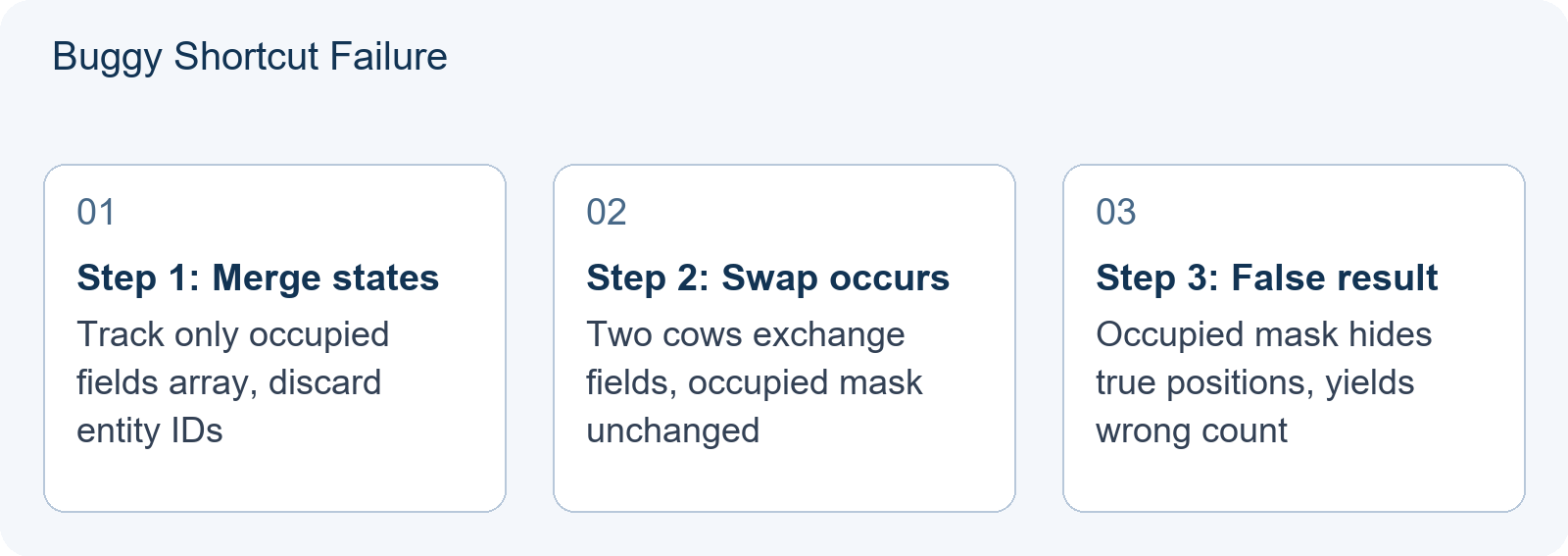
Same problem, buggy approach: A student tries to optimize by storing only occupied, a boolean array marking which fields currently have the farmer or any cow. They skip tracking individual identities to save code length.
The hidden bug: Two cows swap fields in the same minute. With only occupied, the array shows both fields still occupied before and after—no encounter detected. But if the farmer moves into a field that a cow just left, occupied falsely shows an encounter (farmer and cow were never in the same field at the same time). The state variable conflates “who is where” with “which fields are occupied,” losing temporal precision.
Trace the same scenario: farmer at 0, cow at 2. After minute 1: farmer at 1, cow at 1. The occupied array shows field 1 occupied—correctly. But now add a second cow at field 0 that moves to field 2. After minute 1: field 0 empty, field 1 has farmer+cow A, field 2 has cow B. occupied = {false, true, true}. Minute 2: farmer moves to 2, cow A moves to 0, cow B moves to 1. After movement: farmer at 2, cow A at 0, cow B at 1. But during the update, if we clear then set occupied, we might see farmer entering 2 while cow B still marked—false encounter. Or if we use a temporary array, we lose the ability to detect when farmer and cow arrive at the same field simultaneously from different directions. The merged state cannot distinguish these cases.
This bug passes small cases where swaps are rare but fails on large, dense test data. The student sees correct output on their own tests and submits confidently.
Diagnostic Table: Spotting the Pattern
| Symptom | Likely cause | Fix |
|---|---|---|
| Wrong answer on large cases, correct on small | State variable too coarse; loses per-entity tracking | Decompose into per-entity state arrays |
| Off-by-one in time-based results | Checking condition before all updates complete | Strict update-then-check ordering |
| Inconsistent results with same input | Update order depends on container iteration order | Explicit sort or index-based update |
| Memory limit exceeded unexpectedly | Storing full history when only current state needed | Keep only current and next state |
When you encounter these symptoms, resist the urge to patch with special cases. Return to your state variable definitions and ask: does this variable faithfully represent one conceptual entity, or has it become a grab-bag?
A Targeted Practice Sequence
To build reliable state-variable intuition for Bronze simulations:
- Trace by hand: Pick any past Bronze simulation. Write the state variables on paper and execute three steps manually. Identify exactly when each variable changes.
- Introduce a deliberate bug: Merge two state variables, run your code, and observe which hidden case fails. This reverse exercise builds sensitivity to the patterns above.
- Code review with the diagnostic table: Before submitting, check your solution against each row in the table. If any symptom could plausibly apply, justify why your design prevents it.
For students choosing between competition paths, USACO, CCC or the Domestic Route? Choosing a Computing Competition Path From a China International School provides comparative context. The structured approach in USACO Coaching for Bronze Students: Why Practice May Not Be Producing Progress may help you place your simulation practice in a broader training context.
What to Demonstrate Next
After working through this article, you should be able to: given a new Bronze simulation problem, list candidate state variables, identify which ones risk conflation or ordering bugs, and justify your final choice with reference to update order and temporal precision. This skill transfers directly to Silver-level problems where state space expands, but the discipline of clean state decomposition remains identical.
Frequently Asked Questions
Can I use a single array if the problem only asks about positions, not identities?
Only if the problem’s required output truly does not depend on distinguishing which entity is where. When in doubt, decompose. The memory cost of per-entity tracking is negligible at Bronze constraints, while the debugging cost of a merged state is high.
How do I know if my update order is correct?
State the invariant: after each complete step, every variable must reflect the problem’s definition of the current state. Verify this invariant holds on paper for at least three steps, including edge cases like simultaneous moves.
Are these examples from official USACO problems?
No. The farmer-and-cows scenario is an original teaching illustration designed to isolate the state-variable reasoning pattern. It is not an official past-paper question, and no official marking criteria are claimed.