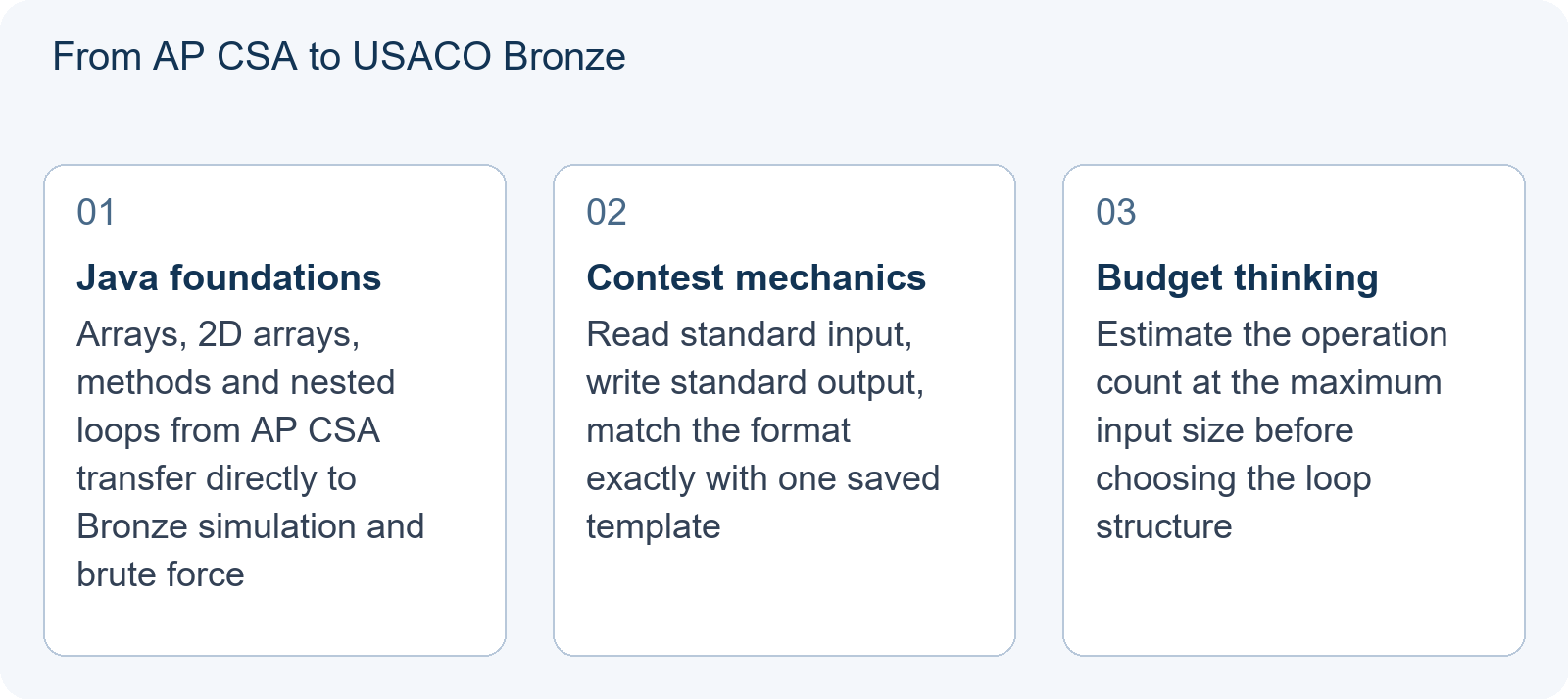
Short answer: AP Computer Science A (AP CSA) is a useful base for the USA Computing Olympiad (USACO) Bronze division, but it is not a Bronze preparation course. It would be wrong to describe AP CSA as “syntax only” — arrays, two-dimensional arrays, parameter passing, helper methods and nested loops are genuine problem-solving tools, and Hanlin Curriculum’s coaching position is that Java can serve AP CSA and USACO preparation at the same time. What AP CSA does not supply is the contest layer: turning a story into state variables, handling standard input and output yourself, and estimating the operation count of a loop structure before you commit to it. At Bronze that layer is thin and learnable in weeks. It widens sharply at Silver.
Bronze is USACO’s entry division. Hanlin Curriculum, in a WeChat article published 26 October 2026, notes that newly registered competitors begin at the lowest level and climb from there, so nothing has to be cleared before entering — the only question is what you can solve once you are inside. Hanlin Curriculum’s 3 October 2026 comparison of eight computing competitions lists the 2026-27 contest windows as early January to late February 2027, and flags those dates in print as “for reference only; confirm with the official site.”
Where AP CSA coverage ends and Bronze begins
| Skill area | What AP CSA typically gives you | What USACO Bronze adds | Practice that closes it |
|---|---|---|---|
| Arrays and 2D arrays | Declaring, traversing, mutating, nested traversal of grids | Using a grid as a live board and updating it repeatedly inside a simulation | Grid-state simulation drills with multi-step updates |
| Nested loops | Writing and hand-tracing double loops | Deciding whether the double loop is affordable at the stated input size | Operation-count estimation before coding |
| Methods and decomposition | Splitting logic into helpers with given signatures | Inventing the decomposition from a story with no signature provided | Blank-page modeling: name variables, then write the skeleton |
| Input and output | Data arrives as method parameters; output is a return value or a print | Reading raw standard input and producing exactly the required output format | A fixed personal I/O template, reused until it is automatic |
| Correctness bar | Correctness is the target; efficiency is rarely graded | Correctness plus a budget: the hidden tests are built at the size limit | Testing your solution at the worst allowed input, not the sample |
What transfers, and why it transfers
Start with what genuinely carries over, because students often under-rate it. A Bronze simulation problem typically hands you a board, a queue, or a list of events, and asks you to repeat a fixed rule for a fixed number of steps. Implementing that requires exactly the skills AP CSA already drills: index arithmetic, a loop that walks an array, a nested loop that walks a two-dimensional structure, and small helper methods that keep the main loop readable. If a student can trace a double loop accurately on paper and can mutate a 2D array without losing track of row versus column, they already own the mechanical core of most Bronze simulation and brute-force solutions. For deeper practice on this specific skill, see our guide on USACO Bronze Simulation: Choosing State Variables That Prevent Hidden Bugs.
What does not transfer is the framing. AP CSA practice questions usually tell you which method to write and what parameters it takes; the interesting decision — how to represent the situation at all — has already been made for you. Contest statements make the opposite demand: the representation is the problem. Two students with identical Java fluency can score very differently on the same Bronze problem purely because one of them chose a state representation that made the update rule simple and the other chose one that made it fiddly. This is the core of USACO Problem Modeling: Convert Story Constraints into State and Algorithms.
Hanlin Curriculum’s 3 October 2026 comparison of eight computing competitions states the coaching judgment directly: AP CSA covers the basic-syntax layer, while USACO preparation requires systematically adding data structures and algorithm analysis. Read that sentence against the table above and its practical meaning for Bronze becomes narrow rather than intimidating. For Bronze, the “extra algorithm analysis” is mostly operation counting; the “extra data structures” are mostly the humility to use an array or a list well before reaching for anything exotic. The source article lists enumeration, dynamic programming, graph theory and segment trees among USACO’s broader topics across its four-level progression, but those later families belong to Silver and above. No Bronze candidate needs dynamic programming or graph theory to be ready for Bronze.
The three gaps that actually cost Bronze points
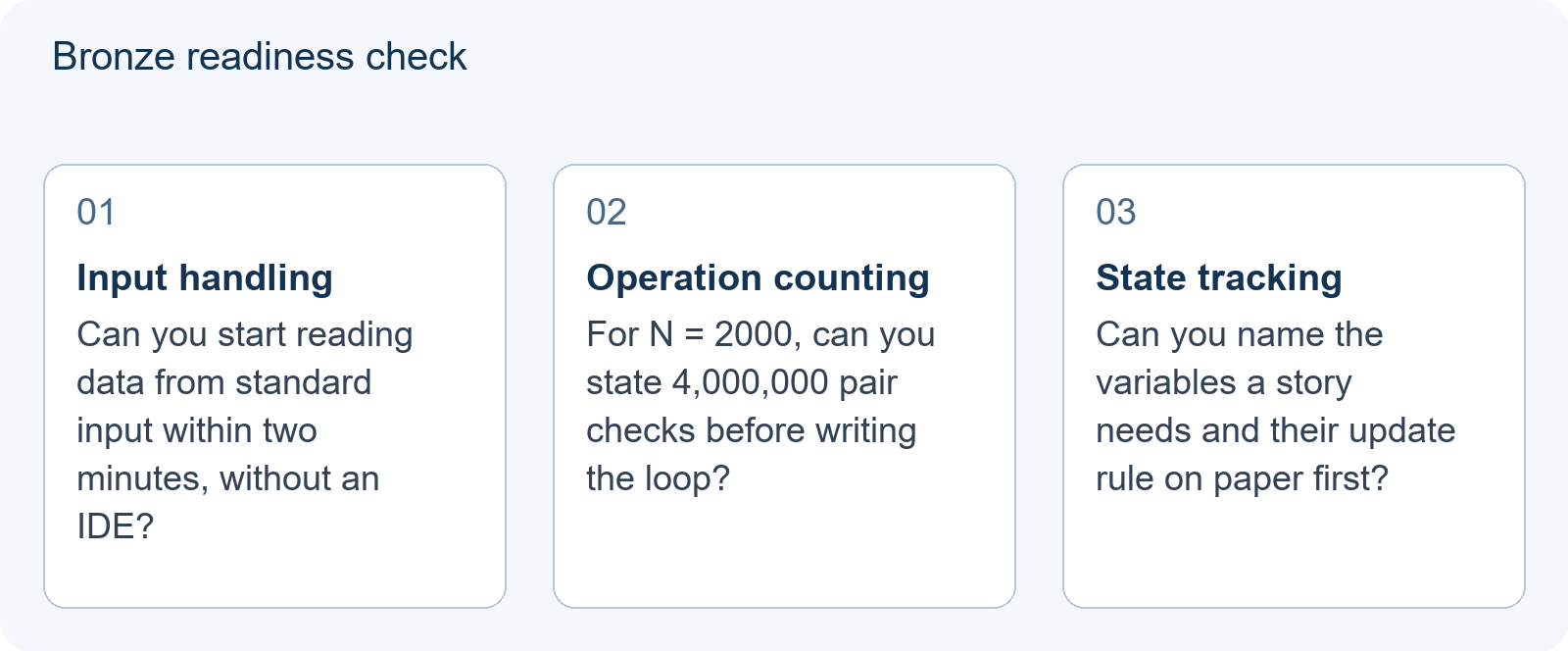
1. Contest input and output. School Java usually receives data through parameters, and a scanner or buffered reader that the teacher already set up. USACO gives one sample test case per problem during the contest, and the real grading happens on hidden data, so your program has to read and write exactly the expected format with no human in the loop. This is a small, boring, entirely learnable skill — and it is the single most common reason a capable AP CSA student loses the first twenty minutes of a contest. Build one I/O template in Java, save it, and start every practice attempt from that file rather than from an empty editor.
2. Problem modeling. Converting a paragraph into variables, update rules and a loop structure is a separate skill from writing correct Java. Train it explicitly: read a past Bronze statement, close the editor, and write on paper only — the variables you need, their types, what changes each step, and when the process stops. Then compare your paper model against the editorial. Students who do this ten times stop freezing at the start of statements.
3. Operation counts. In AP CSA, an O(N²) solution usually earns full credit because the test data is small. In a contest, the hidden data sits at the stated maximum, so the same code can quietly become unusable. The fix is not a lecture on asymptotics; it is a habit of computing the rough operation count at the worst allowed input size and writing that number down before coding. Hanlin Curriculum’s 26 October 2026 planning guide puts the same shift in its own words: for a student who already has the syntax, the core task is converting that knowledge into problem-solving capability, built through algorithmic thinking and past-paper practice rather than more grammar. Our detailed breakdown of USACO Bronze Exhaustive Search: Bound the Work Before Writing Nested Loops provides specific examples of this calculation.
Where the gap widens: Silver, not Bronze
It is worth saying clearly which part of the ladder this article is about. AP CSA plus a short contest layer is a realistic route into Bronze. The same course plus the same short layer is not a route into Silver, because Silver stops rewarding “try everything” and starts rewarding recognition of a technique plus a reason the technique is valid. That is the point at which the source note’s phrase about adding data structures and algorithm analysis stops being boilerplate. So if your plan is “finish AP CSA, then sit Bronze in January,” the plan is reasonable with a few weeks of the practice described above. If your plan is “finish AP CSA, then skip to Silver,” the plan is not reasonable, and no amount of speed in typing Java will repair it.
Three-task readiness diagnostic
Before registering, run these three tasks with a clock and no editor. They are practice tasks written for this article, not contest questions.
Task 1 — Trace a nested loop. Write a double loop over an array of N elements where the inner loop runs from 0 to N−1 each time. Ask the student to state, without running anything, exactly how many times the innermost statement executes, then to modify the inner loop so that it runs from the outer index to N−1 and state the new count. A student who answers N² and then N(N+1)/2 by reasoning is ready for the arithmetic part of Bronze.
Task 2 — Estimate before coding. Give the constraint N = 2000 and ask how many pair checks an all-pairs solution performs. The expected reasoning is 2000 × 2000 = 4,000,000 checks, which is a comfortably small amount of work for a Java loop, so the brute force is acceptable here. Then change the constraint to N = 100,000 and repeat. The number is now 10,000,000,000 pair checks; no simple double loop will finish that inside a contest time limit, so a different approach — sorting first, or storing seen values in a set — is required. The teaching point is the habit of computing the number first, not a memorised threshold.
Task 3 — Story to state. Take a short past Bronze statement, and instead of coding it, ask the student to list every variable they will need, its type, and the single line of the update rule that changes each of them per step. If they can state those comfortably, the coding is downstream. If they cannot, more Java exercises will not help; more reading and modeling will.
Teaching illustration (invented, not a contest problem): bounding a brute force before writing it
The following is a teaching illustration written for this article. It is not drawn from any USACO contest.
Premise: you are given an array A of N distinct integers and a target value X, and you must decide whether two distinct positions i and j exist such that A[i] + A[j] = X. N is given in the statement. Nothing else is given.
An AP CSA-trained student will very reasonably write a double loop: for each i, scan every j from i+1 to N−1, and check the sum. This is the pair-check count from Task 2. If the statement says N = 1000, the loop performs about 1000 × 999 / 2 ≈ 500,000 checks, which is trivially small. The brute force is correct and affordable, and the student should submit it without hesitation. If the statement says N = 100,000, the same loop performs about 5 billion checks — the pattern is identical, the syntax is identical, and the program is not viable. The fix is not better Java. The fix is sorting the array first and using two moving pointers, or walking the array once while remembering the values already seen in a set; both routes cut the work to roughly N log N or N. The lesson is that the deciding input is the constraint line in the statement, read before the first bracket is typed.
Notice how this illustration sits relative to AP CSA. Nothing about it requires knowledge the course does not already teach in some form — loops, indexing, comparisons. What it requires is a decision the course rarely forces: which of two correct implementations is the one the test data will accept.
A transition plan from AP CSA to Bronze
Weeks 1-2 — build the I/O template. Write one Java file that reads a typical contest input from standard input and prints to standard output, and keep re-using it. Aim to open a problem and be reading data within two minutes. Practise reproducing it from memory, because a template you cannot rebuild by hand is a template you do not own.
Weeks 3-4 — complexity drills, short and daily. Ten minutes a day: given a loop structure and a constraint, compute the operation count on paper. Include the cases that go badly — N² at N = 100,000, and N³ at N = 1,000 — so the failure is as familiar as the success.
Weeks 5-8 — one problem per technique, logged. Work through past Bronze problems in labelled groups: simulation, complete search, and simple greedy checks. For each problem, record the paper model, the operation count, and the reason your final approach was affordable. That log is the artifact that shows whether progress is real. Hanlin Curriculum’s 26 October 2026 preview makes the same point about the value of this core reasoning in a year when writing boilerplate code is cheap; the same article reports that the new season explicitly prohibits generative-AI assistance during contests, which is a further practical reason the underlying skill has to be yours.
Language: if the student is already fluent in Java from AP CSA, keep Java. Hanlin Curriculum’s 26 October 2026 planning guide lists Java alongside other supported languages and argues that the language is secondary to computational thinking and algorithm selection. Switching languages mid-preparation buys a distraction, not an edge.
If you want a faster read on where a specific student stands, a Bronze readiness diagnostic that maps the school CS syllabus against contest skills is the practical first step — it converts “my child finished AP CSA” into a list of the three tasks above and what each one currently returns.
General event background is available at Event background.
This is an independent preparation guide, not affiliated with, endorsed by, or sponsored by USACO, IOI or EGOI.
Frequently Asked Questions
Does AP CSA count as USACO experience?
No. AP CSA is a school course assessment; USACO is a separate competitive programming contest with its own registration and divisions, and it grants no credit or status for course completion. The useful statement is narrower and more practical: the arrays, 2D arrays, methods and nested loops from AP CSA are the tools most Bronze simulation and brute-force problems are built on, and they transfer directly once contest input, modeling and operation counting are added.
Is Java allowed in USACO?
Yes. Hanlin Curriculum’s 26 October 2026 season preview lists Java among USACO’s supported programming languages, alongside Python, C and C++. Students already fluent in Java from AP CSA do not need to switch in order to enter Bronze; switching is a preference, not a requirement.
Should a student learn C++ immediately?
Not necessarily. For Bronze specifically, the deciding factor is almost never language speed but whether the solution’s operation count fits the stated constraint, and a Java solution that respects the constraint is a perfectly good submission. Hanlin Curriculum’s 26 October 2026 planning guide emphasises computational thinking and algorithm choice over language choice, and recommends language transitions only after core concepts are solid. A student who is still learning to bound a loop will not gain from a second syntax to learn at the same time. Revisit the language question when Silver-level time limits start to matter, not before.