The contests in
USACO’s orbit
The USA Computing Olympiad (USACO) does not stand alone. It is the United States’ selection route to the International Olympiad in Informatics (IOI), it fields a national team at the European Girls’ Olympiad in Informatics (EGOI), and it sits alongside contests like the Canadian Computing Competition and math contests such as the AMC in a strong competitive-CS profile. This page maps the neighbourhood.
Independent guide — not affiliated with the contest organizer. Facts on USACO, IOI and EGOI checked against usaco.org; details on other contests from public sources · Last reviewed 15 July 2026.
| Contest | Scope | Tie to USACO |
|---|---|---|
| IOI | Global | USA TEAM |
| EGOI | Europe · girls | USA TEAM |
| CCC | Canada | COMBINE |
| ACSL | USA | COMBINE |
| Codeforces | Online judge | PRACTICE |
| AtCoder | Online judge | PRACTICE |
Where The Ladder Leads
Which international olympiads does USACO lead to?
USACO is the pathway to two international informatics olympiads. Its top scorers are invited to a summer training camp, from which the top four represent the USA at the International Olympiad in Informatics (IOI) — the most prestigious high-school algorithmic contest — while a separate team of four competes at the European Girls’ Olympiad in Informatics (EGOI).
The IOI was launched in 1989 by UNESCO and is described by USACO as the most prestigious international computing contest at the high-school level. Dr. Don Piele founded USACO in 1992 specifically to bring a USA team to it. At the IOI all code must be written in C++ — which is why USACO recommends C++ once you reach its higher divisions — and USA teams now regularly place among the top countries. At IOI 2025 in Bolivia the USA earned one gold, two silver and one bronze; IOI 2026 runs August 9–16 in Uzbekistan.
The EGOI is a competition of similar prestige, modeled after the European Girls’ Mathematical Olympiad. USACO has trained and sent a team of the top four female high-school students in the USA since 2021, with steadily stronger results — at EGOI 2025 in Germany the USA team took three golds and a bronze. EGOI 2026 is scheduled for May 12–18 in Italy, ahead of the training camp. How USACO selects these teams from the contest season is covered in the USACO story and the competition guide.

Year-Round Practice
Where do USACO students practise between contests?
Between USACO’s handful of contests a season, most students train on year-round online judges. Codeforces and AtCoder are two of the most widely used: both run frequent rated contests and host large archives of algorithm problems, giving USACO trainees a steady supply of practice at every difficulty level.
Codeforces
A widely used competitive-programming platform built around frequent rated contests and a deep problem archive. It is popular for volume practice and for keeping algorithm skills sharp between USACO windows — a training tool, not a credential or an olympiad-selection route.
AtCoder
A Japan-based judge also widely used internationally, known for regularly scheduled rated contests spanning beginner to expert difficulty. Like Codeforces, it complements USACO rather than replacing it — the two build the same problem-solving muscles a USACO contest tests.
What stays the credential
These judges are for practice; USACO’s divisions and the IOI/EGOI pipeline are what selective programs actually read. For a structured way to use them, follow a learning path by division instead of grinding at random.
Contests Students Combine
What other computer-science contests do students take alongside USACO?
Two national contests come up most often next to USACO: the Canadian Computing Competition (CCC), run by the University of Waterloo, and the American Computer Science League (ACSL). Both are approachable entry points and neither replaces USACO’s role as the US route to the IOI — students often do them in parallel.
Canadian Computing Competition
Hosted by the University of Waterloo’s Centre for Education in Mathematics and Computing (CEMC), the CCC runs in a Junior and a Senior division. It is a single three-hour paper of five problems worth 15 points each, 75 in total. About a quarter of participants earn an honour certificate, and roughly the top 5% appear on Waterloo’s official results list — a credential especially valued when applying to Waterloo’s computer-science and math programs.
How USACO compares →American Computer Science League
ACSL is one of the longest-running US school computer-science contests, with more than 40 years of history. It spans several age divisions — from an Elementary division through Junior and Intermediate to a Senior division aimed at AP Computer Science A students — and each round pairs a short individual written paper of CS problems with a longer team programming challenge, with the top teams advancing through successive rounds.
Build the underlying skills →| Contest | Host / origin | Format snapshot | Where it fits |
|---|---|---|---|
| CCC | Waterloo CEMC · Canada | Junior / Senior · 3h · 5 problems · 75 pts | Gateway contest · Waterloo applications |
| ACSL | USA · 40+ years | Multi-division · written + team programming rounds | Early, team-based entry point |
| USACO | USA · since 1992 | 4 divisions · 4–5h · scored /1000 | US route to IOI — see the guide |
Details on CCC and ACSL summarised from public contest descriptions; USACO facts checked against usaco.org · Last reviewed 15 July 2026.
The Application Profile
How does USACO fit with math competitions like the AMC?
They are complements, not substitutes. USACO is the algorithmic computer-science signal on a competitive-CS application; the AMC — the American Mathematics Competitions, the best-known US math-contest track — is the quantitative one. Selective computer-science programs like to see strength in both, so many students run a math contest and USACO in parallel rather than choosing between them.
The two worlds are closely related. The IOI was designed in the spirit of the older international high-school olympiads, and USACO’s own EGOI team competes at a contest explicitly modeled after the European Girls’ Mathematical Olympiad. A student strong in mathematics contests usually has the reasoning foundation that Silver and Gold USACO problems reward, and vice versa — which is why the AMC track and USACO reinforce each other on a transcript rather than competing for the same slot.
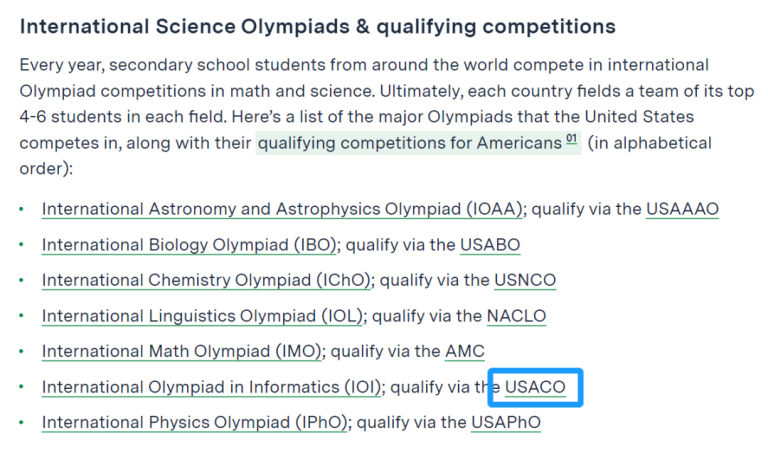
Where USACO carries unique weight is the direct line to the IOI: MIT Admissions lists it as the US qualifying competition for the International Olympiad in Informatics. A Gold or Platinum USACO result paired with a strong math-contest record reads, to an admissions officer, as genuine depth across the two pillars of computer science. For exactly what each USACO division tests before you commit, see the competition guide.
USACO, IOI, EGOI and MIT-listing facts checked against usaco.org and the MIT Admissions blog; AMC is referenced as the widely recognised US math-contest track · Last reviewed 15 July 2026.
FAQ
Related competitions — frequently asked questions
Short, self-contained answers about where USACO sits among the IOI, EGOI and the other contests students take alongside it.
Does USACO qualify students for the IOI?
Yes. USACO selects the USA team for the International Olympiad in Informatics: its top scorers are invited to a summer training camp, and the top four go on to represent the USA at the IOI. The IOI, launched in 1989 by UNESCO, is the most prestigious high-school algorithmic programming contest in the world.
What is the EGOI and how is it related to USACO?
The European Girls’ Olympiad in Informatics (EGOI) is a competition of similar prestige, modeled after the European Girls’ Mathematical Olympiad. USACO has trained and sent a team of the top four female high-school students in the USA since 2021; at EGOI 2025 in Germany the USA team earned three golds and a bronze.
Should I use Codeforces or AtCoder as well as USACO?
They are practice platforms, not a substitute for USACO. Codeforces and AtCoder are widely used online judges that run frequent rated contests and host large problem archives, so they are a good way to keep your skills sharp between USACO windows. USACO’s divisions and IOI pathway remain the credential.
How is the Canadian Computing Competition (CCC) different from USACO?
The CCC is run by the University of Waterloo’s CEMC in a Junior and a Senior division: one three-hour paper of five problems worth 75 points total. Roughly the top 5% appear on Waterloo’s official results list, valued for Waterloo applications. Unlike USACO, it is not the US selection route to the IOI.
What is ACSL?
The American Computer Science League is one of the longest-running US school computer-science contests, with more than 40 years of history. It runs across several age divisions from elementary through a senior division aimed at AP Computer Science A students, pairing a short written CS paper with a team programming challenge each round.
Should I do math competitions like the AMC alongside USACO?
They complement each other. USACO is the algorithmic computer-science signal on an application, while the AMC math-contest track is the quantitative one, and selective computer-science programs like to see both. Many students run a math contest and USACO in parallel rather than choosing between them.