Why Monotonicity Matters in USACO Silver
Binary search is a staple of the USACO Silver division, but its correct application hinges on one critical property: monotonicity. Many students struggle not with the code structure, but with proving that their feasible(x) function behaves predictably across the search space. If the condition flips from false to true (or vice versa) more than once, standard binary search will fail silently or return incorrect bounds.
This article addresses a specific preparation need: how to rigorously test and prove that your feasibility check is monotone before coding. We distinguish this narrow reasoning skill from broad algorithmic overviews covered in our The Six Shapes of a USACO Silver Problem: Spot the Technique, Then Prove It Is Allowed guide.
Teaching Illustration 1: The Standard Monotone Case
This is an original teaching illustration, not an official USACO problem.
Consider a hypothetical problem: You have N cows and want to place them in stalls such that the minimum distance between any two cows is at least D. Can we place all cows if D = 5? What about D = 6?
- Feasibility Function:
can_place(D)returns true if we can fit all N cows with spacing ≥ D. - Monotonicity Check: If
can_place(5)is true, thencan_place(4)must also be true (easier constraint). Ifcan_place(6)is false, thencan_place(7)must also be false (harder constraint). - Result: The sequence of truth values looks like [T, T, T, F, F]. This single transition point allows binary search to find the maximum feasible D.
Teaching Illustration 2: The Non-Monotone Trap
This is an original teaching illustration, not an official USACO problem.
Now consider a flawed assumption. Suppose you are searching for an integer x where (x % 3 == 0) OR (x > 10). You might think you can binary search for the smallest x satisfying this.
- Truth Sequence (x = 1 to 12): x=1: F; x=2: F; x=3: T (3%3=0); x=4: F; x=5: F; x=6: T (6%3=0); x=7: F; x=8: F; x=9: T (9%3=0); x=10: F (10%3=1, 10>10 false); x=11: T (11>10); x=12: T (12%3=0).
- Problem: The condition flips repeatedly: F,F,T,F,F,T,F,F,T,F,T,T. It is not monotone.
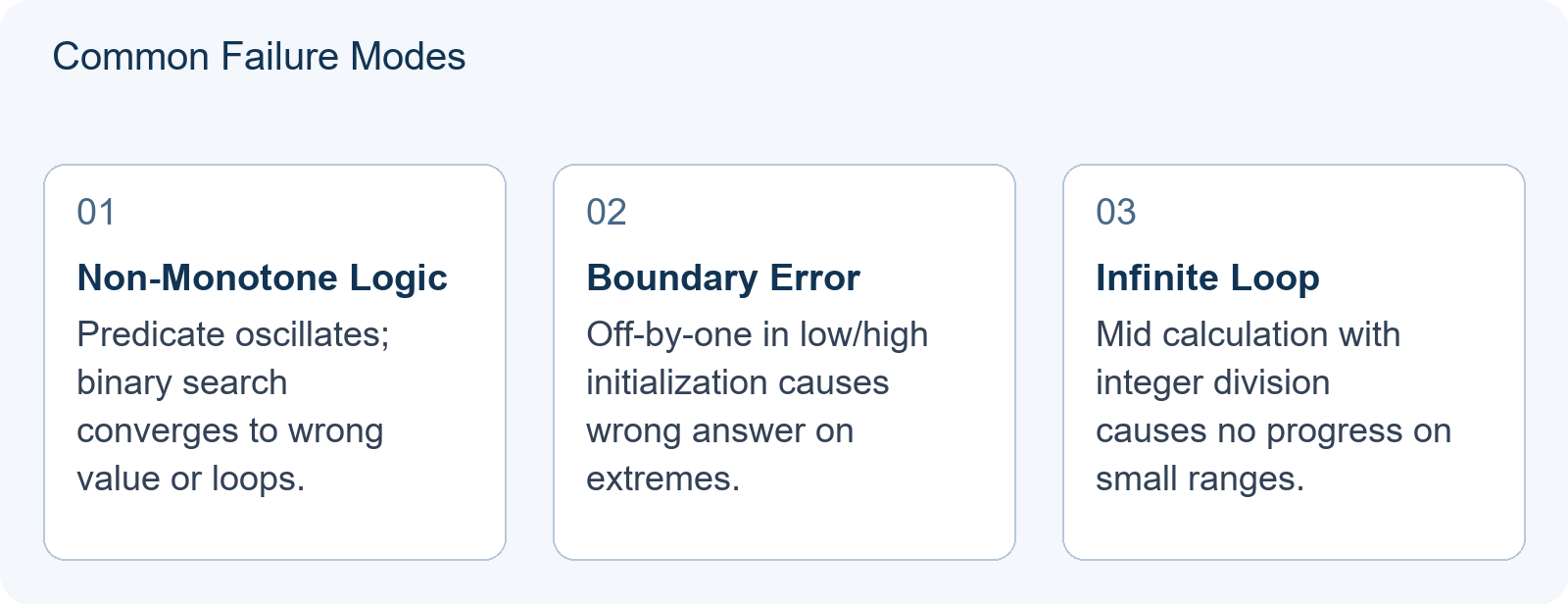
- Consequence: Binary search assumes a sorted array of booleans with at most one transition. Here, the predicate oscillates unpredictably. Binary search may converge to x=3, x=6, or x=9 depending on initialization, or fail entirely depending on mid-point selection.
This illustrates why you cannot blindly apply binary search to any “find the first value” problem. The predicate must define a contiguous block of false values followed by true values (or vice versa). Multiple transitions destroy the binary search invariant.
Diagnostic Table: Common Mistakes in Monotonicity Proofs
| Mistake Pattern | Symptom | Correction Strategy |
|---|---|---|
| Assuming linearity | Works on small tests, fails on edge cases | Prove implication: if P(k) is true, P(k-1) is true |
| Ignoring boundary conditions | Infinite loop or wrong answer on min/max | Check behavior at low/high bounds explicitly |
| Complex predicates with hidden oscillation | Multiple transitions in truth table | Decompose into simpler monotone sub-problems |
| Confusing necessary with sufficient conditions | Predicate true but solution invalid, or vice versa | Re-state feasibility in terms of existence, not properties |
Step-by-Step Practice Decision: Before You Write Binary Search
Follow this decision workflow to avoid implementing binary search on a non-monotone predicate:
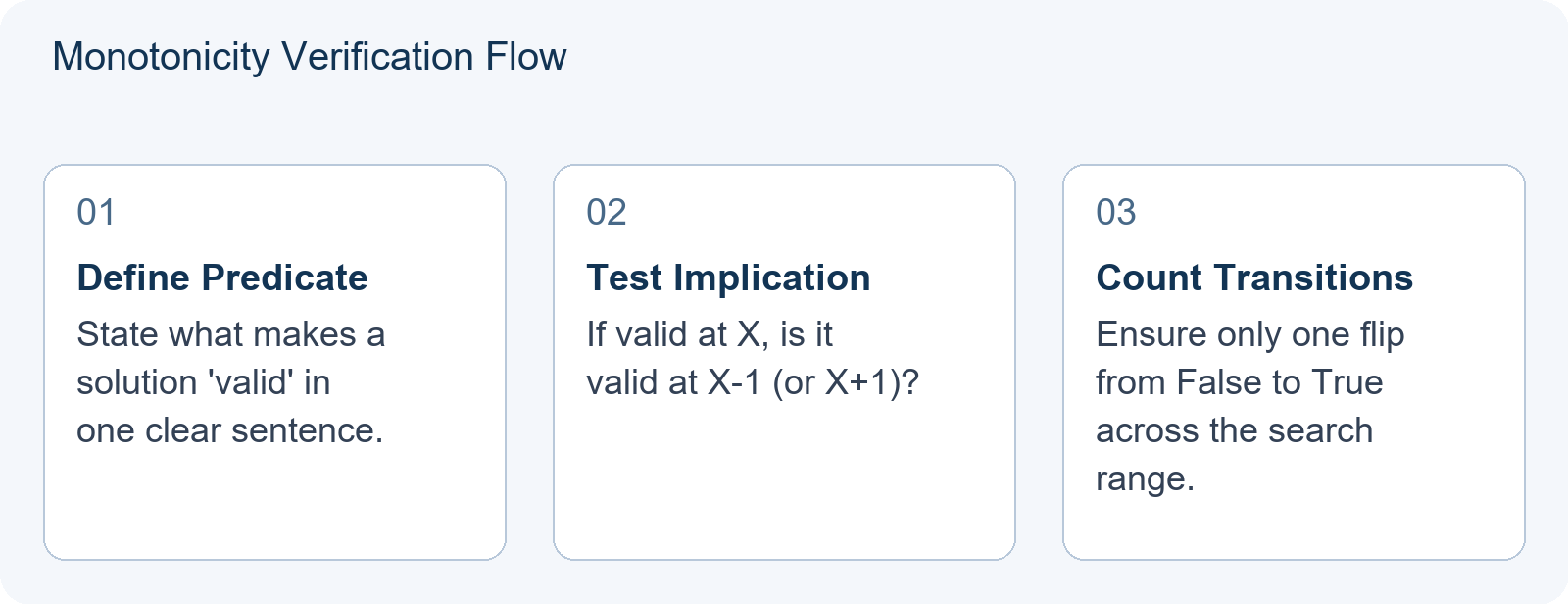
- State the Predicate in Plain English: Write one sentence describing what makes a parameter value “feasible.” If you cannot state this simply, your predicate may be ill-defined.
- Test the Implication Direction: Ask: “If parameter X works, does every easier parameter also work?” For maximization problems: if D works, does D-1 work? For minimization: if D works, does D+1 work?
- Construct a Mini Truth Table: For your actual constraints, manually check 5-10 consecutive values. Count transitions. Exactly one transition confirms monotonicity; more than one signals a problem.
- Verify Boundary Behavior: Check the smallest and largest possible values. Does the predicate behave as expected at extremes? Off-by-one errors often hide here.
- Write the Proof Sketch Before Code: In contest conditions, spend 30 seconds writing: “If feasible(k), then feasible(k-1) because [reason].” This catches logical gaps before they become debugging sessions.
Targeted Practice Sequence
To build reliable intuition, follow this progression:
- Manual Verification: Take a past Silver problem and manually write out the truth table for
feasible(x)for x=1 to 10. Count the number of transitions. Verify exactly one exists. - Proof Sketching: Before coding, write a one-sentence proof: “If I can achieve X, I can automatically achieve Y because…” If you cannot complete this sentence, re-examine your predicate.
- Edge Case Testing: Implement the solution and test specifically on the boundaries identified in step 1. Include cases where the answer is “no valid value exists.”
- Post-Implementation Verification: After your code passes samples, trace through your binary search manually for a small case. Confirm the invariant holds at each step.
For further reading on spotting which technique applies, see The Six Shapes of a USACO Silver Problem: Spot the Technique, Then Prove It Is Allowed. If you are weighing coaching options, our guide on USACO Coaching or Self-Study? How to Choose for the 2026-27 Season, and How to Check Any Course Before You Pay covers how to evaluate whether a program emphasizes this kind of proof-based reasoning. For complexity budgeting that prevents zero scores on correct logic, see Why Your Correct Solution Scores Zero: Complexity Budgeting for USACO Bronze and Silver.
What Skill to Demonstrate Next
After mastering monotonicity proofs, you should be able to: state the feasibility predicate in plain English, verify in two sentences why it has at most one transition point, and only then write the binary search loop. This discipline separates students who pattern-match from those who solve novel problems under contest pressure. The specific skill to demonstrate is the ability to reject binary search as inappropriate when monotonicity fails, rather than forcing the technique onto an unsuitable problem structure.
Frequently Asked Questions
Can I use binary search if my function has two peaks?
No. Binary search requires a strictly monotone predicate with exactly one transition from false to true. Multiple peaks or oscillations violate this condition and will produce incorrect results.
How do I prove monotonicity quickly during a contest?
Ask yourself: ‘If I make the constraint easier, does the solution remain valid?’ If yes, it is likely monotone. Test small edge cases mentally. Spend 30 seconds on a one-sentence proof before writing code.
Is this topic relevant for Gold division?
Yes. Gold problems often involve complex constraints where proving monotonicity is the hardest part of the solution design. The same proof discipline applies at higher divisions with more sophisticated predicates.