Most students can start USACO without paid coaching: entry is free, the online contests are taken from home, and practice material is plentiful. Coaching earns its cost in three situations — a younger student still building programming fundamentals, a plateau nobody can diagnose, and Gold-level work that needs expert feedback — and never inside a contest window, where outside help breaks USACO’s rules. Here is how to tell which situation you are in, and how to check any course before paying for it.
A disclosure first: Hanlin Education runs USACO courses, so we have an interest in this question. The checklist below applies to us exactly as it applies to anyone else, and our own course is described on our tutoring page if you want to test it against the list.
What a USACO course can and cannot sell you
Start from what USACO itself costs, because it reframes the whole decision. The contest instructions on usaco.org state that there is never any fee for participation, and every student registers directly there — no test centre, no agent, no school sign-off. So a course you pay for is selling teaching, feedback, structure and accountability. It is not selling access, and anyone implying that you need them in order to enter is misinforming you.
The same instructions set hard edges on what any helper can do. Contestants work by themselves. Consulting anyone about the problems other than the contest director is prohibited, and nobody may share technical information or code about a contest while it is actively running. Pre-written code and templates are not allowed, and generative AI such as Copilot or ChatGPT is banned. USACO states that violators are banned for life from all USACO activities, that it often contacts a student’s teachers or principal, and that if a university asks about a competitor who was disqualified, that information is passed along. A coach can make a student much stronger before a window opens. Once it opens, the student is on their own.
Match the support to what is actually holding you back
The useful question is not “coach or no coach” but “what is the bottleneck, and who is best placed to fix it?” The table is our coaching team’s judgement from working with China-based students, not an official framework.
| Bottleneck | What it looks like | Can self-study handle it? | What outside help adds |
|---|---|---|---|
| Missing techniques | “I have never seen this idea before.” | Yes, given well-ordered material | Sequencing, so time is not spent deciding what to learn next |
| Recognition | “I knew the technique but did not see it here.” | Partly — it needs unlabelled problem sets | Curated unlabelled sets, and someone who can name the cue you missed |
| Implementation speed | “I knew what to do and ran out of time.” | Yes, with timed drills | Code review that spots the same bug habit recurring |
| Diagnosis | Flat scores across contests, and no idea why | The hardest one to do alone | A reader of your contest logs and code who can name the failure mode |
| Reading English statements | Test groups lost to a misread condition | Partly, with deliberate practice | Support aimed at second-language readers |
| Consistency | A plan that collapses by October | A club or study partner often suffices | Fixed sessions and outside deadlines |
| Gold-to-Platinum modelling | Can follow a solution write-up, cannot generate the model | Partly — it needs strong peers | Expert feedback on the student’s own modelling attempts |
Read down the third column and a pattern appears. Knowledge and fluency are largely self-serve; diagnosis and expert feedback are not. That is the honest boundary of what coaching adds, and it is narrower than most course brochures suggest.
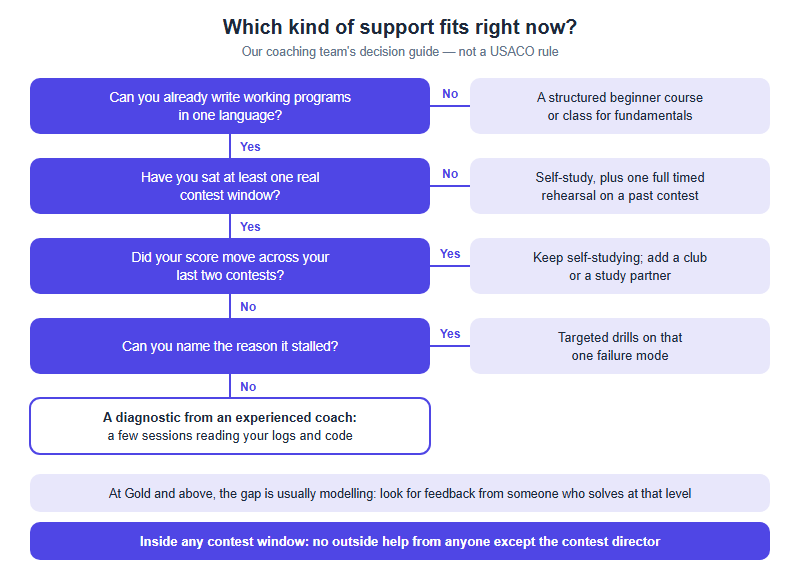
Five student profiles and what usually fits
- Grade 6–8, new to programming. A structured beginner course or class often helps most here, because what is missing is a language and a way of thinking rather than contest technique, and the order in which things are learned matters when there is nothing yet to build on.
- A fluent coder in Bronze or Silver who studies independently. Self-study plus a school club is usually enough. Our guide to running a USACO club at school sets out a weekly structure that survives members being at different levels.
- Two or more contests without movement, cause unknown. This is the strongest case for paying someone — but for a diagnosis rather than an open-ended course. A few sessions reading the student’s contest write-ups and code can name a failure mode that months of extra practice would not have revealed.
- A Gold student aiming at Platinum. Needs feedback from someone who solves Platinum-level problems, or a peer group working at that level. A general class pitched at lower divisions rarely moves this student.
- An exam-year student with two or three hours a week. Rarely a coaching question at all. Enter fewer contest windows, practise on the student’s own failure log, and protect the hours that genuinely exist.
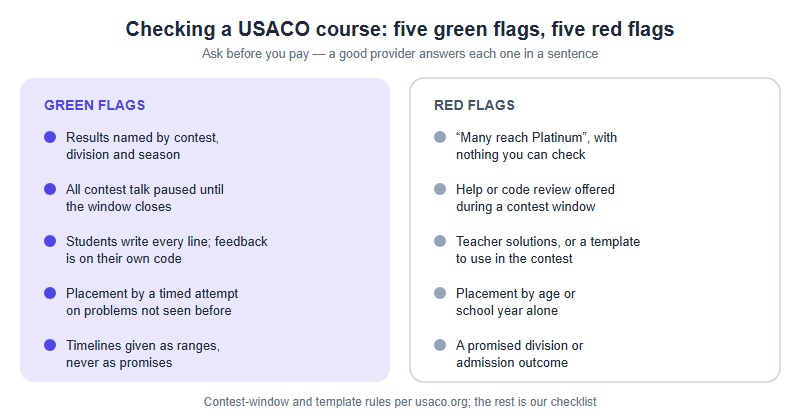
A ten-point check for any USACO course, including ours
Ask these before paying anyone. A good provider can answer each in a sentence; hesitation on several of them is informative.
| Check | A good answer sounds like | A warning sign |
|---|---|---|
| 1. Verifiable results | Named by contest, division and season — de-identified but specific | “Many of our students reach Platinum”, with nothing checkable |
| 2. Contest-window policy | All talk about a live contest stops until the window closes on usaco.org | An offer to look at code or answer questions during a contest |
| 3. Who writes the code | The student writes every line; feedback is on the student’s own code | Teacher-written solutions to copy, or a template “for the contest” |
| 4. Placement | A timed attempt on problems the student has not seen | Placement by age or school year alone |
| 5. Timelines | Ranges and conditions, acknowledging that cutoffs are set per contest | “Gold by March”, or any promised division |
| 6. Training unit | Timed sets, upsolving and a failure log | Problem counts treated as progress |
| 7. Feedback | Written notes on the student’s own attempts | Lectures only, with no individual review |
| 8. AI policy | Plain that generative AI is prohibited in contests | Vague, or pitched as a way to code faster |
| 9. Language plan | A reasoned view on when, or whether, to move to C++ | A forced switch in the middle of a season |
| 10. Admissions talk | Explains what a result does inside an application | A guaranteed admission, or admission statistics with no source |
Our own record, read as a shape rather than a promise
Because we are asking you to check results, here are ours. Across six seasons from 2020-21 to 2025-26, our de-identified cohort record shows 451 division outcomes: 249 at Silver, 155 at Gold and 47 at Platinum (per Hanlin). These are counts of students reaching each division in each season — not a funnel following the same students, and not a USACO statistic. Platinum was about a tenth of all outcomes and never exceeded 11 students in a season; Gold sat between 18 and 32 every year. In 2025 one student from our programme was selected for New Zealand’s IOI team (per Hanlin); as our review notes, national-team selection routes differ by country. The full breakdown, including why the 2025-26 season is not directly comparable with earlier ones, is in our six-year progression review.
The honest reading is the one we would give about any provider. In our own record most outcomes above Bronze sit in Silver or Gold, the top is narrow, and no course can promise where a particular student ends up. Promotion is decided per contest against a cutoff USACO sets for that contest, so a provider quoting a fixed promotion score in advance is quoting a number that does not yet exist.
Why the student, not the coach, has to own the result
A USACO division does real work in a university application, and the mechanism is cross-validation. An admissions reader does not weigh the division on its own; they set it beside the computer science grade, the activity list, and what the student writes and says about their own thinking. When a student can explain in their own words how they cracked a Silver or Gold problem — the wrong turn, the observation that unlocked it, the edge case they nearly missed — the division and the explanation corroborate each other, and the whole file becomes more believable. A division the student cannot talk about does the opposite: it stands unsupported, and it gives a careful reader a reason to look harder at the rest of the file.
That is the best argument for choosing support that builds the student’s own reasoning rather than supplying answers, and it lines up exactly with USACO’s rules: the student who wrote every line can defend every line. Nothing here guarantees an admission outcome anywhere; it describes how the pieces of a file relate to one another, and why the cheapest-looking shortcut is also the most expensive one.
Frequently asked questions
Do you need a coach to do well in USACO?
No. Many students progress through self-study. Coaching helps most with early fundamentals, undiagnosed plateaus and Gold-level feedback.
Can a coach help during a USACO contest window?
No. USACO bars consulting anyone but the contest director and sharing contest information while a contest is running.
How do I check a USACO coach’s claimed results?
Ask which contest, division and season each result came from. Specific answers are a good sign; round totals with no detail are not.
Does USACO charge an entry fee?
No. USACO’s instructions state there is never a fee to participate, and students register directly on usaco.org.
This is an independent guide operated by Hanlin Education for China-based international-school students. It is NOT affiliated with, endorsed by, or sponsored by USACO (the USA Computing Olympiad). Contest rules, eligibility, promotion cutoffs and registration are set by USACO and can change between seasons — always confirm current details on usaco.org, where registration and participation take place. Cohort figures are our own de-identified record, not a USACO statistic, and individual results vary. If you spot an error in this article, we will correct it within 7 working days.