Across six USACO seasons (2020-21 to 2025-26), one training cohort produced 451 division outcomes: 249 at Silver, 155 at Gold and 47 at Platinum — roughly a 5:3:1 pyramid. Platinum accounted for about 10% of all outcomes and never exceeded 11 students in a single season. The honest takeaway is that a Bronze-to-Platinum climb is normally a multi-season project, not a one-year sprint.
Why cohort shape is worth publishing
Most USACO writing describes the ladder — four divisions, a cutoff, a promotion. Very little of it tells you what the ladder looks like when a real group of students actually walks up it over several years. That gap matters, because the single most common planning error we see in Greater China is a student in Bronze in September assuming Platinum is reachable by the following spring.
What follows is our own cohort data, de-identified, covering six seasons. It is not USACO’s data and it is not a sample of the global field. It is one training provider’s record of how many students reached each division in each season. Read it as a shape, not as a benchmark.
The six-year numbers
| Season | Silver | Gold | Platinum | Season total | Platinum share |
|---|---|---|---|---|---|
| 2020-21 | 25 | 18 | 11 | 54 | ~20% |
| 2021-22 | 53 | 29 | 8 | 90 | ~9% |
| 2022-23 | 71 | 29 | 10 | 110 | ~9% |
| 2023-24 | 37 | 32 | 8 | 77 | ~10% |
| 2024-25 | 38 | 25 | 5 | 68 | ~7% |
| 2025-26 † | 25 | 22 | 5 | 52 | ~10% |
| Six-year total | 249 | 155 | 47 | 451 | ~10% |
Hanlin cohort, de-identified, per Hanlin. Counts are students reaching each division in that season. Results vary and are not guaranteed.
† 2025-26 is not directly comparable with earlier seasons: USACO reset nearly all Platinum competitors back to Gold at the start of that season (2025 IOI finalists and former finalists at a comparable level kept Platinum), so Platinum had to be re-earned and that season’s Gold count includes returning Platinum students. Division and promotion rules are set by USACO and change between seasons — confirm current rules on usaco.org.
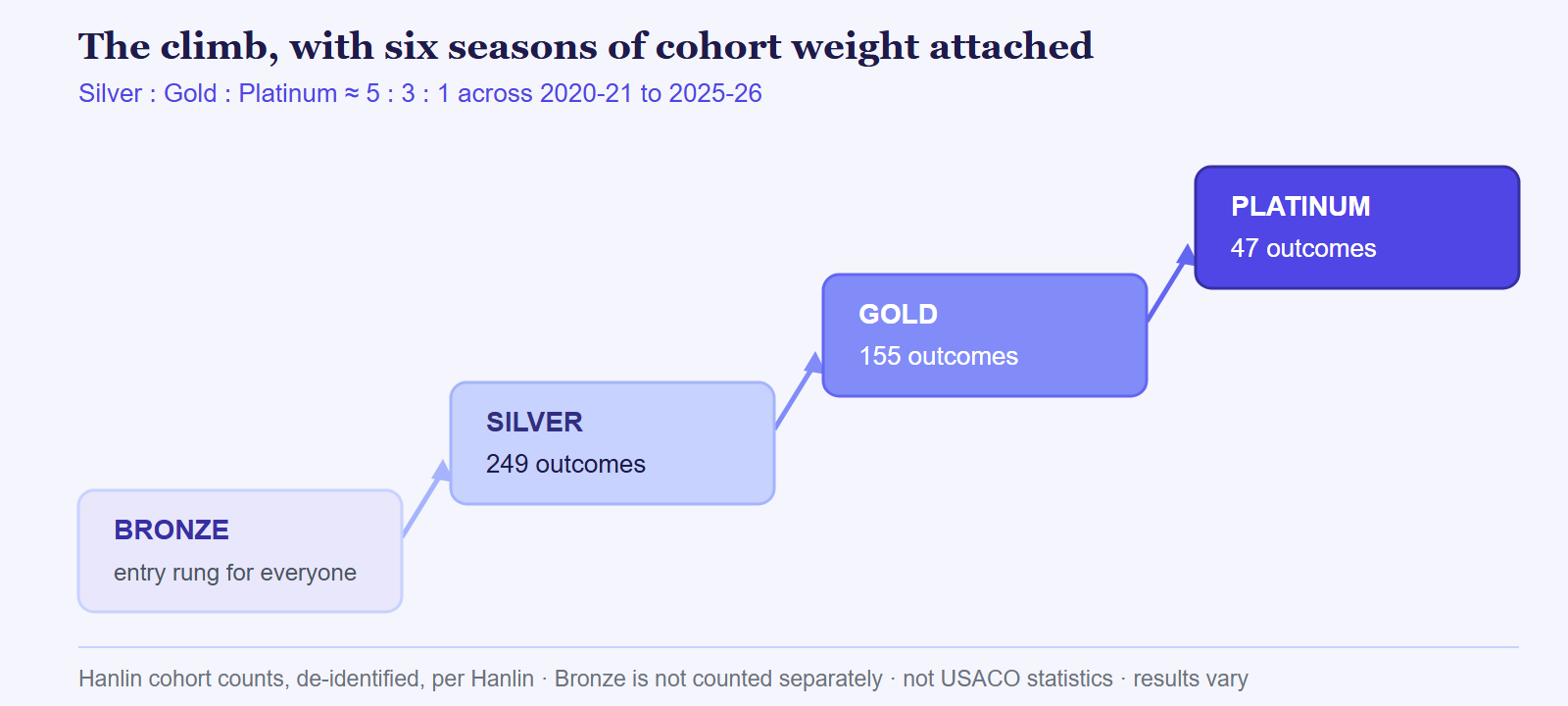
What 5:3:1 does and does not mean
It is tempting to read the pyramid as a conversion funnel — “one in five Silver students becomes Platinum”. That reading is wrong, and it is worth being precise about why.
These are counts of students reaching a division in a given season, not a tracked longitudinal cohort. A student who reached Silver in 2021-22 and Gold in 2023-24 appears in both rows. Students join at different ages and different starting levels, and some leave the programme before their climb finishes. So the ratio is a description of cohort shape, not a probability you can apply to yourself.
What the shape does tell you is honest and useful:
- The top of the ladder is genuinely narrow. Platinum was about 10% of all 451 outcomes, and averaged just under 8 students per season. In no single season did it exceed 11.
- Gold is not the top — it is the broad middle of a serious cohort. Gold-or-above accounted for roughly 45% of outcomes. Gold is where most students who stay with it eventually land.
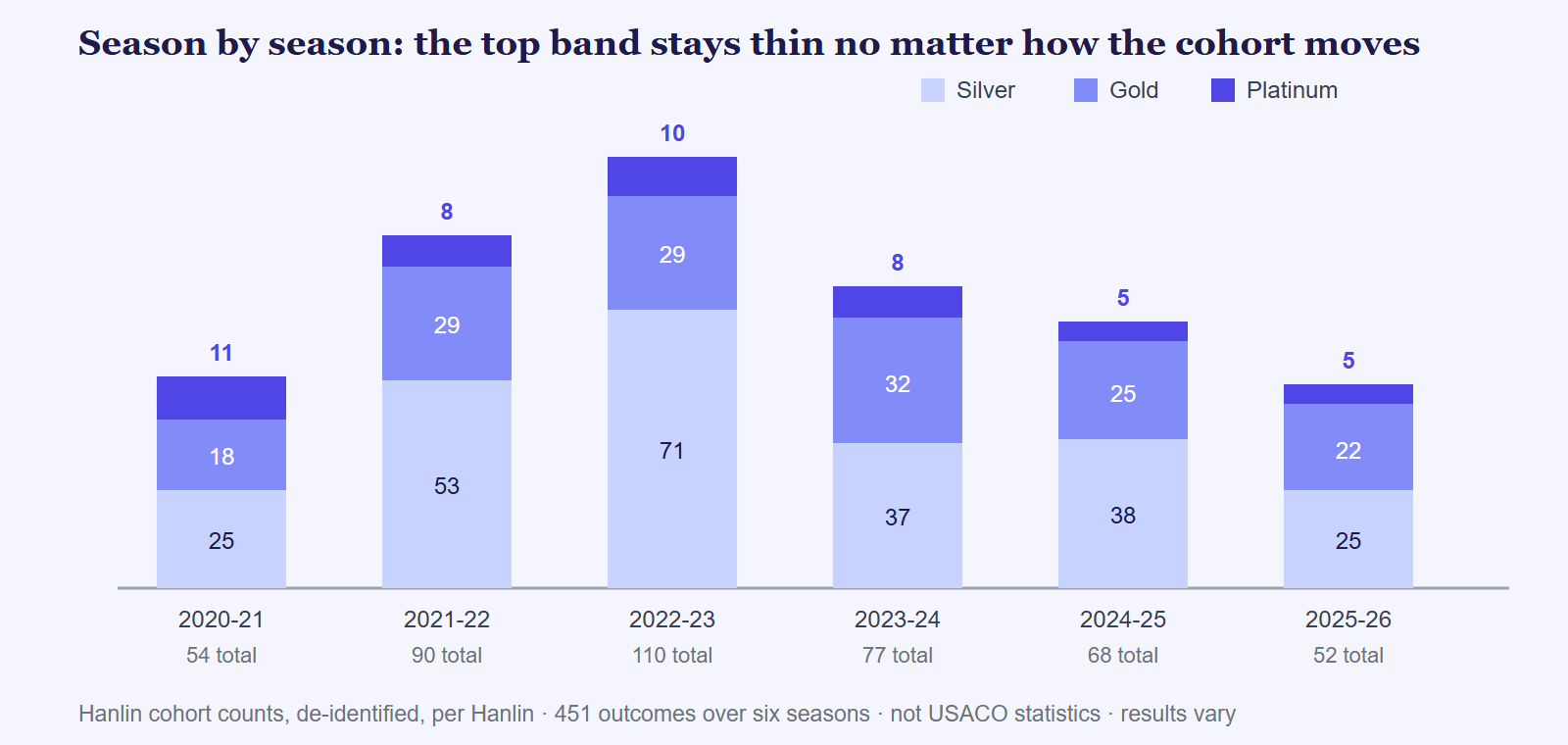
- Gold is also the most stable band. Silver ranged from 25 to 71 across the six seasons and Platinum from 5 to 11, but Gold sat between 18 and 32 every year, and between 22 and 32 in the last five. Cohort size moves; the Gold layer barely does.
Why the seasons differ — and why that is not a trend
Season totals move a lot: 54, then 90, then a peak of 110, then 77, 68 and 52. It would be easy to read the last three years as decline. It is mostly not that. Cohort totals track how many students were enrolled and how many divisions they were spread across, and those shift for reasons that have nothing to do with USACO difficulty — class sizes, how many beginners joined in a given year, how many students were already sitting at Gold and therefore could not “reach Gold” again.
Two things do survive the noise. First, the 2020-21 season had an unusually high Platinum share — 11 of 54 outcomes, about 20%, the highest of any season — because that cohort was small and skewed towards experienced students. Second, across the comparable seasons — 2021-22 through 2024-25 — Platinum settled into a band of 5 to 10 per season regardless of whether the total was 110 or 68. That is the signal: widening the base does not proportionally widen the top. The 2025-26 season should not be read alongside those directly: USACO reset nearly all Platinum competitors back to Gold at the start of it, so that season’s Platinum figure reflects status that had to be re-earned rather than a like-for-like continuation.
What this means for pacing your own climb
USACO promotes you when you clear a per-contest cutoff, and cutoffs are set after each contest window closes — they are never announced in advance. Our promotion cutoff scores page collects historical thresholds by season so you can see the range rather than guess at a number. Because promotion is per-contest, the practical planning unit is not “a year” but “how many contest attempts do I get at this division before I need to be ready”.
That is not only a statement about how the rules work; it shows up in the cohort. The 52 outcomes in the 2025-26 bar above did not arrive at the end of the season — they were spread across all three contests, and the divisions peaked in different windows:
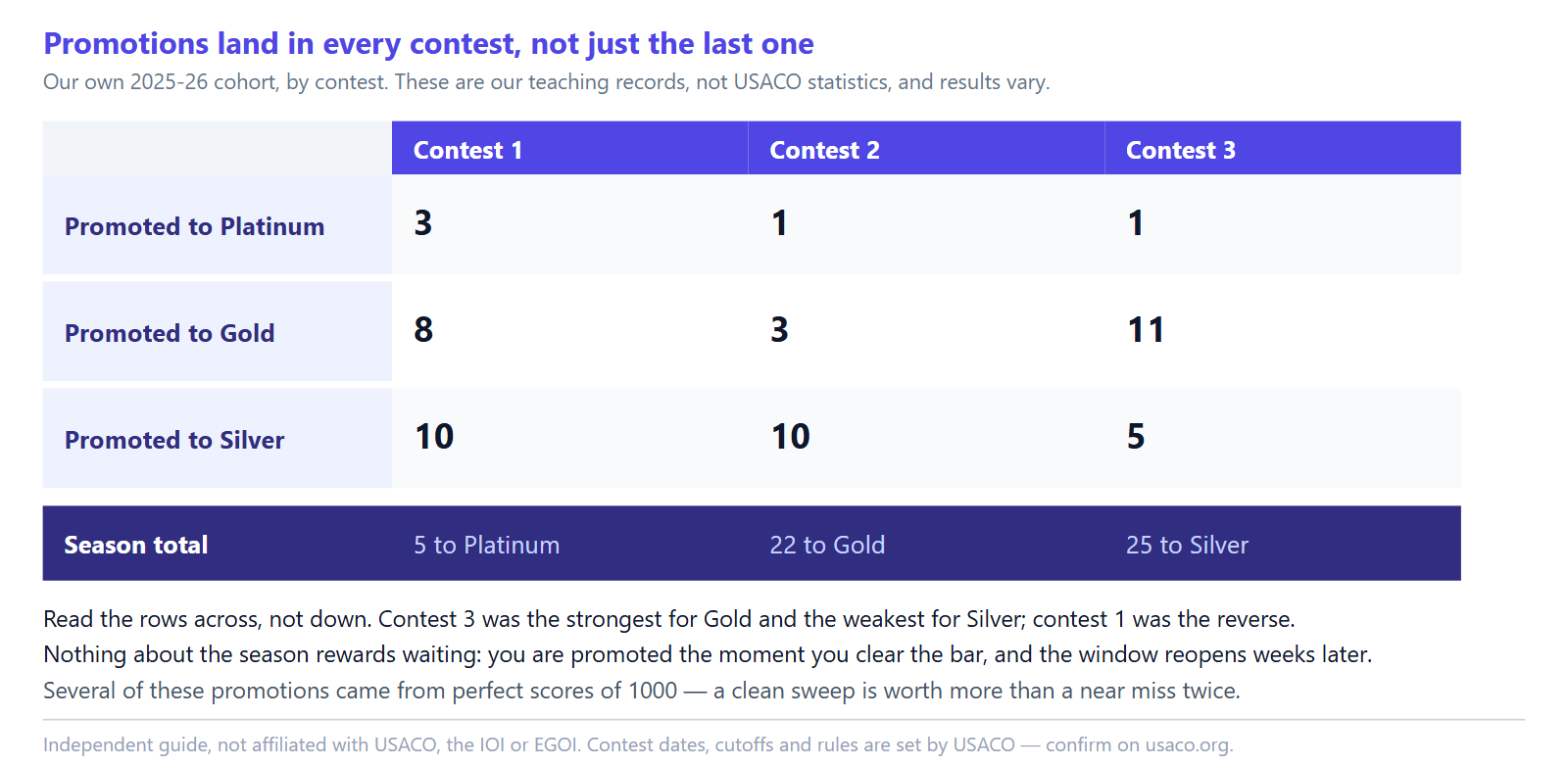
The planning consequence is unglamorous but real. If promotions were concentrated in the final contest, sitting out contest one to prepare harder would cost little. They are not, so it does — a division you could have cleared in December is a division you spend the rest of the season already inside, working on the next set of ideas rather than the same one. Which contest turns out strongest for a given division varies year to year and is not something to plan around; that it is never only the last one is.
Set against the cohort shape above, a realistic frame looks like this:
| Division | What actually changes | Honest pacing note |
|---|---|---|
| Bronze | Careful implementation, simulation, brute force, reading the problem correctly under time pressure. | Often clearable within a season for a student who can already code fluently in one language. |
| Silver | Standard techniques become mandatory: sorting with intent, two pointers, prefix sums, binary search on the answer, basic graph traversal. | The widest band in our cohort (249 outcomes). This is where most students spend real time. |
| Gold | Dynamic programming, shortest paths, union-find, and data structures you must choose rather than recall. | Steadiest band we see (18–32 per season). Reaching it usually spans more than one season. |
| Platinum | No fixed ceiling. Segment trees, advanced DP, and above all problem modelling — recognising what a problem is before you can solve it. | About 10% of outcomes; under 8 per season on average. Plan in years, not months. |
The mistake is not aiming at Platinum. The mistake is budgeting one season for a climb that our own six-year record suggests is normally a multi-season arc — and then abandoning it in February when the cutoff is missed. Students who reach the top of this ladder in our cohort almost always did so having competed across several seasons, not by accelerating through four divisions in one.
How to find out where you actually are
Cohort averages tell you what is plausible. They cannot tell you what you can do in your next contest window. The only reliable diagnostic is a timed contest under real conditions: one contiguous block of 4–5 hours, roughly three or four problems, 1000 points, no interruption, no looking at solutions until the clock stops. Grade yourself against the historical cutoff range for your division rather than against a feeling.
Two practical notes. Contests before December 2020 used file-based input and output while newer ones use terminal I/O, so an old paper will fail locally if you do not adjust — a detail that catches out a surprising number of first-time self-testers. And a score of 400 on a full timed paper is far more informative than a score of 900 on a paper you did across three evenings with hints.
We keep a curated division-by-division practice set for exactly this purpose, together with preparation notes written separately for C++, Java and Python, since USACO accepts all three and the pitfalls are genuinely different in each. Readers can ask us for the set that matches their current division rather than assembling one alone. If you want the framing first, our guide to practising with past contests explains the five-step timed method, and the full competition guide covers format, scoring and eligibility end to end.
One more data point, kept in proportion
In 2025 one student from our programme was selected for New Zealand’s IOI team. That is a real outcome and we are glad to report it, but it belongs at the far end of a distribution whose middle is Gold — and national-team selection routes differ by country. USACO itself runs roughly three online contests plus the US Open each season, then a training camp, then a four-person Team USA to the IOI; the camp and team route is for US pre-college students. Students in China register directly and free of charge on usaco.org and compete in the same divisions, which is why the ladder above applies globally even when the national-team pathway does not.
Frequently asked questions
Do these numbers mean 1 in 5 Silver students will reach Platinum?
No. These are counts of students reaching each division in each season, not a tracked funnel following the same individuals over time. A student can appear in more than one row across different seasons, and students join at different levels. The 5:3:1 figure describes the shape of a cohort, not your personal odds. Use it to calibrate expectations about how narrow the top is, not to compute a probability.
Is Platinum getting harder, given the counts fell from 11 to 5?
There is a structural reason to read the last season separately rather than as a continuation of the trend. At the start of the 2025-26 season USACO reset nearly all Platinum competitors back to Gold — only 2025 IOI finalists and former finalists at a comparable level kept Platinum — so reaching Platinum that season meant re-earning it, and that season’s Gold count includes returning Platinum students. Across the earlier, comparable seasons the counts move mainly with how many students were enrolled and at what level: Platinum stayed in a band of 5 to 10 per season whether the cohort produced 110 outcomes or 68, so widening the base did not proportionally widen the top. Division and promotion rules are set by USACO and change between seasons — confirm current rules on usaco.org.
How many seasons should I budget to reach Gold?
There is no guaranteed timeline, and we will not invent one. What our record supports is this: Gold was the steadiest band across six seasons, sitting between 18 and 32 students each year, and students who reached it had generally competed across more than one season rather than climbing straight through. Plan on multiple contest attempts per division, and treat any single missed cutoff as data rather than a verdict.
Can students in China compete, and does the division ladder work the same way?
Yes. USACO is free and globally open, students register directly on usaco.org, and the four-division structure with per-contest promotion applies the same way. The difference is the national-team route: the training camp and four-person Team USA selection are for US pre-college students. Everything about divisions, contest windows, the 4–5 hour block and the 1000-point scoring applies regardless of where you sit. Contest dates and cutoff values change every year — confirm those on the official channels.
This site is an independent guide to the USA Computing Olympiad. It is not affiliated with, endorsed by or sponsored by USACO, the IOI or EGOI; official registration, contest dates, rules and cutoff announcements stay on usaco.org. Student results cited here are de-identified Hanlin cohort data, vary between individuals, and are not a guarantee of any outcome. Confirmed errors are corrected within 7 working days.