No. USACO’s official contest instructions prohibit the use of generative AI — services such as Copilot and ChatGPT are named — during a contest, alongside long-standing rules against outside help. Confirm the current wording on usaco.org before you sit down. The rule matters more than most students assume, because the entire format only works if competitors keep it.
What the rule says, and what it is actually protecting
USACO’s Contest Instructions and Rules page states that use of generative AI — it gives services like Copilot and ChatGPT as examples — is prohibited. That sits next to the older and more familiar prohibitions: you may not get help from another person, and you may not discuss the problems or share any code with anyone for as long as the contest is still running, which lasts well beyond the end of your own timer. Because the exact phrasing has been revised across seasons, treat this article as an orientation and read the current instructions page on usaco.org yourself before your first contest of the season.
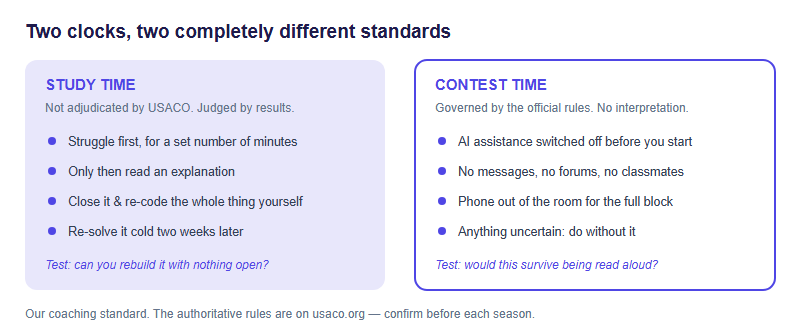
It is worth being precise about the scope. The rules are written about contest conduct — what happens from the moment your timer starts, plus a ban on discussing or sharing anything about the problems until the whole contest window has closed. What you do in an October practice session is not something USACO adjudicates. That does not make it harmless, and the second half of this article is about why. But keep the two questions separate in your head, because students who blur them tend to get both wrong: they take liberties during the contest and then feel vaguely guilty about using a tutorial in practice.
One more thing the rule is not: it is not a statement that AI is useless or that you should never touch it. It is a statement about what a USACO score is supposed to certify. A division record says “this person, alone, in four hours, with no help, produced these programs.” Every part of that sentence has to be true or the record certifies nothing.
Why an unproctored contest can only work this way
Look at the format honestly. Each contest opens a multi-day window. Inside that window you choose your own continuous four-hour block — five at the US Open — and you sit it wherever you are, typically alone, at your own machine. There are roughly three problems and 1000 points on the table. Nobody is standing behind you. (Format details vary by season; confirm on usaco.org, and see our division and format guide for how the four divisions are structured.)
That design is unusually generous. It is what lets a student in Shanghai or Shenzhen compete on the same terms as a student in California, for free, with no travel and no proctor to book. But generosity of this kind is structural: it can exist only because the rules are doing the job a proctor would otherwise do. The self-timed window is not an oversight to be exploited — it is the mechanism, and the integrity rules are the load-bearing wall holding it up.
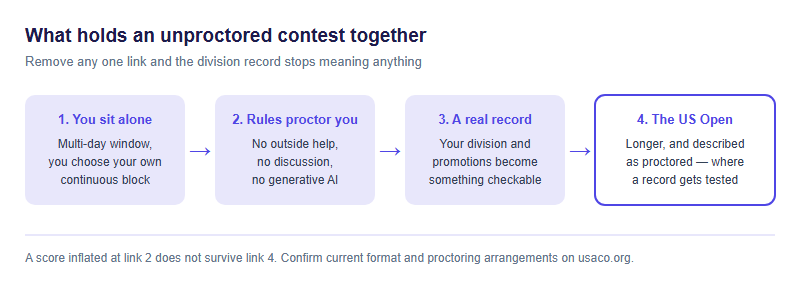
There is a second reason to care, and it is specific to international competitors. Anyone in the world can enter the online contests for free — there is no nationality or grade restriction on competing. But the selection pipeline beyond that point, the training camp and the four places on Team USA that lead to the IOI, is reserved for pre-college students in the USA. Confirm the current eligibility statement on usaco.org. For a student based in China, that means the thing you are building is the division record itself: Bronze, then Silver, then Gold, then Platinum, and the dates you cleared each cutoff. That record is the entire product. It is also precisely the thing a violated contest destroys.
Decide the grey zones now, not at hour three
Almost nobody plans to break a rule. What happens is narrower and more human: at 2:40 into a four-hour window, with one problem half-working and a bug you cannot see, a browser tab is one keystroke away. The defence is to have decided in advance, so that in the moment there is no decision to make.
The table below is how we ask our own students to behave. It is deliberately stricter than the letter of any rule, because a rule you have to interpret under time pressure is a rule you will interpret badly. Where a row says “confirm”, that means we are not going to guess on your behalf — read the instructions page.
| Situation, timer running | Our standing instruction | Why |
|---|---|---|
| Asking Copilot or ChatGPT to write, complete or fix contest code | Do not. Prohibited by the official instructions | This is the case the rule names explicitly |
| Asking an AI to explain what a contest problem is asking | Do not. Treat as outside help | Reading the statement correctly is part of what is being tested |
| Messaging a classmate about a live problem | Do not, in any form, including “I only asked if it was DP” | Discussion during the window is outside help |
| Editor autocomplete that suggests whole solution lines | Turn AI assistance off before you start | Removes any argument about where a line came from |
| Your own template file, written by you before the contest | Do not. The official instructions say you may not use pre-written code or templates | This one is named in the rules and is not a grey zone – confirm the current wording on usaco.org |
| Looking up standard language documentation | Confirm on usaco.org; when unsure, do without it | Same reason |
| Using AI to study a past problem after the window closed | Not a rules question — but see the next section | It is a skill question, and a serious one |
On consequences: USACO treats integrity violations seriously, and the penalties reach beyond a single contest score. We are not going to publish a specific sanction here, because the exact wording has changed between seasons and you deserve the current version rather than ours. Read it on usaco.org, and read our own academic integrity statement for how we handle it in our own classes.
The quieter cost: what AI-assisted practice does to your contest score
Here is the part that has nothing to do with getting caught, and that we think matters more for the average student.
There are two different mental states that feel almost identical from the inside. The first is recognition: you read a solution, you follow every line, you think “yes, obviously, prefix sums.” The second is reconstruction: from a cold start, with no prompt, you generate that idea yourself, and then turn it into working code that survives the official test data. Recognition feels like understanding. It arrives faster, it is more pleasant, and it is not the thing the contest measures.
An AI assistant is an extraordinarily efficient machine for producing recognition. It removes the stall — the twenty minutes of staring at a bound of 200,000 and being annoyed. But that stall is not wasted time; it is the training stimulus. The student who sits in it builds the reflex that fires in hour two of a real contest. The student who dissolves it with a prompt builds a comfortable feeling and no reflex, and then finds out which one they have on contest day, alone, at 1000 points.
Our own cohort record points the same way. Across the 2026 season our students took 5 Platinum, 22 Gold and 25 Silver promotions (de-identified, per Hanlin; results vary and this is our own teaching record, not an official USACO statistic). What those promotions had in common was not talent or hours logged — it was that the students could rebuild an approach from nothing. The ones who plateaued were, far more often than not, extremely good at following someone else’s solution.
Building the reflex before the season opens
The season’s online contests fall across the winter months, with a US Open in spring; the exact dates are published each year on usaco.org, so check there rather than trusting any third-party calendar. From an August starting point that leaves a long runway, and the way to use it is not to grind more problems — it is to make your practice look like a contest.
Four habits do most of the work:
- Run full timed sets, not single problems. Three problems in one continuous four-hour block is a different skill from three problems across three evenings. Budgeting attention across a set is itself trained.
- Close everything before the timer starts. Same room, same setup, same rules you will use in January. If you would not have a tab open during the contest, do not have it open in practice.
- Write down where you stalled, not just whether you solved it. “Could not see that it was a graph” and “saw it was a graph, could not code the traversal” are two entirely different problems with two entirely different fixes.
- Re-solve, cold, later. A problem you solved with help is not finished until you have rebuilt it from a blank file weeks afterwards.
If you want material to run these sets on, work through the past-contest set we have gathered and organised on our past contests page — a number of the years come with worked walkthroughs, and the set keeps growing as our teachers add to it. Use the walkthrough only after your timer has expired. That single ordering rule is worth more than any tool you could add.
Frequently asked questions
Is using ChatGPT during a USACO contest against the rules?
Yes. The official contest instructions prohibit generative AI such as Copilot and ChatGPT during contests. Confirm the current wording on usaco.org.
Can I use AI to study past problems outside contest time?
That is not a rules question, it is a skill question. Struggle first, read after, then re-code the solution yourself from a blank file.
What happens if someone is caught cheating?
USACO treats it as a serious violation with consequences beyond one score. We do not restate the sanction here — read the current wording on usaco.org.
Does the AI rule apply differently to international competitors?
No. The contest rules apply to everyone who enters, wherever they sit. Eligibility for camp and Team USA is separate — confirm on usaco.org.
This is an independent guide operated by Hanlin Education for China-based international-school students. We are not affiliated with, endorsed by, or sponsored by USACO (the USA Computing Olympiad). Contest rules, dates, eligibility and registration are set by USACO alone, and registration stays on usaco.org — confirm current details there. Spotted an error? We correct confirmed factual errors within 7 working days.