Silver rewards you for spotting the right tool. Gold rewards you for designing one. The step up is not a difficulty dial — it is a change of job, and it runs through four specific families: dynamic programming, shortest paths on weighted graphs, union-find, and data structures that survive updates. Get those four and Gold stops feeling random.
What actually changes between Silver and Gold
Our division guide describes Silver as the division of standard algorithmic tools — greedy reasoning, binary search, prefix sums, graph traversal — and Gold as the division of dynamic programming, shortest paths, union-find and efficient data structures. That is accurate, but it reads like a syllabus, and a syllabus does not tell you what the exam feels like. Here is the version that helps.
At Silver, most problems have a recognisable shape. Once you identify it — this is a sorting problem, this is a two-pointer problem, this is binary search on the answer — the rest is careful implementation. The intellectual work is classification, and it is why Silver responds so well to drilling: you are building a lookup table between problem shapes and tools.
At Gold, that lookup table stops covering the input. Gold problems are far more often assembled from parts. You are not asked “which tool is this?” so much as “what is the state of this system, what moves it, and what is the cheapest structure that can answer the questions being asked?” A Gold problem may need a graph you construct yourself out of something that was never described as a graph, then a shortest path over it, then a data structure to make the queries fast. The work is modelling, and modelling does not come from more drilling. It comes from building the four families deeply enough that you can combine them.
One concrete consequence worth planning around: constant factors start to bite. The rules permit C, C++, Java and Python — confirm the current list on usaco.org — but at Gold and Platinum, C++ is the standard choice among serious competitors, because the intended solution can be near the limit even when implemented well. If you are still on Python and aiming at Gold this season, plan the switch now rather than in January.
The four families, and what triggers each one
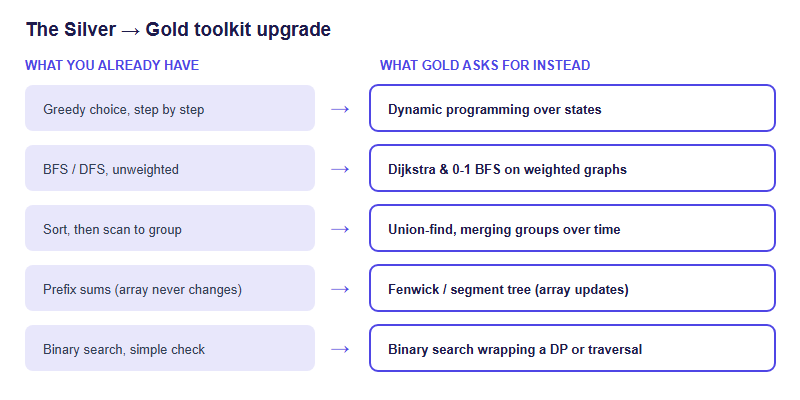
The single most useful mental upgrade is to stop learning topics in isolation and start learning them as replacements: here is the Silver reflex, here is what breaks it, here is the Gold tool that takes over. Read the table below in that direction, from left to right.
| Your Silver reflex | What breaks it | The Gold upgrade |
|---|---|---|
| Greedy: take the locally best option each step | Choices interact — a good move now closes a better move later | Dynamic programming. Enumerate states, not moves; let the table remember every branch |
| BFS or DFS on an unweighted graph | Edges carry different costs, so “fewest edges” stops meaning “cheapest” | Weighted shortest paths (Dijkstra; 0-1 BFS when weights are only 0 or 1) |
| Sort, then scan to group things together | Groups merge over time, and you need to know connectivity after each merge | Union-find / DSU, with union by size and path compression |
| Prefix sums for range totals | The array is modified between queries, so your precomputation goes stale | Fenwick tree or segment tree — updates and queries both in logarithmic time |
| Binary search on the answer with a simple check | The feasibility check is itself a non-trivial algorithm | Same outer search, but the check becomes a DP or a graph traversal |
A note on the second row, because it is the one students most often skip. “Shortest path” is a misleading name — a very large share of Gold graph problems are not about roads or distances at all. Grid states, sequences of moves, configurations of a puzzle, tuples of position-and-fuel-remaining: all of these become vertices, and the transitions between them become weighted edges. Learning Dijkstra is the easy half. Learning to see the graph in a problem that never mentions one is the half that promotes you.
The habit that separates Gold solvers: design the state before you type
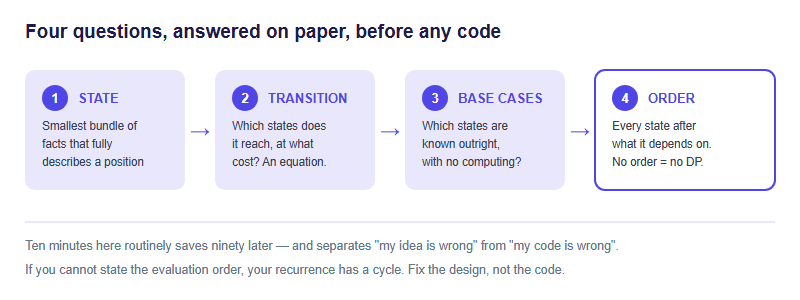
Most failed Gold attempts we see are not failures of knowledge. The student knows what DP is. They can recite the Fibonacci example. What they cannot do is sit in front of an unfamiliar problem and answer four questions in order, on paper, before touching the keyboard.
Those four questions are the whole method:
- What is the state? What is the smallest bundle of facts that fully describes a situation? If you find yourself saying “and also we need to remember whether we already used the coupon” — that goes in the state.
- What is the transition? From a given state, what states can you reach, and at what cost? Write it as an equation, not as code.
- What are the base cases? Which states are known outright, without computing anything?
- In what order do you evaluate? Every state must be computed after everything it depends on. If you cannot name the order, your recurrence has a cycle and it is not a valid DP.
Doing this on paper costs ten minutes and routinely saves ninety. It also converts the most common Gold disaster — writing 120 lines, getting wrong answers, and having no idea whether the bug is in the idea or the implementation — into a boring five-minute debug, because you already know the idea is sound.
A realistic build order for the months before the season
The online contests fall across the winter months with a US Open in spring; exact dates are published each season on usaco.org, so plan backwards from what is posted there rather than from any third-party calendar. From a late-summer start you have a genuine training block, and the ordering below is chosen so that each family is used by the next one rather than sitting in isolation.
| Block | Focus | You have it when you can… |
|---|---|---|
| Weeks 1–3 | DP foundations: 1-D and 2-D, knapsack-style choices, DP on a grid | State the four design questions for an unfamiliar problem without looking anything up |
| Weeks 4–5 | Weighted shortest paths: Dijkstra with a priority queue, 0-1 BFS | Model a problem that never says “graph” as a graph, and justify the edge weights |
| Weeks 6–7 | Union-find: union by size, path compression, offline processing by sorted order | Answer connectivity questions as edges are added, without recomputing from scratch |
| Weeks 8–9 | Fenwick / segment tree: point update with range query, then range logic | Recognise instantly that an array is being modified between queries |
| Weeks 10–12 | Mixed timed sets only — full three-problem blocks, no topic labels | Pick the family yourself, under time pressure, with nothing telling you which it is |
Weeks 10 to 12 are the part people cut, and they are the part that matters. Practising DP when you already know the problem is a DP problem trains half a skill. The contest never labels anything.
How to tell whether you are actually ready
The mechanical answer is the cutoff. A contest carries roughly three problems and 1000 points, and at the end a cutoff is set for each division based on how hard that contest turned out to be; clear it and you are promoted. Recent cutoffs have mostly landed somewhere in the 650–750 range, but the number moves every contest — see our cutoff history page for the shape, and confirm anything current on usaco.org. There is also an in-contest route: a perfect score during your window promotes you immediately, with a fresh timer for the next division, so you can move up without waiting for the season to end.
The practical answer is a self-test. You are ready to attempt Gold seriously when, on an unfamiliar Silver-to-Gold boundary problem, you can:
- read the constraints and name the complexity class you need before considering any approach;
- say out loud which of the four families it belongs to, and why the other three do not fit;
- write the state and transition on paper before writing code;
- implement it cleanly enough that when it fails, you can tell within ten minutes whether the idea or the code is at fault.
For calibration on how the funnel actually behaves: across the last three seasons our students recorded 100 promotions into Silver, 70 into Gold, and 18 into Platinum (de-identified, per Hanlin; results vary). Those are promotion counts across different students and different entry points, not a tracked cohort funnel, so read the shape rather than any conversion rate. The shape is simply that far more of those promotions land in Silver and Gold than in Platinum. Because these are separate students rather than one tracked cohort, read that as a rough distribution and not as any individual student’s odds of progressing. Budget your expectations accordingly, and do not treat a season spent consolidating Gold as a season wasted.
When you move to timed practice, run full three-problem blocks against the organised past-contest set on our past contests page rather than cherry-picking single problems by topic — several of the years there carry worked walkthroughs, and the set grows as our teachers add to it. Read a walkthrough only after your own timer has run out.
Frequently asked questions
How long does Silver to Gold usually take?
It varies enormously by starting point and hours available. Plan a training block in months, not weeks, and judge progress by whether you can model unlabelled problems.
Do I have to switch to C++ for Gold?
The rules permit C, C++, Java and Python — confirm on usaco.org. In practice C++ is the standard choice at Gold and above for constant-factor reasons.
What score do I need to be promoted to Gold?
A cutoff set per contest, based on its difficulty. Recent cutoffs have mostly sat between 650 and 750, but it moves — confirm on usaco.org.
Can I be promoted in the middle of a contest?
Yes. A perfect score during your window promotes you immediately, with a fresh timer for the next division. Confirm the current mechanics on usaco.org.
This is an independent guide operated by Hanlin Education for China-based international-school students. We are not affiliated with, endorsed by, or sponsored by USACO (the USA Computing Olympiad). Contest rules, dates, division definitions and registration are set by USACO alone, and registration stays on usaco.org — confirm current details there. Spotted an error? We correct confirmed factual errors within 7 working days.