Why More Practice Hours Don’t Guarantee Bronze to Silver Progress
Many students preparing for USACO Bronze believe that increasing practice volume alone will lead to promotion. Yet a common pattern emerges: dozens of solved problems later, the score on contest day barely budges. If you are evaluating USACO coaching, the first step is not to hire a tutor for more problems, but to identify which of four distinct bottlenecks is actually blocking progress.
Students who plateau in Bronze often confuse familiarity with mastery. They recognize problem types during review but fail to solve them under contest conditions. The issue is rarely a lack of effort; it is usually a mismatch between where time is spent and where the real gap lies.
Inspect Recent Attempts Rather Than Total Hours
Before deciding on coaching support, examine your last three to five contest attempts or timed practice sessions. Ask these specific questions:
- Did you understand what the problem was asking within the first few minutes?
- Could you outline a solution strategy before writing any code?
- Did your code pass sample cases but fail on hidden tests?
- Did you revisit the problem after the contest and understand the correct approach?
Total hours logged matter less than the pattern across these recent attempts. A student who misreads problems consistently has a different coaching need from one who understands the logic but cannot translate it into working code. This diagnostic step alone prevents mismatched support and accelerates the transition from Bronze to Silver.
Separate Four Kinds of Bottleneck
Effective USACO coaching targets the specific failure mode. Here is how the four common bottlenecks appear in Bronze-level preparation:
Problem Reading
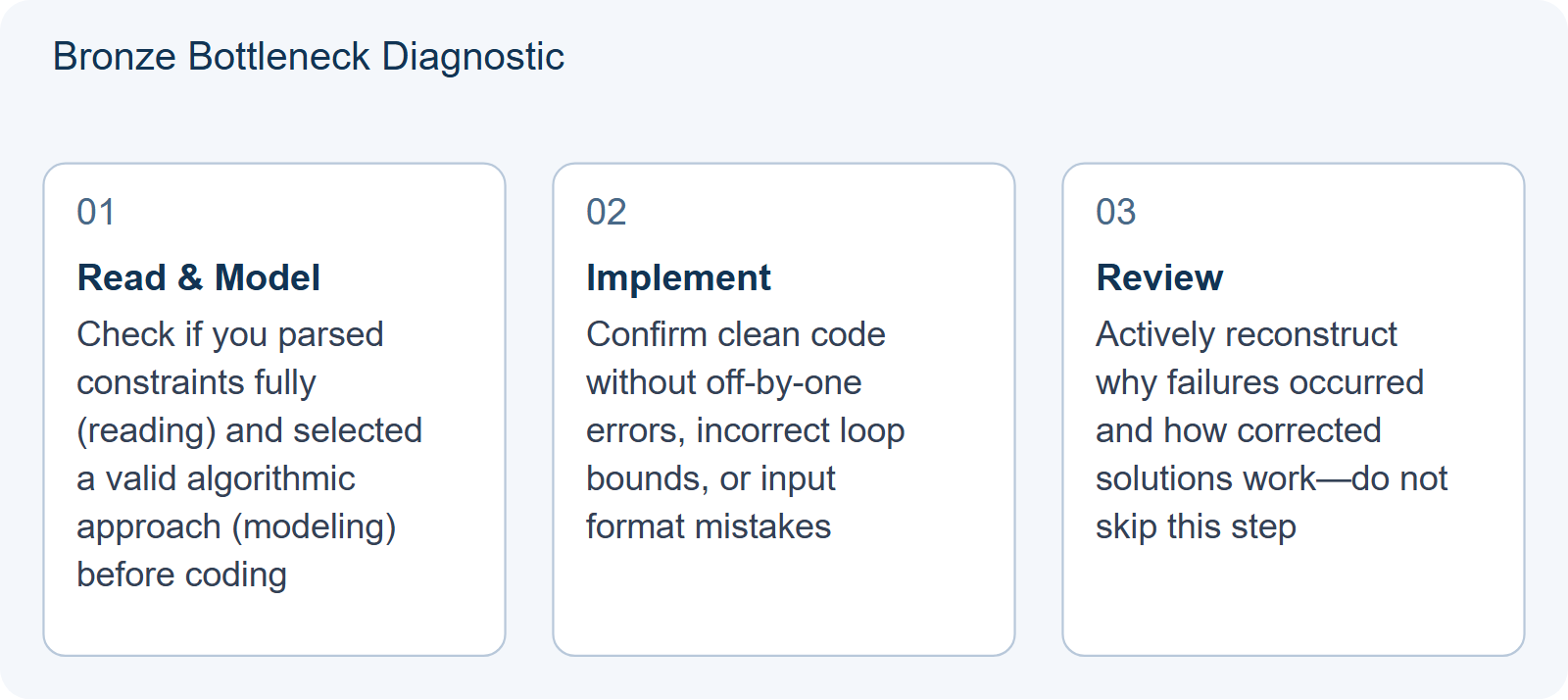
The student rushes into coding without fully parsing constraints or edge cases. USACO problems often embed critical details in lengthy statements. A student with this bottleneck may solve the problem correctly in theory but implement the wrong version of the question.
Modeling
The student understands the problem but cannot select or construct the right algorithmic approach. At Bronze level, this typically involves choosing between brute force, simulation, or simple greedy strategies. Modeling gaps become more pronounced when transitioning to Silver, where standard algorithms like flood fill or prefix sums enter play.
Implementation
The student has the correct approach but makes errors during coding—off-by-one mistakes, incorrect loop bounds, or misunderstanding of input formats. This bottleneck is especially common for students using Python who have not yet developed careful debugging habits, or for those beginning to switch from Python to C++ for performance reasons.
Review
The student never systematically analyzes failed attempts. Without structured review, the same errors recur. Review is not passive re-reading but active reconstruction of why a solution failed and how a corrected version works.
For a broader view on how language choice intersects with these bottlenecks, see our analysis of C++, Python or Java for USACO? Choosing Your Contest Language.
What a Meaningful Coaching Review Should Show
If you are considering coaching, demand that any trial or consultation demonstrate how the instructor diagnoses your specific bottleneck. A meaningful review should include:
- Walkthrough of a recent failed problem with you explaining your original thought process
- Identification of exactly where the breakdown occurred—reading, modeling, implementation, or review
- A concrete adjustment for the next practice session, not just more problems assigned
Effective USACO coaching structures include tiered Bronze, Silver, and Gold notes with language-specific code examples, designed to address each bottleneck type with targeted practice rather than generic problem sets. C++ Bronze notes, for instance, group problems by topic to isolate modeling challenges, while Python materials accommodate students still building implementation fluency.
Choose Support Proportional to the Gap
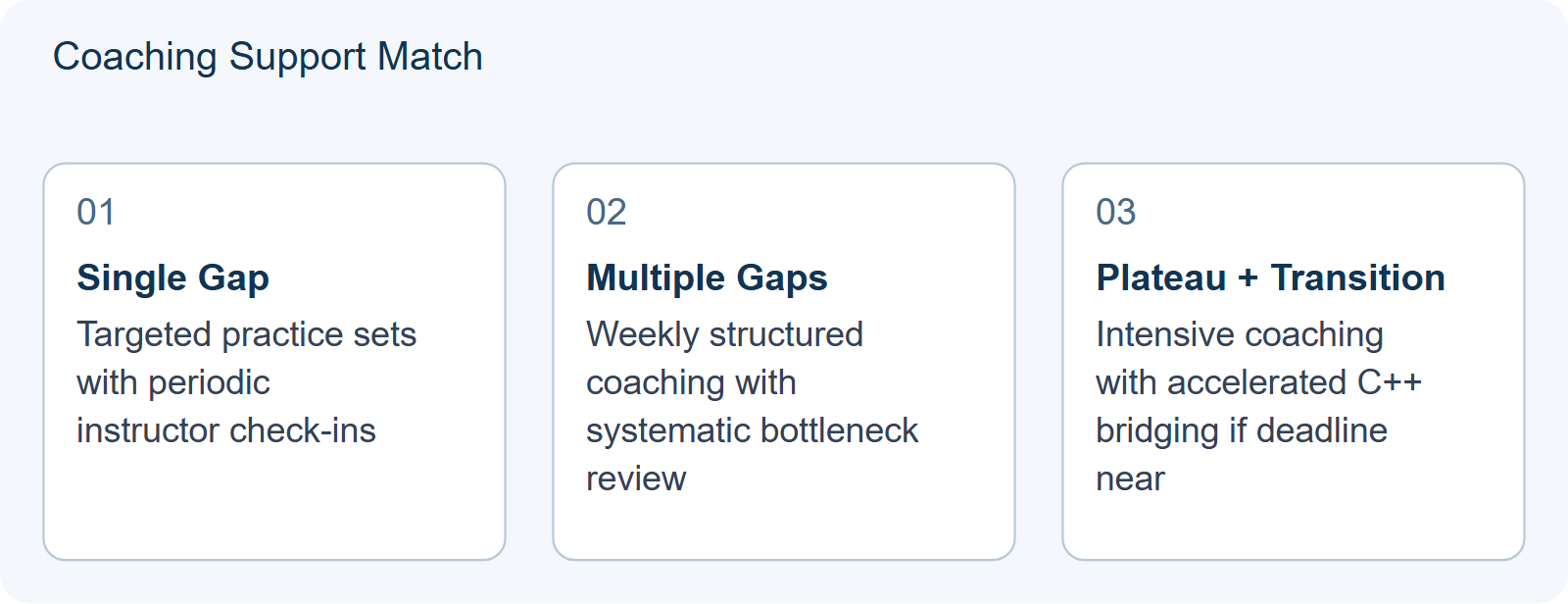
Not every Bronze student needs the same intensity of coaching. Use this framework to match support level to your situation:
| Bottleneck Pattern | Indicated Support Level | Illustrative Timeline |
|---|---|---|
| Single bottleneck, recent identification | Targeted problem sets with periodic check-ins | Often 4–8 weeks, flexible |
| Multiple bottlenecks, some contest experience | Structured coaching with weekly review | Often 8–12 weeks, flexible |
| Persistent plateau, multiple contest cycles | Intensive coaching with full diagnostic and language transition support | 12+ weeks, or accelerated if deadline near |
Students with under eight weeks until a contest deadline who also need to bridge from Python to C++ face a compressed timeline. In these cases, accelerated language transition support becomes essential. C++ offers the highest runtime efficiency among USACO-permitted languages and is the choice for students targeting Silver and beyond, where algorithmic efficiency requirements increase. For guidance on structuring this transition, refer to our discussion of Silver preparation with C++ transition support.
Prepare Attempted Code and Reasoning for a Consultation
To make any coaching consultation productive, arrive with specific materials rather than general complaints. Prepare:
- Your original code for two to three problems you failed to solve in contest conditions
- A brief written note of what you thought the problem required at the time
- Any post-contest analysis you attempted, even if incomplete
This preparation allows the instructor to quickly identify whether your gap is reading, modeling, implementation, or review—and to propose targeted next steps rather than generic advice. Instructors with experience guiding students to USACO Platinum and national camp selection emphasize that this diagnostic preparation is the fastest path to productive coaching.
For students ready to assess their current standing and explore structured pathways forward, our USACO program overview and consultation request provides additional context on tiered preparation options.
Key Considerations for the Bronze-to-Silver Transition
The Bronze to Silver transition marks a shift from basic syntax application to algorithmic problem-solving. Silver requires competency in conventional algorithms and intermediate data structures—skills that rarely develop from unstructured practice alone. Students still using Python at this stage often encounter runtime efficiency barriers that C++ resolves, though the language switch itself becomes an additional implementation bottleneck if not managed with focused support.
USACO’s contest structure allows immediate promotion upon achieving a qualifying score during any contest. The season typically includes three regular contests followed by the US Open, with events running from January through March. Students have multiple entry points but limited cycles to advance within a single academic year.
Frequently Asked Questions
How do I know if my Bronze plateau is from Python's speed limits or my own algorithm gaps?
Run the same algorithm in Python and check if it passes with generous time limits on small cases but times out on larger ones. If the logic is correct but runtime fails, the bottleneck is language efficiency. If your approach fails even on small cases, the gap is likely in modeling or implementation. A coaching review can confirm this distinction quickly.
Should I switch from Python to C++ before or after promoting to Silver?
Bronze-level problems are fully solvable in Python, but Silver introduces algorithms where C++'s speed advantage becomes significant. If you have eight or more weeks before your target contest, beginning the transition during Bronze preparation is viable. With less time, focused coaching on C++ fundamentals alongside Silver algorithm introduction is typically more efficient.
What makes a USACO coaching review different from just doing more problems?
A coaching review specifically identifies which of the four bottlenecks—reading, modeling, implementation, or review—caused each failure, then prescribes targeted practice for that gap. Unstructured problem solving often reinforces existing patterns, including errors, whereas coached review interrupts those patterns with deliberate correction.