When your USACO solution passes sample tests but fails hidden test groups, the most effective debugging strategy is not random guessing—it is systematic reduction of failing inputs to their smallest useful counterexample. A counterexample is the simplest input that exposes why your logic breaks. Finding one quickly separates students who progress from those stuck in endless trial-and-error loops.
The Core Principle: Minimal Failure Exposes Maximum Information
A large failing test case contains too much noise. If your code crashes on an input with 100,000 elements, you cannot see which specific element or relationship triggers the bug. By reducing the input size while preserving the failure, you isolate the exact logical flaw. The goal is not just any small failing case, but the smallest known failing case that still fails—this minimal counterexample reveals precisely where your assumption diverges from the problem’s requirements.
This technique works because bugs are structural, not accidental. Your code implements a model of the problem. When it fails, your model is wrong somewhere. A minimal counterexample shows exactly where the model breaks down, allowing you to fix the root cause rather than patching symptoms.
Important caveat: The reduction predicate—”does this smaller input still fail?”—may be nonmonotone. Ordinary binary search on input size is not generally valid for finding minimal failing cases. You must preserve valid input constraints and compare against an independently checked oracle. Hidden test input and exact group names are typically unavailable; you reconstruct from constraints and observed failure patterns.
Worked Teaching Example: Off-by-One in Array Bounds
Teaching Illustration: Given an array of N integers, find the maximum sum of any contiguous subarray of length K, with 1 ≤ K ≤ N.
Student Code (Bronze/Silver level):
def max_subarray_sum(arr, k):
    n = len(arr)
    max_sum = float('-inf')
    for i in range(n - k):  # BUG: should be n - k + 1
        current_sum = sum(arr[i:i+k])  # O(k) slice; acceptable for tiny reference only
        if current_sum > max_sum:
            max_sum = current_sum
    return max_sum
Failing Test: arr = [1, 2, 3, 4], k = 3. Correct windows: [1,2,3] sum=6, [2,3,4] sum=9. Expected answer: 9. Buggy code with range(4-3) = range(1) checks only i=0, returns 6.
Reduction Process:
- Original failing input: N=4, K=3. Two windows, but still complex to analyze.
- Try N=3, K=2: correct checks i=0,1; buggy
range(3-2) = range(1)checks only i=0. Input [1,2,3]: windows [1,2]=3, [2,3]=5. Expected 5, buggy returns 3. Still two windows. - Try N=2, K=1: correct
range(2)checks i=0,1; buggyrange(1)checks only i=0. Input [1,2]: expected 2, buggy returns 1. Two elements, one missed. - Try N=1, K=1: correct
range(1)checks i=0; buggyrange(0)checks nothing, returns-inf. Input [5]: expected 5, buggy fails. This is the minimal case: a single valid window that the loop skips entirely.
Insight from Minimal Counterexample: The loop bound n - k excludes the final valid starting index. When n=k=1, the bug reduces to checking zero windows instead of one. Fix: change range(n - k) to range(n - k + 1). The minimal case made the boundary condition obvious: the loop must execute at least once when a valid window exists.
Contrasting Case: Where Naive Reduction Fails
Not all bugs yield to simple size reduction. Consider a Silver-level problem involving graph connectivity where the bug is in union-find without union-by-size.
Teaching Illustration: Student implements union-find with path compression but omits union-by-rank. On small inputs, it works fine. On large inputs with specific structures, it times out.
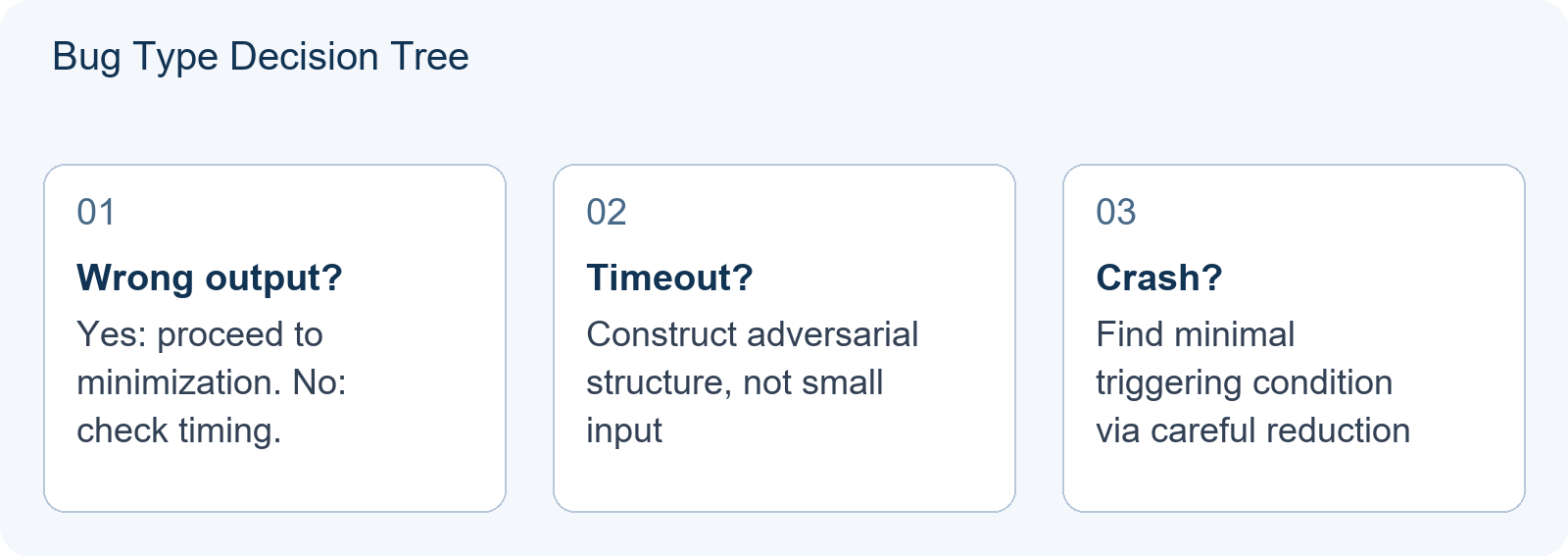
Why Simple Reduction Fails: Shrinking N does not expose the bug because the algorithm remains functionally correct—it just becomes slow due to unbalanced tree depths. The failure mode is performance, not correctness. Reducing to N=10 will not show timeout behavior.
Correct Approach: Instead of reducing input size, construct a pathological structure that maximizes tree depth. For union-find without union-by-size, create a chain by attaching the first root under the second root: union(1,2), union(2,3), …, union(N-1,N). Specifically, if each union attaches the first argument’s root under the second argument’s root, then find(1) traverses the chain 1→2→3→…→N before any path compression occurs. Path compression changes future costs but does not prevent the initial traversal penalty. Union by rank attaches a lower-rank root under a higher-rank root and increments rank when equal ranks merge. Union by size instead attaches the root of the component with fewer elements under the larger component’s root. Either heuristic alone bounds tree depth by O(log N); with path compression, rank is a bound rather than the exact current depth.
Minimal Performance Counterexample: N=5 with unions forming a line as described above. Even at this small size, the depth difference is visible: without union-by-rank, find(1) traverses depth 4 before compression; with union-by-rank, maximum depth is 2. A worse asymptotic bound motivates performance testing, but does not establish TLE at any specific N. Test structure, implementation and time limits all matter. Note that missing rank heuristic does not automatically cause TLE at any specific N; the performance degradation depends on test data structure and time limits.
This illustrates a key distinction: correctness bugs respond to input minimization; performance bugs require structural adversarial construction.
Systematic Reduction Algorithm
Follow these steps when your code fails hidden tests:
- Identify the failing test group: Note which test set failed (e.g., “Test Group 3: Large Random Inputs”). Exact hidden test names may not be available.
- Generate or obtain a failing instance: Reconstruct likely failing cases by varying parameters around boundaries mentioned in problem constraints.
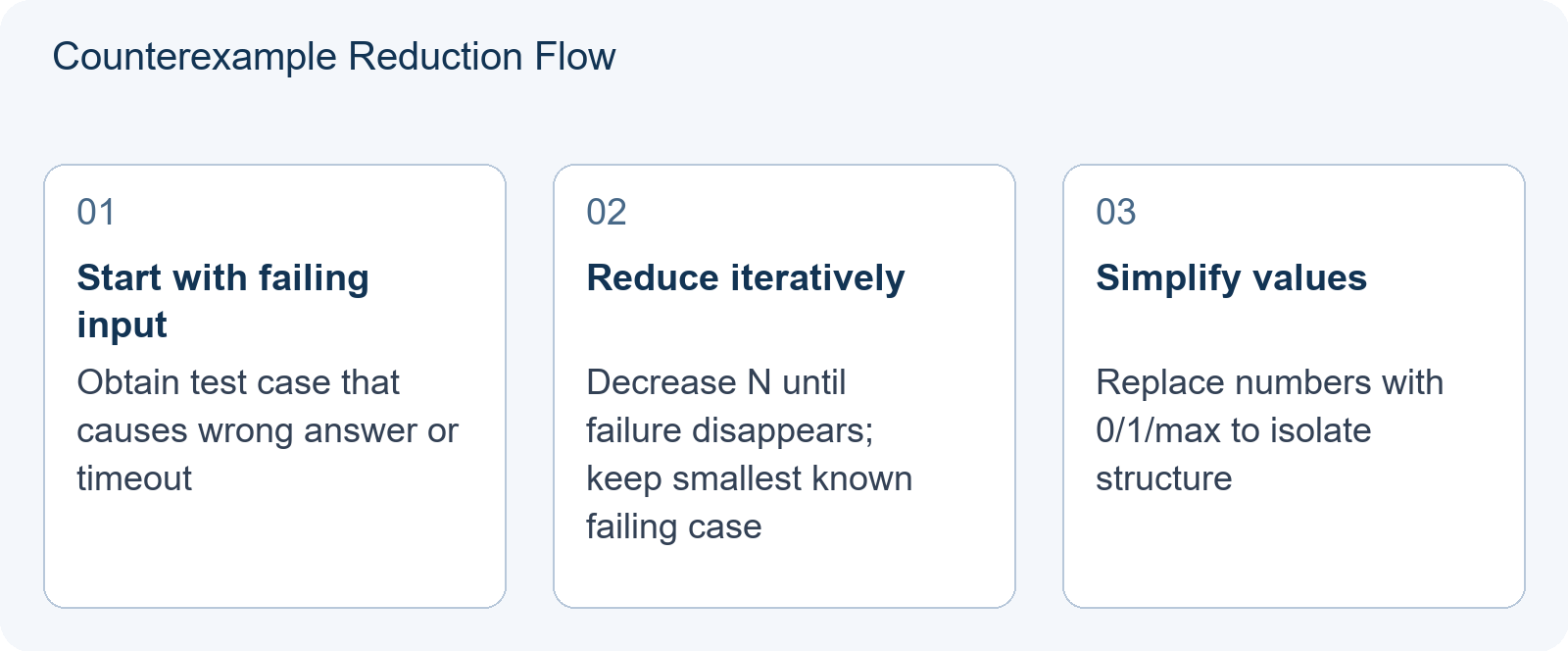
- Iteratively reduce input size: Decrease N carefully, checking at each step whether failure persists. Keep the smallest known failing version. Note: ordinary binary search is not generally valid since the reduction predicate may be nonmonotone.
- Minimize individual elements: Replace values with extremes (0, 1, max allowed) to simplify data.
- Remove irrelevant components: Delete parts of input that do not affect output.
- Verify minimality: Confirm no further reduction preserves failure. Preserve valid input constraints and compare to independently checked oracle.
For example, if processing a grid, try reducing dimensions first, then cell values. If reading strings, shorten them while preserving problematic substrings.
Practical Application: Bronze Simulation Bugs
Bronze problems often involve simulation with state variables. A common bug is forgetting to update a derived variable after modifying its source. USACO Bronze Simulation: Choosing State Variables That Prevent Hidden Bugs covers prevention; here we focus on debugging after the fact.
Teaching Illustration: Track a running sum cache that becomes stale after array updates.
Explicit Operation Sequence:
- Initialize: arr = [1, 2]. Compute and cache sum: cached = 3.
- Update: arr[0] = 4. True sum is now 4 + 2 = 6.
- Bug: Code returns cached = 3 instead of recomputing 6.
Minimal Case Analysis: Two elements suffice. The first update changes a value that contributes to the cached sum. The bug requires at least two elements so that updating one element changes the total while the stale cache remains unchanged. With one element, update and recomputation are indistinguishable if the cache is simply the element itself.
Fix Insight: Invalidate or recompute the cached sum after every mutation, or derive sums on-the-fly rather than caching. The explicit operation sequence [1,2] → cache 3 → arr[0]=4 → true 6, cached 3 makes the staleness immediately visible.
Advanced Technique: Differential Testing
When manual reduction stalls, compare outputs between your buggy code and a known-correct brute-force implementation on randomly generated small inputs.
Process:
- Write a naive O(N²) or exponential solution guaranteed correct for tiny N.
- Generate random inputs of increasing size.
- Run both solutions; stop at first discrepancy.
- That input is your counterexample—then minimize it as above.
This automates discovery of subtle bugs like incorrect sorting stability assumptions or floating-point comparison errors.
What This Means for Your Preparation
Mastering counterexample reduction transforms debugging from art to science. Students who internalize this skill spend less time guessing and more time fixing actual flaws.
For self-study: Take past USACO problems, intentionally introduce common bugs (off-by-one, forgotten updates, wrong initialization), then practice finding minimal counterexamples within 5 minutes. Time yourself.
For coaching contexts: Instructors should assign exercises where students must produce the smallest failing case for given buggy code snippets—not just identify the error, but prove it with minimal evidence. This builds rigorous thinking habits essential for Gold/Platinum levels.
USACO USACO Tutoring Feedback: What to Ask When Code Passes Samples but Fails Tests, so these techniques must be internalized beforehand. USACO Prefix Sums: Handling Inclusive Endpoints Without Off-by-One Errors provides additional practice with boundary conditions that commonly produce counterexamples. Practice makes perfect—and precise.
Interpreting the Minimal Counterexample
Finding the smallest failing case is only half the work. The critical step is translating that specific failure into a general logical correction. In our array bounds example, the minimal case was N=1, K=1. The buggy code returned negative infinity because the loop range range(0) executed zero times. This reveals the structural flaw: the upper bound of the loop excluded the final valid starting index.
Diagnostic Question: If your code fails on N=1, K=1, does it also fail on N=2, K=2? Yes. The bug is not about array size; it is about the relationship between N and K in the loop condition. The correct number of windows is always N - K + 1. When N=K, there is exactly one window. A loop bound of N-K yields zero iterations, missing the single valid case.
Concrete Practice Task: Take a different USACO Bronze-style problem involving sliding windows or fixed-length subarrays. Intentionally introduce an off-by-one error in your loop bounds (e.g., using < instead of <= or miscalculating the end index). Then, apply the reduction method: start with a large random input, shrink it until you find the smallest case where your output differs from a brute-force check. Do not just fix the code; write down the exact reason why the minimal case failed. Was it an empty loop? An out-of-bounds access? A missed final element? This habit transforms debugging from trial-and-error into precise logical deduction.
Frequently Asked Questions
How do I get failing test cases from USACO?
USACO provides feedback indicating which test groups failed but not the exact inputs. Reconstruct likely failing cases by varying parameters around boundaries mentioned in problem constraints, or use differential testing against brute force. Exact hidden test names and inputs are not available.
Is minimizing always necessary?
For correctness bugs, yes—minimal cases reveal root causes clearly. For performance issues, focus on constructing worst-case structures instead of shrinking inputs. The reduction predicate may be nonmonotone, so ordinary binary search on size is not generally valid.
Can I use this during contests?
Absolutely. These are standard debugging techniques permitted under USACO rules. Only generative AI assistance is prohibited during competition time. Syntax and library documentation remain allowed.