For students preparing for the Silver or Gold divisions of the USA Computing Olympiad (USACO), the prefix sum technique is a fundamental tool for answering range queries efficiently. However, a persistent source of lost points is not the algorithm itself, but the subtle handling of array indices—specifically, whether endpoints are inclusive or exclusive. This article addresses that narrow technical difficulty directly, distinguishing it from broader preparation advice.
The Core Difficulty: Indexing Conventions
In competitive programming, arrays are typically 0-indexed in languages like C++ and Python, while problem statements often describe ranges using 1-based indexing (e.g., “sum from index L to R”). The mismatch between these conventions creates two primary failure modes:
- Off-by-One Error: Calculating the sum as
prefix[R] - prefix[L]instead ofprefix[R] - prefix[L-1], effectively excluding the element at L. - Boundary Overflow: Accessing
prefix[-1]when L=0, causing a runtime error or undefined behavior.
Mastering this requires more than memorizing a formula; it demands understanding how the prefix array is constructed. The following sections present two teaching illustrations to demonstrate the reasoning process.
Teaching Illustration 1: The Standard Construction
This is an original teaching illustration, not an official USACO contest problem or scoring guidance.
Consider an array A = [5, 3, 8, 2]. We want to answer queries for the sum of elements from index L to R (inclusive).
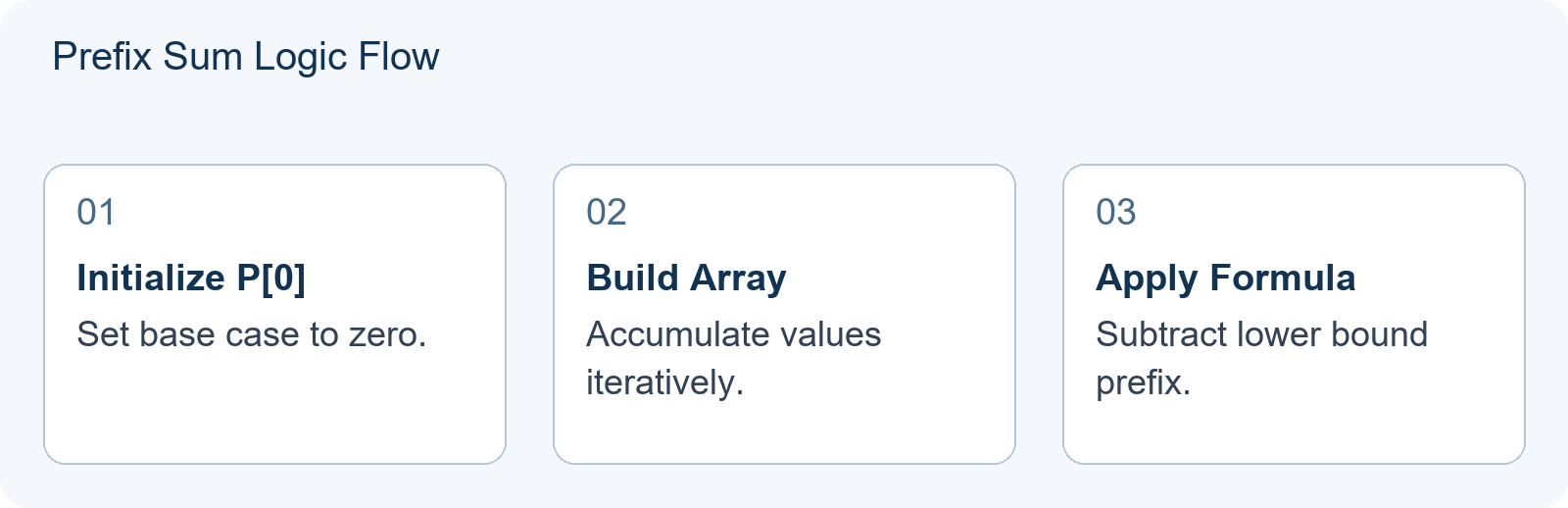
Step 1: Construct the Prefix Array
We define P[i] as the sum of elements from index 0 up to i-1. This is a common convention where P[0] = 0.
P[0] = 0
P[1] = A[0] = 5
P[2] = A[0] + A[1] = 5 + 3 = 8
P[3] = A[0] + A[1] + A[2] = 5 + 3 + 8 = 16
P[4] = A[0] + A[1] + A[2] + A[3] = 5 + 3 + 8 + 2 = 18
Step 2: Answer a Query
Suppose we need the sum from L=1 to R=2 (elements 3 and 8). The expected sum is 11.
Using the formula Sum(L, R) = P[R+1] - P[L]:
Sum(1, 2) = P[3] - P[1] = 16 - 5 = 11
This works because P[R+1] includes all elements up to index R, and subtracting P[L] removes all elements before index L. Note that if L=0, we subtract P[0]=0, which is safe.
Teaching Illustration 2: The 1-Based Convention Pitfall
This is an original teaching illustration, not an official USACO contest problem or scoring guidance.
Let’s assume the same array A but indexed 1 to 4: A[1]=5, A[2]=3, A[3]=8, A[4]=2. We construct P[i] as the sum of first i elements.
P[0] = 0
P[1] = 5
P[2] = 8
P[3] = 16
P[4] = 18
Query: Sum from L=2 to R=3 (elements 3 and 8). Expected sum: 11.
Correct Formula: Sum(L, R) = P[R] - P[L-1]
Sum(2, 3) = P[3] - P[1] = 16 - 5 = 11
The Common Mistake: Students often write P[R] - P[L]. Here, that would be 16 - 8 = 8, which incorrectly excludes the element at L=2. Conversely, if they forget to initialize P[0]=0 and try to access P[-1] for L=1, the program crashes.
Diagnostic Table: Identifying Your Convention
To avoid confusion during a timed contest, explicitly state your indexing convention in comments. Use this table to verify your implementation against your chosen method.
| Convention | Prefix Definition | Range Sum Formula (L to R) | Edge Case Check |
|---|---|---|---|
| 0-based, Exclusive Upper Bound | P[i] = sum(A[0..i-1]) |
P[R+1] - P[L] |
Ensure P[0]=0; no negative indices. |
| 1-based, Inclusive Both Ends | P[i] = sum(A[1..i]) |
P[R] - P[L-1] |
Ensure P[0]=0; handle L=1 carefully. |
| 0-based, Inclusive Both Ends | P[i] = sum(A[0..i]) |
P[R] - (L>0 ? P[L-1] : 0) |
Requires conditional check for L=0. |
The third row is generally discouraged in contests due to the extra branch condition, which can slow down execution and increase bug risk. Stick to the first two conventions.
Targeted Practice Sequence
Do not just read about prefix sums; implement them under pressure. Follow this sequence:
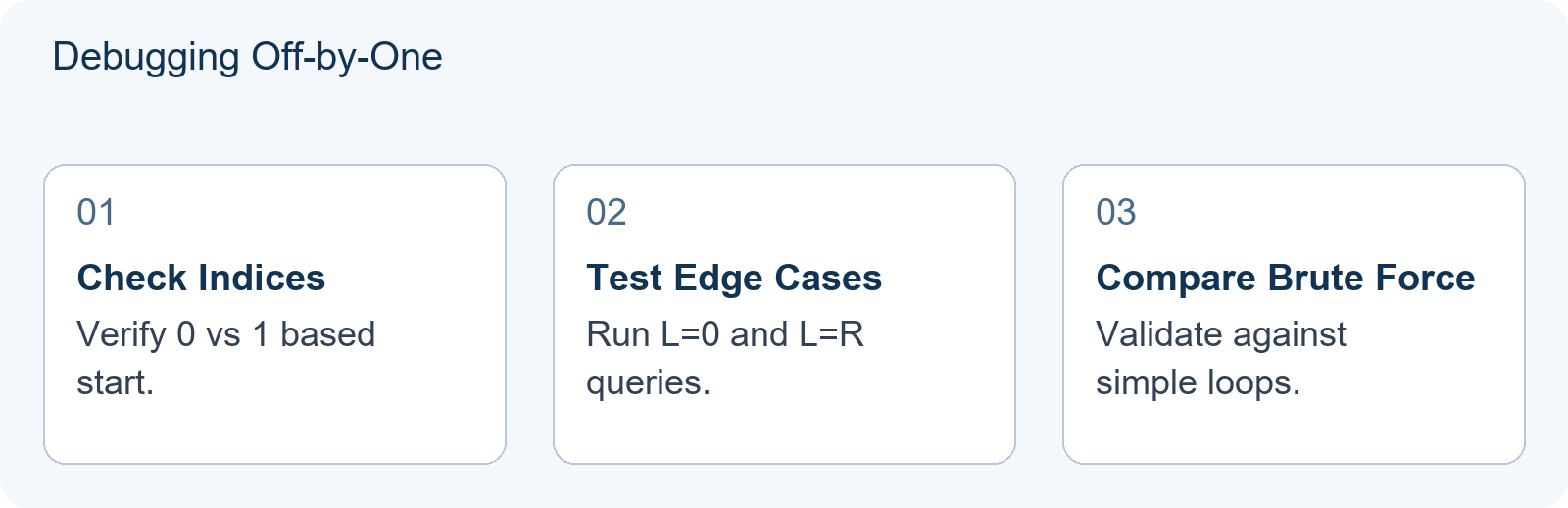
- Manual Trace: Take a small array (size 5) and manually calculate prefix sums for three different ranges. Verify against brute-force summation.
- Code Implementation: Write a function that takes an array and a list of queries. Implement both the 0-based exclusive and 1-based inclusive versions. Test with edge cases: L=R, L=0 (or 1), R=N-1 (or N).
- Contest Simulation: Find past USACO Silver problems involving range queries. For guidance on building test cases when your code passes samples but fails hidden tests, see USACO Tutoring Feedback: What to Ask When Code Passes Samples but Fails Tests. Focus on setting up the prefix array correctly within the time limit.
- Error Injection: Deliberately introduce an off-by-one error in your code. Run tests until you see the failure. Then fix it. This builds pattern recognition for debugging.
Demonstrable Skill for Next Steps
After practicing, you should be able to demonstrate the following skill: Given any range query problem, you can instantly choose a consistent indexing convention, write the prefix construction loop, and derive the correct subtraction formula without hesitation. You should also be able to explain why P[R] - P[L] is wrong for inclusive ranges in most standard implementations.
For students struggling to progress from Bronze to Silver, our article on USACO Coaching for Bronze Students: Why Practice May Not Be Producing Progress examines common plateaus in early training. For first-time competitors preparing account setup, see USACO Registration: A First-Time Account and Practice-Submission Checklist.
Frequently Asked Questions
Why do I get Runtime Errors when L=0?
You likely tried to access P[-1]. Ensure your prefix array has a dummy element at index 0 representing the empty sum, so you never subtract a non-existent index.
Is it better to use 0-based or 1-based indexing?
Consistency matters more than choice. 0-based is native to C++/Python vectors. 1-based matches many problem statements. Pick one convention and stick to it throughout the contest to avoid mental switching costs.
Does this apply to 2D prefix sums?
Yes, the principle is identical. You must carefully manage the boundaries of the sub-rectangle. The inclusion-exclusion principle applies, but the off-by-one risks remain at each dimension’s edges.