It is one of the most frustrating experiences in competitive programming: you write code, run it against the provided sample inputs, see the correct output, submit it—and then watch your score drop because several hidden test groups failed. For students seeking USACO tutoring, this scenario often leads to confusion. Is the bug in the logic? Is it an efficiency issue? Or did I miss a constraint?
Effective coaching isn’t just about fixing the code; it’s about teaching you how to diagnose why it broke. Here is a guide on what to ask your tutor when your solution passes samples but fails official tests.
1. Clarify the Failure Type
Not all failures are equal. Before asking for a fix, ask your tutor to help you interpret the error message from the grader. Did you get a “Runtime Error,” “Time Limit Exceeded” (TLE), or simply “Wrong Answer” (WA)?
- Runtime Error: Often indicates array out-of-bounds, division by zero, or stack overflow. Ask: “Which input size triggered the crash?”
- TLE: Your algorithm is too slow. Ask: “What is the Big-O complexity of my solution versus the expected one?”
- WA: Logic flaw. Ask: “Can we generate a minimal counter-example where my logic diverges from the correct answer?”
2. Request Edge Case Generation
Samples are rarely comprehensive. A key part of quality USACO tutoring is learning to think adversarially. Ask your tutor to demonstrate how to create custom test cases that target boundary conditions.
| Test Category | Why It Matters | Example Question for Tutor |
|---|---|---|
| Minimum Input | Catches empty arrays or N=1 errors. | “Does my loop handle N=0 or N=1 correctly?” |
| Maximum Input | Tests memory limits and integer overflow. | “Will `int` overflow if values sum to >2 billion?” |
| Extreme Values | Checks sorting stability or comparison logic. | “What happens if all elements are identical?” |
3. Verify Environment Consistency
A common pitfall is coding in an IDE that behaves differently from the USACO grader. For instance, some compilers optimize differently, or default stack sizes vary. If your local tests pass but the grader fails, ask your tutor: “Are there any compiler-specific flags or environment differences between my local setup and the USACO platform?” This aligns with best practices for setting up your coding environment.
4. Analyze Time Complexity Together
If you receive TLE, don’t just accept a faster code snippet. Ask your tutor to walk through the complexity analysis. Why was O(N^2) acceptable for Bronze but not Silver? Understanding the constraints helps you choose the right data structures. You can further explore this concept in our article on identifying problem shapes.
5. Review Academic Integrity Rules
Remember that USACO strictly prohibits the use of generative AI tools like Copilot or ChatGPT during the actual contest. However, using them for *learning* outside the contest window is different. Ensure your tutoring sessions focus on understanding logic, not just copying solutions. As noted in official guidelines, cheating results in permanent bans. Use external resources wisely, such as practicing with verified problem sets, to build genuine skill.
Conclusion
When your code fails hidden tests, view it as a diagnostic puzzle rather than a defeat. By asking targeted questions about error types, edge cases, and environment consistency, you transform a simple correction into a deep learning opportunity. Effective USACO tutoring empowers you to debug independently, preparing you for the high-pressure reality of the contest window.
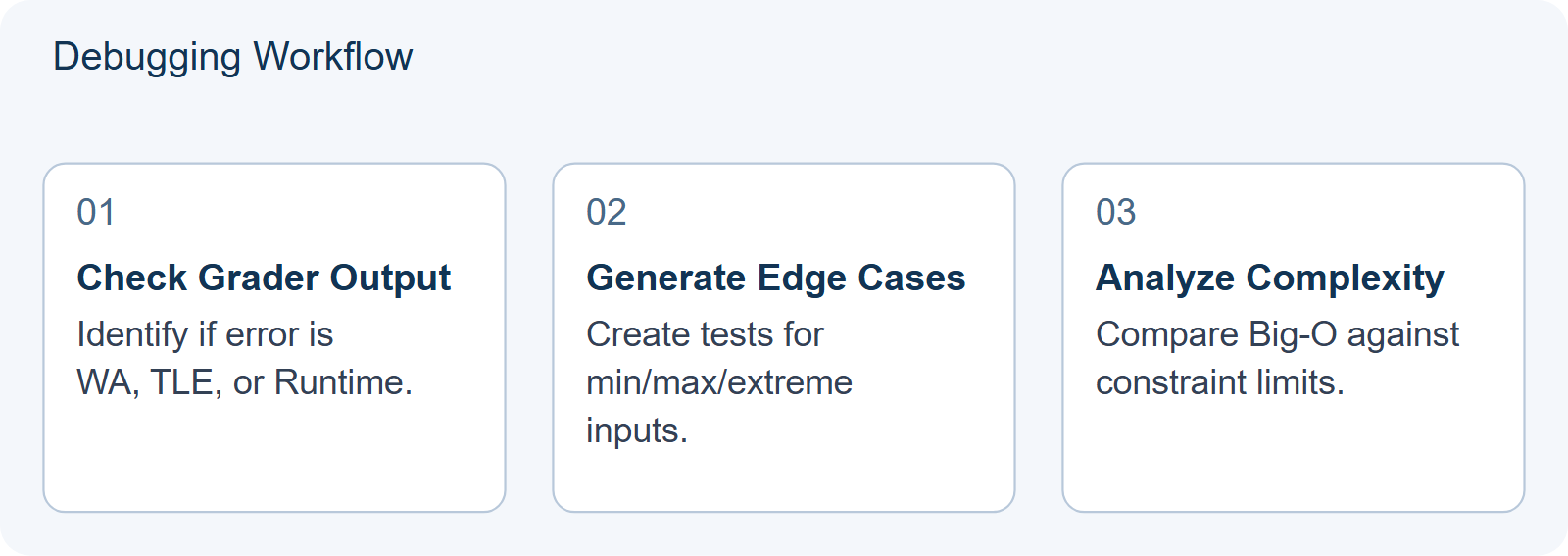
HYPOTHETICAL/ILLUSTRATIVE: The “Greedy Trap” Diagnostic Workflow
To move beyond abstract advice, consider a specific, illustrative scenario involving a Bronze-level problem where the task is to maximize the number of items collected within a weight limit. A student submits a solution that passes all provided sample inputs but fails on hidden test groups with a “Wrong Answer” (WA) verdict. This example demonstrates how to apply the diagnostic questions from the previous sections to a concrete preparation choice.
The student’s initial approach was greedy: sort items by value-to-weight ratio and pick them until capacity is full. Locally, this worked for the samples because the item values were distinct and proportional. However, the hidden tests likely included cases where integer division or rounding errors in the ratio calculation caused the greedy algorithm to skip an optimal combination of lower-ratio items that summed to a higher total value. Instead of immediately asking the tutor for a dynamic programming rewrite, the student should first engage in a structured diagnosis.
First, the student asks the critical question regarding failure type: “Is this WA due to logic divergence or precision error?” By comparing their code against a brute-force solver for small N (e.g., N=10), they can identify if the discrepancy occurs only when ratios are close. If the brute force yields a different answer, it confirms a logic flaw rather than an environment issue. Next, the student requests edge case generation specifically targeting the greedy assumption. They ask the tutor to construct a test case where two items have nearly identical ratios but one has a slightly higher absolute value that fits better into the remaining capacity. This reveals that sorting by floating-point ratios introduces instability.
This process highlights a key decision point in tutoring sessions: do you fix the bug or fix the mindset? A less effective practice would be to simply accept the tutor’s corrected code. A more substantial practice involves the student writing a custom test generator that creates random instances with tight constraints, then running both their original greedy code and the correct solution against these generated tests. This transforms passive learning into active verification.
| Preparation Choice | Action Taken | Outcome for Skill Development |
|---|---|---|
| Passive Fix | Tutor provides DP code; student copies it. | Solves immediate problem but leaves conceptual gap regarding why greedy failed. |
| Active Diagnosis | Student generates adversarial test cases proving greedy failure. | Builds intuition for identifying when greedy algorithms break, applicable to future problems. |
The reusable self-check for any WA submission is: “Can I create a minimal input where my algorithm makes a locally optimal choice that leads to a globally suboptimal result?” If the student cannot answer this, they have not fully diagnosed the issue. This method ensures that the tutoring session addresses the root cause—algorithmic selection criteria—rather than just the symptom. It prepares the student to recognize similar patterns in Silver or Gold divisions, where constraints often invalidate simple heuristics. By focusing on generating counter-examples rather than seeking quick fixes, students develop the resilience needed for high-stakes contest environments where hidden tests are designed to catch exactly these types of logical oversights.
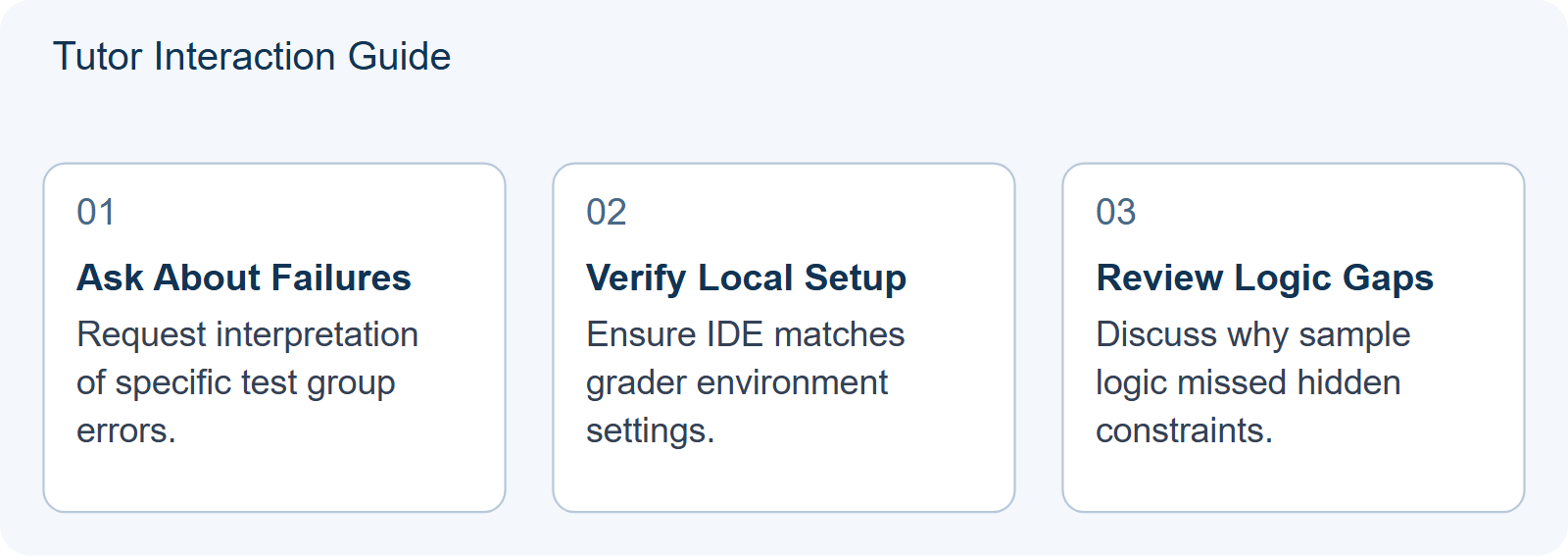
Frequently Asked Questions
Why does my code pass samples but fail USACO tests?
Samples are illustrative, not exhaustive. Hidden tests check edge cases (N=0, max values), performance limits (TLE), and specific logical branches not covered by examples.
Can I use AI tools to debug my USACO code?
During the actual contest, no. USACO prohibits generative AI. Outside the contest, you may use tools for learning, but ensure your tutor teaches you to understand the logic, not just copy fixes.
What should I prepare before a tutoring session?
Bring your code, the exact error messages from the grader, and any custom test cases you tried. This allows the tutor to diagnose issues efficiently rather than starting from scratch.