No single site prepares you for USACO. Rated rounds train speed and nerve, topic ladders fill named gaps, Chinese-language archives remove the friction of a second language, and only past USACO problems rehearse the actual format — a self-chosen four-to-five-hour block, roughly three problems, 1,000 points. The skill is allocating hours between them, not picking a winner.
First decide what a practice hour is for
Most students choose a practice site the way they choose a textbook: they ask which one is best, adopt it, and use it for everything. That is the wrong shape of question, because the four things you need to build fail in different ways and are trained by different sources.
Before comparing platforms, name the four capacities a USACO contestant needs:
- Fluency — getting a straightforward idea into working code without fighting your own syntax. Built by volume of easy problems.
- Coverage — knowing the techniques your division expects. Built by deliberate topic-by-topic study.
- Pressure tolerance — thinking clearly with a clock running and a scoreboard moving. Built only by timed contests you actually care about.
- Format familiarity — knowing how a USACO round feels: the long block, the small problem count, the partial-credit scoring, the English statements. Built only by USACO material.
Once those are separate in your head, the platform question answers itself. You are not looking for the best site. You are looking for the cheapest source of each capacity, and then a weekly structure that touches all four.
The four kinds of source, compared honestly
Details on every external platform below — contest schedules, difficulty labelling, available languages, whether English statements are provided — change over time and should be confirmed on that platform's own site. What follows is a structural comparison of what each type of source trains, which is more stable than any specific feature.
| Source | What it trains best | Where it misleads a USACO contestant | Best used for |
|---|---|---|---|
| Rated online contest sites (e.g. Codeforces) | Pressure tolerance, reading speed, fast implementation, willingness to submit imperfect work | Round format is short and problem-dense; scoring rewards speed in a way USACO does not. A rating here is not a division there. | Weekly timed exposure; building nerve |
| Graded beginner ladders (e.g. AtCoder beginner contests and their archive) | Fluency, gradual difficulty progression, clean problem statements | Very gentle early problems can flatter you; the ramp is smoother than a USACO division boundary | Bronze-level fluency; recovering confidence after a hard season |
| Large Chinese-language archives (e.g. Luogu) | Volume, topic tagging, community solutions in your first language | Removes the English reading you must do on contest day; solution write-ups make giving up too easy | Learning a new technique quickly; drilling a named topic |
| Interview-style practice sites (e.g. LeetCode) | Basic data-structure fluency and clean coding habits | Optimised for interviews, not olympiad problems; problem style, constraints and grading all differ | Marginal — useful only for early fluency, not for division progression |
| Past USACO problems | Format familiarity, partial credit instincts, English statement reading, honest calibration against your division | Nothing, structurally — but the supply is finite, so spending it carelessly is a real cost | Calibration and full-length rehearsal; the core of any serious plan |
Two things in that table deserve expansion.
The Chinese-language archive trade-off is real and cuts both ways. For a student in China, a domestic archive is fast to reach, searchable in your first language, and full of community explanations. That makes it the most efficient place to learn a technique. It is also the reason some students arrive at their first contest having never practised the reading half of the task — and USACO statements are in English, on a long timer, with no translation assumed. Use the archive to learn; do not let it become the only place you practise.
Past USACO problems are a finite resource. There is a limited supply of authentic material in the exact format, and every problem you burn casually is one you cannot later use as a clean mock. Treat them as calibration instruments rather than as everyday volume. We keep past problems organised by division on our past contests page; the discipline of upsolving them properly rather than skimming solutions is where their value actually sits.
A rating on another site is not a division here
This is worth its own section because it causes more misjudged planning than anything else in this topic.
Every external platform has its own difficulty scale — ratings, colours, star levels, contest divisions with names that unhelpfully echo USACO's own. None of these are calibrated to USACO. Promotion in USACO happens exactly one way: you clear a per-contest cutoff in a real contest. Recent cutoffs have tended to sit somewhere in the region of 650–750 out of 1,000, but they move contest by contest and are set by USACO — our cutoff history page shows the spread, and usaco.org is the authority.
So resist two temptations. The first is treating an external rating as a division equivalent and concluding you are “really” a Gold contestant. The second is the reverse: concluding from a mediocre rating elsewhere that you are not ready to enter. USACO is free and open to enter, registration is on usaco.org, and the fastest way to find out where you sit is to sit a contest.
Where cross-platform difficulty judgement is useful is in choosing practice problems — you want problems that are hard enough to make you think and easy enough that you finish some. For that, a rough personal heuristic is fine. Ours, used purely for selecting practice and explicitly not an official mapping of any kind: pick problems where you succeed unaided roughly half the time. If you are solving nearly everything, move up; if you are solving almost nothing, move down. That rule needs no external scale at all.
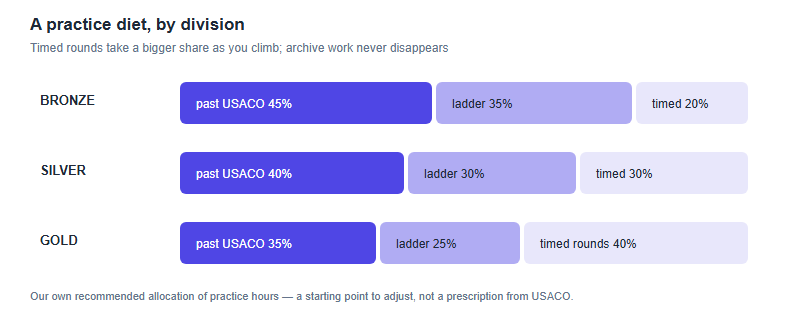
Building the week: one primary, one secondary, one archive
A practice week that touches all four capacities without becoming a second full-time job has three sources and one notebook. More sources than that produces the familiar pattern of accounts on six sites and consistent progress on none.
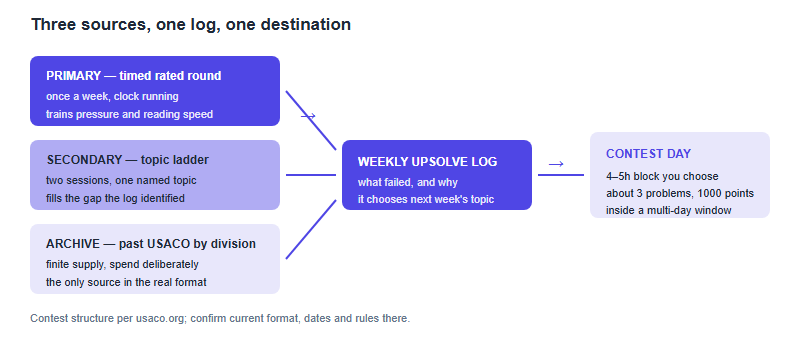
Concretely, a workable in-season week looks like this:
- One timed round. Whatever rated contest fits your school timetable. Treat it as a rehearsal for thinking under pressure, not as a rating exercise. Then upsolve the first problem you failed.
- Two topic sessions. One named technique, chosen by last week's log rather than by mood. This is where a Chinese-language archive earns its place: fastest route from “I have never seen this” to “I can implement it”.
- One archive session. A past USACO problem at your division, read in English, attempted without help for a fixed struggle budget. This is your calibration instrument — it tells you whether the other two sessions are working.
- Occasionally, one full mock. A four-to-five-hour block with about three problems, scored honestly. Expensive in time and in archive material, so once a month at most outside the season, more often as contest windows approach.
Three failure modes to watch for. Solution-reading drift: on any platform with abundant community write-ups, the temptation to read the answer at the first hard moment is enormous, and it produces students who recognise techniques but cannot deploy them. Rating chasing: optimising an external number that does not appear anywhere in USACO promotion. Comfort practice: doing problems you can already solve, on the platform where you feel best, which feels productive and moves nothing.
One final calibration point. USACO runs a small number of contests each season — three online rounds plus the US Open, with the dates set and published by USACO — so the number of real promotion opportunities per year is genuinely limited. That scarcity is the argument for structured weekly practice rather than intense bursts: the contests arrive when they arrive, and you sit them in whatever condition the preceding months left you in. Topic references by division are collected on our resources page, and registration and current contest information stay on usaco.org.
Frequently asked questions
Is Codeforces good preparation for USACO?
Yes, for pressure tolerance and implementation speed. Its round format and scoring differ from USACO, so pair it with past USACO problems for format familiarity.
Does a Codeforces rating tell me my USACO division?
No. Promotion happens only by clearing a per-contest cutoff in a real USACO contest. External ratings are not calibrated to USACO divisions.
Can I prepare using Chinese-language sites only?
You can learn techniques that way efficiently, but statements on contest day are in English. Practise reading English statements before the season.
Is LeetCode useful for USACO?
Only marginally. It builds basic coding fluency, but its interview-oriented problem style and constraints differ from olympiad contest problems.
This is an independent guide operated by Hanlin Education for China-based international-school students. It is not affiliated with, endorsed by, or sponsored by USACO (the USA Computing Olympiad), nor with any external practice platform mentioned. Contest format, promotion cutoffs, rules and dates are set by USACO and may change — always confirm current details on usaco.org, where registration and participation take place. Any factual error brought to our attention is corrected within 7 working days.