Contest 2 of the 2025–26 USACO season has wrapped up. Another online round is complete, and students who cleared their division’s promotion cutoff move up for the contests ahead.
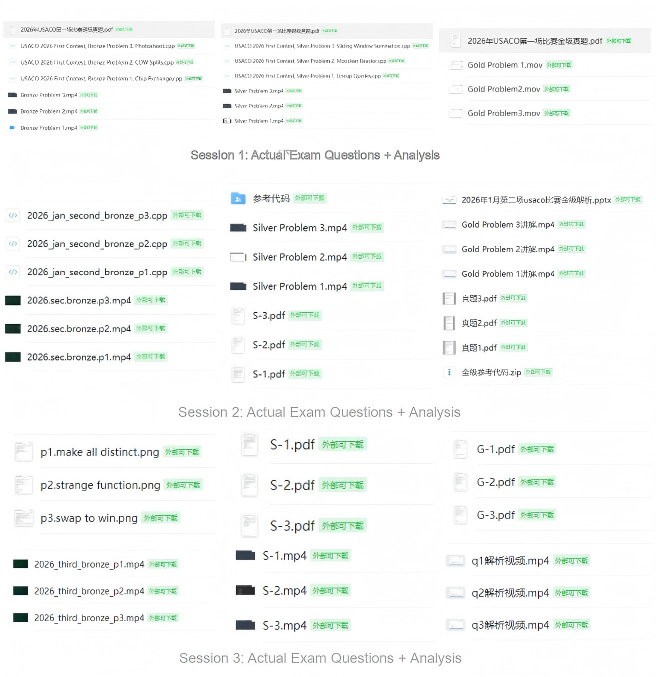
The full set of problems, solutions, and video walkthroughs is now available. Hanlin Computer Science instructors Mr. Luo, Mr. Wei, and Mr. Jiang put together a post-contest analysis right after the round, breaking down the key ideas in the Gold, Silver, and Bronze divisions. Below is a detailed look at what each division tested.
USACO Contest 2 Analysis
Bronze Division
Promotion Cutoff
Promotion cutoffs are set per contest and are not fixed in advance. In recent seasons the Bronze cutoff has usually fallen in roughly the 650–750 range; in 2024–25 it was 700 in every contest. The official Contest 2 cutoff had not been published when this analysis was written, so any figure before the official release is an estimate. Based on the difficulty of this round, a similar range looks likely.
Difficulty Overview
This Bronze round was a step up from Contest 1. A perfect score was hard to reach, especially on Problem 2: the input sizes were large enough that a naive brute-force search would time out, and without a bitwise optimization full marks were difficult. That said, reaching the promotion cutoff was still well within reach for most students.
Key Topics and Problem Insights
Problem 1: Simulation
A reverse-simulation problem. The final output depends on the key originally pressed and on how many ‘O’s appear after that position.
- If the number of ‘O’s after a position is even, the character stays the same.
- If it is odd, the character flips.
Simulating forward is inefficient, so it is best to process the string from back to front.
Problem 2: Optimized Search
At first glance this looks like a brute-force search over 2^20 possibilities, but with up to 2×10^5 queries, plain brute force is too slow.
The key is to avoid recomputing the same work. Because each position has only two states, a bitmask representation fits naturally; choosing 3 positions out of 20 cuts the search to 20×19×18 = 6,840 combinations.
Grouping valid configurations and aggregating their scores brings a further speed-up.
Problem 3: Greedy and Preprocessing
This problem builds on binary decomposition: any integer can be written as a sum of powers of two.
We precompute the minimum cost for each unit size, then weigh two options:
- combining smaller units, or
- over-buying a larger unit when that works out cheaper.
The target is to reach at least x units, so the final answer compares an exact-purchase strategy against an over-purchase one.
Bronze Summary
Bronze this round leaned on simulation, optimized search, and greedy strategies. Bitwise operations and binary techniques are worth prioritizing in future preparation.
Silver Division
Promotion Cutoff
As in Bronze, the Silver cutoff varies from contest to contest. Recent monthly contests have generally fallen in the 650–750 range; in 2024–25 the Silver cutoff was 700. The official Contest 2 figure was not out at the time of writing, and a similar range looks likely based on this round.
Difficulty Overview
This round was a little harder than Contest 1. It leaned less on textbook algorithms and more on logical reasoning and the flexible use of data structures, which made both promotion and a perfect score tougher to achieve.
Key Topics and Problem Insights
Problem 1: Greedy Construction
The task is to construct a valid sequence under given constraints, with a flavor similar to finding a Hamiltonian cycle.
The main conditions to satisfy:
- equal counts of specific transitions,
- parity constraints,
- state switching using paired patterns.
Problem 2: Simulation with a Priority Queue
This one echoes the well-known USACO “Cereal” problem. Because the queries involve suffixes, processing from back to front works best.
A priority queue tracks the candidates and supports efficient replacement operations.
Problem 3: Two Pointers, Sweep Line, and Priority Queue
A circular-interval problem that calls for traversal in both directions.
Using a sweep-line approach, you:
- define the key transition events,
- maintain two priority queues,
- use lazy deletion to keep it efficient.
Silver Summary
Silver rewarded logical reasoning, greedy construction, and comfortable use of data structures. Students should work on generalizing their problem-solving approach and shoring up core algorithms.
Gold Division
Promotion Cutoff
Gold cutoffs also vary per contest. In 2024–25 the Gold cutoff was 700 in the monthly contests, with the US Open going higher. This was a demanding round, so the official Contest 2 cutoff — not yet released when this was written — could sit in that range or a little above. Treat any figure before the official release as an estimate.
Difficulty Overview
This was a demanding round that rewarded strong mathematical insight and a solid grasp of graph structures.
Key Topics and Problem Insights
Problem 1: Binary Search and Mathematics
The outer layer is a binary search; the inner logic involves analyzing convex functions and locating the optimal point through changes in slope.
Problem 2: BFS and Greedy
This problem pairs breadth-first search with greedy choices to keep the state optimal as it evolves.
Problem 3: Functional Graph
A tougher graph-theory problem built around cycles and tree-like structures.
Gold Summary
Gold called for advanced mathematical modeling, graph theory, and strong abstraction. The emphasis continues to shift toward deeper reasoning rather than straightforward implementation.
Final Thoughts
Taken together, Contest 2 of the 2025–26 season points to a clear emphasis on problem-solving depth, logical reasoning, and mathematical abstraction.
Students preparing for the contests ahead should focus on:
- bitwise optimization techniques,
- data-structure efficiency,
- graph-theory fundamentals,
- pattern recognition and modeling.
Hanlin Computer Science provides structured training, detailed solutions, and instructor guidance for students working toward USACO.
The full Contest 2 problem set, solutions, and video walkthroughs are available on request. Scan the WeChat code below to get them from Hanlin Computer Science.