The third contest of the 2025-26 USACO season (February 20-23, 2026) has now finished, and the full results of the second contest are available as well.
In the second contest, Hanlin students earned promotions into the Silver, Gold, and Platinum divisions. More results are still being confirmed.
For Round 3, Hanlin instructors Jiang and Wei have put together detailed breakdowns of the Bronze, Silver, and Gold problem sets, walking through the key ideas and approaches for each problem. Their analysis follows.
After each contest, our instructors prepare a set of video explanations and suggested solutions for every problem, to help students review and prepare for future contests. Students and parents who would like these materials can scan the QR code below to request them at no charge.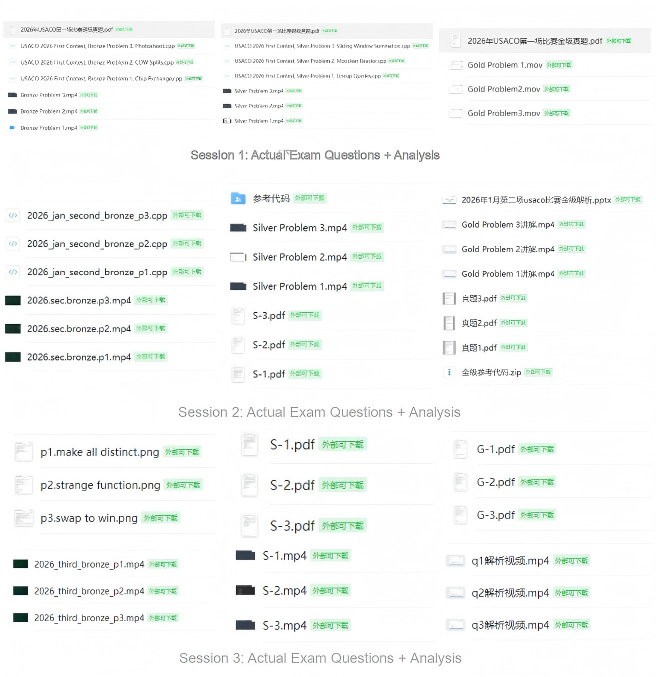
Scan the QR code in WeChat to request the free materials.

Bronze Division Analysis
Score Trends
The official promotion cutoff for Round 3 has not been announced yet. In recent seasons, monthly-contest cutoffs have usually landed in the 650-750 range, and given this round’s difficulty we would expect it to fall within that band.
Difficulty Overview
This Bronze round was a little easier than the first two contests of the season. Problems 1 and 3 used fairly standard approaches, while Problem 2 required more careful observation and pattern recognition. Recent Bronze problems have increasingly leaned on binary-based thinking. Based on past cutoffs, most participants should find a promotion score achievable.
Key Problem Insights
Problem 1: Greedy and Sorting.
This problem involves modular arithmetic. By grouping numbers according to their remainder modulo K, we can see that only numbers sharing the same remainder can become equal after repeatedly adding K. Within each group, we sort the quotients and apply a greedy strategy so that they form a strictly increasing sequence with the fewest operations. Whenever a conflict occurs, incrementing by exactly one step keeps the result optimal.
Problem 2: Ad Hoc Pattern Discovery.
This problem asks for the minimum number of operations to reduce a large number x to zero under specific rules. Direct simulation is infeasible because of the size of the constraint (x can be on the order of 10^(2×10^5)). The key insight is to transform the number into a binary-like structure, after which the total number of operations simplifies to a formula: total operations = val + floor(val / 2). This turns a complex iterative process into a straightforward calculation. The challenge is recognizing the pattern through small-scale simulations.
Problem 3: Greedy and Simulation.
This is a string-transformation problem with two types of swaps: within a single string and between two strings. The solution scans the string from left to right, always choosing the lowest-cost operation available. Each position can be fixed in at most two operations, which makes the greedy approach both efficient and optimal.
Summary
The Bronze division tested a mix of mathematical reasoning, greedy strategies, and simulation. Problem 2 in particular shows the value of spotting hidden patterns rather than relying on standard templates.
Scan the QR code in WeChat to request the free materials.
Silver Division Analysis
Score Trends
As with Bronze, the official cutoff has not been released. Recent monthly contests have generally fallen in the 650-750 range, which is a reasonable expectation here.
Difficulty Overview
The difficulty was similar to the second contest. Fewer classic algorithms were needed, but the problems called for strong logical reasoning and flexible use of data structures. Full scores were a little harder to reach than in the previous round.
Key Problem Insights
Problem 1: Greedy, Simulation, and Data Structures.
This problem combines several techniques, including priority queues, ordinary queues, prefix sums, and binary search. The main challenge is avoiding timeouts by detecting cycles in the simulation. Once a repeating pattern is found, the simulation can be split into two phases — entering the cycle and processing within it — and prefix sums plus binary search are then used to compute the results efficiently.
Problem 2: Math and Segment Tree.
This problem models water flowing across buckets with periodic flipping behavior. By deriving recurrence relations for each bucket’s flip time and start time, we can compute the total water flow mathematically. Because of the dynamic updates, a segment tree is needed for efficient recalculation. Full implementation is involved, but partial solutions can still earn significant points.
Problem 3: Greedy and Parity Constraints.
This problem is about constructing valid pairings under parity constraints. By segmenting the values and analyzing their odd-even properties, we can determine the feasible matching ranges. The final step combines results from two dimensions, checking both range coverage and parity consistency.
Summary
Silver problems continued to emphasize pattern recognition, greedy construction, and logical reasoning over heavy algorithmic implementation. Preparation should cover these areas alongside the core algorithms.
Scan the QR code in WeChat to request the free materials.
Gold Division Analysis
Score Trends
The cutoff has not been announced. Recent contests have typically fallen in the 650-750 range; because this round was on the harder side, the cutoff may sit toward the lower end.
Difficulty Overview
This round was notably challenging, with an emphasis on mathematically driven algorithm design. Problems 2 and 3 in particular required deep reasoning and abstraction.
Key Problem Insights
Problem 1: Fenwick Tree, Greedy, and Rotation.
This problem analyzes a permutation under cyclic shifts. A Binary Indexed Tree (Fenwick tree) efficiently computes inversion-related metrics. The key idea is to convert the effect of a dynamic rotation into static contribution changes using difference arrays, then find the optimal shift with a greedy scan.
Problem 2: Shortest Path and Logical Inference.
A demanding graph problem involving reachability constraints and logical validation. The solution builds distance structures with BFS or Dijkstra and applies reverse reasoning to determine which states are valid. It requires careful control over graph traversal and condition handling.
Problem 3: Tree Combinatorics and Modular Arithmetic.
This problem combines tree structures with combinatorics. By precomputing factorials and modular inverses and analyzing subtree sizes, the solution derives a counting formula for the valid configurations. It calls for solid mathematical intuition and familiarity with tree-based dynamic programming.
Summary
The Gold division tested a broad range of advanced skills:
- Problem 1 focused on data-structure optimization.
- Problem 2 emphasized complex graph modeling and logical reasoning.
- Problem 3 required a solid grasp of combinatorics and tree algorithms.
Overall, the contest reflected a shift toward testing mathematical abstraction and problem modeling rather than implementation alone.
Analysis and video explanations by Hanlin Computer Science instructors.
The analysis and video walkthroughs above were prepared by Instructor Wei and Instructor Jiang of Hanlin Computer Science.
Instructor Wei
Hanlin Computer Science instructor.
- Master’s degree in Software Engineering, Tsinghua University
- Bachelor’s degree in Software Engineering, Nanjing University
Instructor Wei is patient and attentive with students. He is good at breaking complex concepts down into simple steps and adapting to each student’s needs, adjusting the pace in real time and focusing on the priorities that make the best use of limited time.
Teaching Experience
- Coaches one-on-one students across the Silver, Gold, and Platinum divisions
- Has helped middle-school students reach the Gold division
- Across recent seasons, has guided many students to Silver and Gold promotions, and some to Platinum
- Works with students on both USACO and international olympiad preparation
Instructor Jiang
Hanlin Computer Science instructor.
- East China Normal University
- Combined bachelor’s and master’s program in Computer Science
Instructor Jiang combines ACM and USACO problems with industry-standard coding practices. His teaching includes:
- A dynamic system that identifies each student’s weak points and adjusts the training plan in real time
- A structured approach to algorithmic thinking
- Competition-psychology preparation tailored to the IOI and USACO formats
Teaching Experience
- Has guided students, including middle-school students, up to the Gold division
- Uses a step-by-step method for breaking down algorithmic problems, helping students move from Bronze toward Gold
How Hanlin Supports USACO Preparation
Hanlin has years of experience with USACO training.
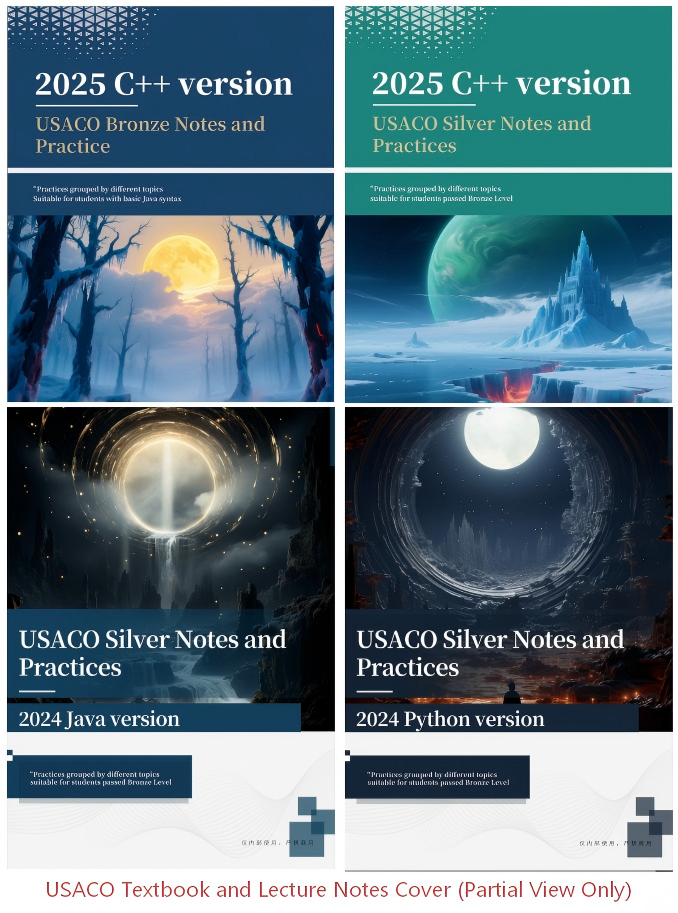
The curriculum is developed and regularly updated by Hanlin’s academic team. It supports C++, Python, and Java, and organizes past USACO problems by topic, pairing each concept with worked examples and exercises that build from basic to advanced levels.
Past contest problems are also sorted into five difficulty tiers, so students can build their problem-solving skills step by step.
USACO Course Offerings
Alongside one-on-one coaching, Hanlin offers several small-group classes:
Pre-USACO Foundation Course
- Class size: 3-8 students
- Total hours: 30
- Start date: March 7
USACO Bronze Full Course
- Class size: 3-8 students
- Total hours: 40
- Start date: March 2
USACO Silver Full Course
- Class size: 3-8 students
- Total hours: 50
- Start date: March 7
USACO Gold Full Course
- Class size: 3-8 students
- Total hours: 60
- Start date: March 7
Students who enroll in Hanlin’s USACO courses receive the full set of course materials at no extra charge.
Contact us to learn more or reserve a place.