The first contest of the 2025–26 USACO season (January 9–12, 2026) has concluded, and attention now turns to Contest 2. What topics appeared, and how hard was this round? This article breaks down the Bronze, Silver, and Gold divisions.
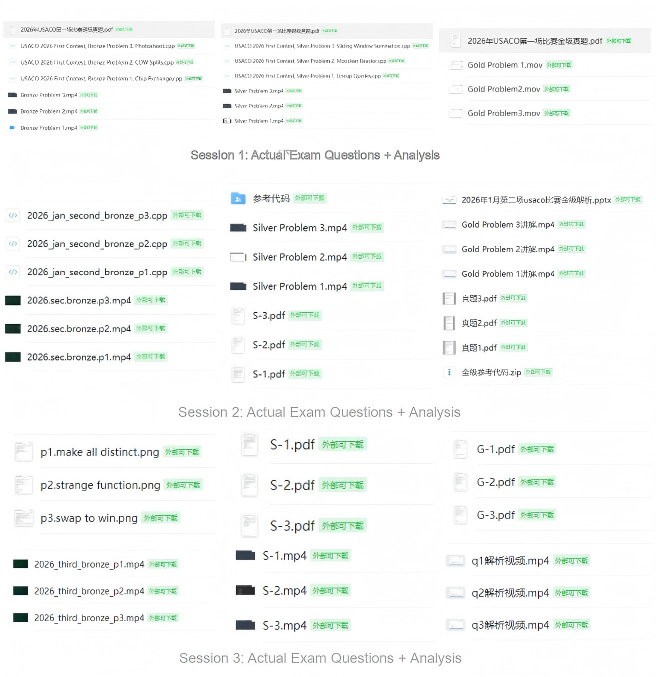
Hanlin Computer Science instructors Mr. Wei and Mr. Luo put together a post-contest analysis of the Bronze, Silver, and Gold problems. Free problem sets, video explanations, and reference solutions are available — scan the WeChat QR code below to request them.
Scan the WeChat QR code below to request the free problem sets, solutions, and video explanations.

Contest 1 Analysis by Division
Below is a division-by-division look at how difficult Contest 1 was, the topics it tested, and problem-by-problem notes from our instructors.
Bronze Division
Score Cutoff Trends
The official promotion cutoff for Contest 1 has not yet been announced. For reference, the Bronze cutoff was 700 in every contest of the 2024–25 season, and recent monthly cutoffs have mostly fallen between 650 and 750.
Difficulty Overview
This Bronze round was comparable in difficulty to previous contests. A perfect score was hard to reach — Problem 2 in particular — but partial solutions were enough to clear the likely promotion cutoff.
Key Topics and Problem Insights
Problem 1: Ad hoc (case analysis). This problem calls for working through several cases based on the relationships between the variables. A common pitfall is missing that one value can grow up to a point without triggering an extra operation, so careful case analysis matters.
Problem 2: Greedy. This was the hardest problem in the Bronze set, and many students were misled by the sample patterns. Simple grouping earns partial credit, but a full solution requires seeing that two operations suffice under the right conditions once the string is restructured.
Problem 3: Complete search. A more approachable problem. Rather than recomputing everything, you only need to account for local changes: enumerate the squares that include the current position and update incrementally for an efficient solution.
Bronze Summary
The Bronze set covered a balanced mix of topics with an emphasis on logical reasoning. Simulation did not appear this round and may show up in a later contest.
Silver Division
Score Cutoff Trends
The official cutoff has not yet been announced. In the 2024–25 season the Silver cutoff was 700 for the monthly contests and 750 for the US Open; recent monthly cutoffs have mostly fallen between 650 and 750.
Difficulty Overview
Full marks were hard to reach this round. Reaching the promotion range took both strong reasoning and solid algorithmic skills.
Key Topics and Problem Insights
Problem 1: Ad hoc and simulation. Writing out the steps makes the pattern visible. Instead of simulating every step, you can use the differences in time and position to bring the complexity down to O(log T). Some queries also require working backwards.
Problem 2: Graph, coordinate compression, difference array, and prefix sums. A problem that combines several techniques. The early cases suggest a chain structure that reduces to interval-overlap questions, while a full solution has to handle cycles, including the difference between odd and even cycles. The implementation adapts standard templates such as graph coloring, coordinate compression, and prefix sums.
Problem 3: Greedy (constructive). The sequence splits into k independent chains. Each chain is handled on its own, but a global constraint still has to hold; XOR-style operations keep the implementation simple.
Silver Summary
The Silver problems blended reasoning with algorithmic technique. A good habit is to analyze the simple cases first and then extend to the harder ones. Core topics such as binary search and trees may appear in future contests.
Gold Division
Score Cutoff Trends
The official cutoff has not yet been announced. In the 2024–25 season the Gold cutoff was 700 for the monthly contests and 850 for the US Open; recent monthly cutoffs have mostly fallen between 650 and 750.
Difficulty Overview
This Gold round was a little easier than in some past years, though full marks were still hard to reach. Problem 2 was the most challenging, but a partial O(N²) solution could still earn enough points to promote.
Key Topics and Problem Insights
Problem 1: Disjoint Set Union (DSU). A standard DSU problem with small modifications. The structure tracks how many items of each category fall in a set and supports resetting parent pointers when needed.
Problem 2: Greedy with a Binary Indexed Tree (BIT). The key is to reason about weighted sums: smaller values should be merged earlier to limit their impact. Rather than simulating directly, working backwards lets you compute the answer efficiently, using a BIT to track swaps and updates.
Problem 3: BIT or segment tree with dynamic programming. A classic data-structure problem. Inserting elements in reverse and counting valid combinations lets dynamic programming produce the final result efficiently.
Gold Summary
In Gold, identifying the right algorithm was fairly direct except for Problem 2, which needed deeper reasoning. Combining greedy strategies with advanced data structures remains a recurring theme.
Final Thoughts
Contest 1 of the 2025–26 season underscores how much both logical reasoning and algorithmic fundamentals matter. Students preparing for the next rounds should focus on:
- Strengthening problem-analysis skills
- Mastering core data structures such as Binary Indexed Trees and segment trees
- Practicing greedy strategies and optimization techniques
- Learning to spot patterns from the sample cases
Contest 2 runs from January 30 to February 2, 2026. Contest 3 follows on February 20–23, and the season’s proctored US Open is on March 28. Give yourself time to prepare and make full use of the practice resources.
Scan the WeChat QR code below to request the free problem sets, solutions, and video explanations.