If your family is aiming for a USACO Gold or Platinum result that counts as certified, the contest is no longer just a four-hour task you fit into a busy weekend. A Chinese-language USACO briefing published on October 19, 2026 by Hanlin’s course team reports a fixed-start requirement for US students seeking certification in those divisions. The briefing states that such students must begin at 12:00 PM US Eastern Time on Saturday, when that division’s problems are first released. It also says Gold and Platinum have added certified start windows, and that violations void scores. Those claims change the planning problem. They do not replace the official rules on usaco.org, so this article treats the briefing as an attributed operator report and explains how to plan around the reported fixed start without assuming more than the report says.
What the operator report means by a certified result
In the briefing’s terms, a certified result is tied to the fixed start, not merely to submitting within the open contest period. That distinction matters because USACO has long been described as an online, individual contest in which students submit code through the official site. The briefing lists a 4-5 hour contest duration for recent seasons. The briefing does not define every non-certified case, but it clearly ties certification to the synchronized start.
The report does not spell out every downstream use of a certified score. It does not say that certification guarantees college admission, scholarship consideration, or national-team selection. Treat certification as a contest-status label, not as a promise about admissions. The practical question is narrower: if a fixed start is required, how should a student prepare so that the first minute of the contest is spent reading the problem, not troubleshooting a laptop or waking up.
The reported fixed start: Saturday 12:00 PM Eastern Time
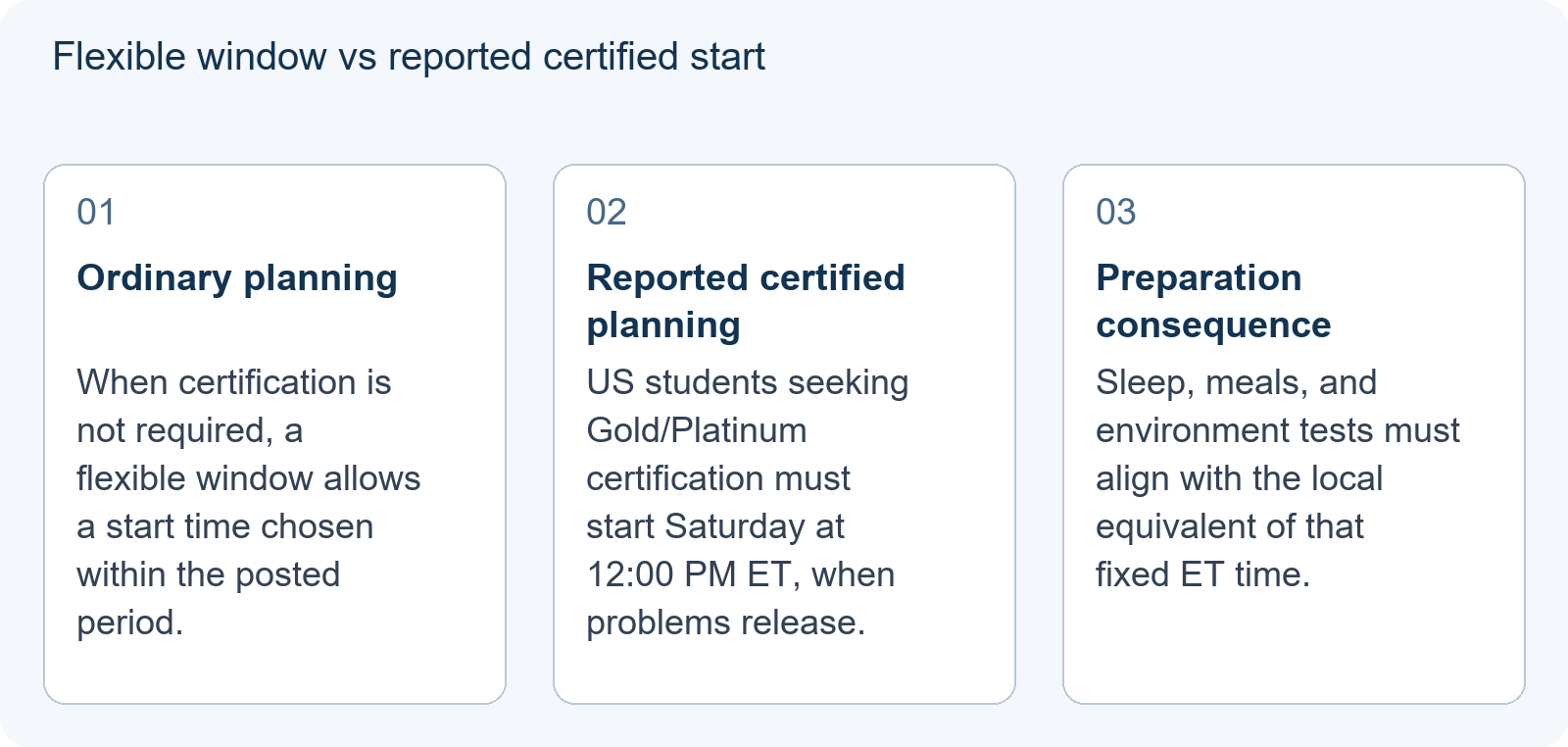
The briefing’s key sentence is specific: US students who want a certified result in Platinum or Gold must start on Saturday at 12:00 PM Eastern Time, and the division’s problems are released for the first time at that moment. The briefing places this note against the round schedule and describes it as a per-round certification condition. In other words, the certification requirement is not something you discover halfway through the contest; it controls when you may begin.
This is a different kind of deadline from submit by the end of the window. A submission deadline can be met by starting early. A fixed start cannot be met by starting early or late. If the reported rule applies to your division and your certification goal, then 12:00 PM ET is not a suggestion, a recommended time, or a target. It is the reported start of the certified attempt. The briefing adds that violations void scores, so a family should plan as if the start is hard.
Why flexible windows and certified starts are different planning problems
If a contest window is flexible, it lets a student optimize for personal energy. A night owl can start after dinner; a morning person can begin early. A certified start removes that choice. The planning problem becomes: how do we make this student ready to reason about algorithms at exactly the reported hour? That question affects sleep, meals, schoolwork, practice schedule, and technical setup.
It also changes the cost of a technical failure. In a flexible window, a laptop crash at one hour can sometimes be absorbed by restarting later, subject to the contest rules. At a fixed certified start, a crash at 12:05 PM ET directly threatens the attempt. There may be no equivalent restart within the same certified conditions. The briefing does not describe a make-up policy, so the safe assumption is that the start must be protected.
Existing guides on this site already cover general contest-day logistics, including Contest Day from China: Planning Your USACO Window, Time Zones and Submission Mechanics. This article is different because the reader problem is not general time-zone awareness. It is the decision to pursue a certified Gold or Platinum attempt under a reported synchronized start. Families who are still deciding whether to enter a given round at all should compare the broader window-choice questions in USACO and Your Exam Year: How to Choose Which of the Four Contest Windows You Actually Enter.
Converting the reported ET start time for other zones
Eastern Time is not one fixed offset all year. During Eastern Standard Time, ET is UTC-5. During Eastern Daylight Time, ET is UTC-4. The official reference is always the ET clock in the rule, not a local clock. Before you plan a study schedule, convert the reported 12:00 PM ET into your local time for the exact contest date.
The table below is a planning illustration, not an official converter. It shows the two standard offset cases. Verify daylight-saving transitions in your own location because the USACO season can cross a DST boundary.
| Location | If ET is EST (UTC-5) | If ET is EDT (UTC-4) |
|---|---|---|
| New York | 12:00 PM | 12:00 PM |
| Chicago | 11:00 AM | 11:00 AM |
| Los Angeles | 9:00 AM | 9:00 AM |
| London | 5:00 PM GMT | 5:00 PM BST |
| Beijing | 1:00 AM next day | 12:00 AM next day |
| Berlin | 6:00 PM CET | 6:00 PM CEST |
Check the arithmetic carefully. If ET is UTC-5, 12:00 PM ET equals 17:00 UTC. Beijing is UTC+8, so 17:00 UTC becomes 1:00 AM the next day. If ET is UTC-4, 12:00 PM ET equals 16:00 UTC, which becomes 12:00 AM the next day in Beijing. California is three hours behind ET in both cases shown, so the local start is 9:00 AM. London is five hours ahead of ET’s UTC offset but shifts between GMT and BST, which keeps the local clock at 5:00 PM in the two standard cases shown.
Planning around school, exams, and sleep
A fixed Saturday start can collide with Friday exams, travel, or a week of poor sleep. The report’s fixed start means you cannot compensate by starting later. If a student has a major school assessment on Friday, the family should treat Friday night as part of contest preparation. The goal is not only to finish homework but to protect sleep before the certified start.
For a 12:00 PM ET start, local start times can range from breakfast to late evening depending on location. A student in California starts at 9:00 AM local time under both offset cases shown above. A student in Beijing starts at midnight or 1:00 AM the next day. Those are very different human situations. A Beijing student pursuing the reported US-certified window would need a sleep plan that treats the contest as an overnight event. A California student needs an early-morning routine. A London student starts at 5:00 PM and must manage end-of-day fatigue.
Do not simply move the contest to a convenient local hour if the reported certified rule requires the ET start. If you are not seeking certification, different planning may apply, but the briefing’s certification claim is specifically about US students in Gold and Platinum. Check the official site before making assumptions about your own case.
Technical setup and backup plan
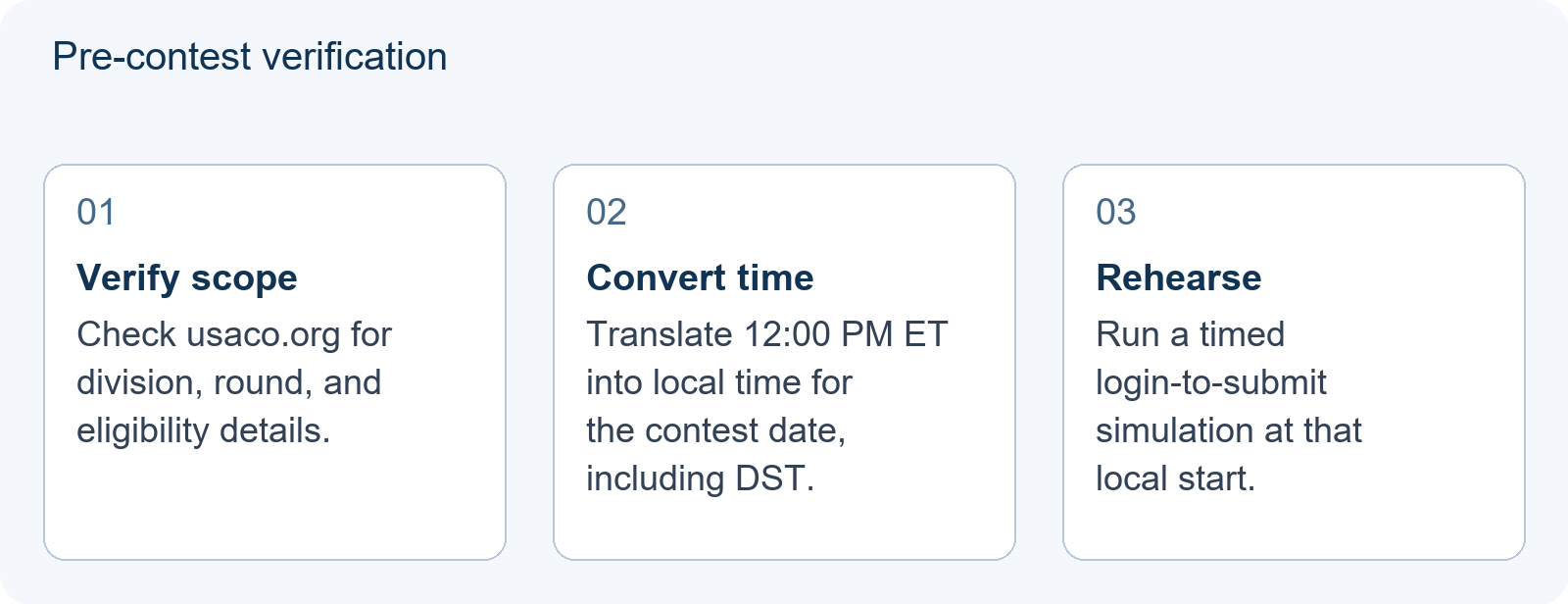
The fixed start raises the value of a pre-contest environment check. Before the season, confirm that your USACO account works, that you can log in, and that your preferred language environment compiles locally. Then run at least one timed simulation that starts at the exact local time of the reported ET start. The simulation should include logging in, reading a problem, writing a solution, and submitting a practice file or sample solution through the same workflow you will use on contest day.
Prepare a backup device and a backup network path. If your primary laptop fails, do you have another machine with the same compiler and editor setup? If home internet drops, can you use a phone hotspot or a nearby reliable connection? The point is not to predict the failure; it is to reduce the number of decisions you must make at 12:00 PM ET. On contest day, a prepared student should know where the login page is, which language template is ready, and how to contact the organizers if the official platform itself fails.
Integrity and the certified score
The same October 19, 2026 briefing notes that the new USACO season explicitly prohibits ChatGPT, Claude, Copilot, and other generative AI assistance. The briefing also reports that Gold and Platinum have a certified start window and that violations void scores. Whether or not you agree with those rules, they define the value of the result. A certified score is supposed to represent unaided problem solving under controlled conditions. If a student uses prohibited tools, the score may be voided, and the planning work is wasted.
Families should therefore separate two questions. First, can the student solve the problem without prohibited assistance? Second, can the student demonstrate that under a fixed start? The first is a training question. The second is a logistics and integrity question. This article focuses on the second because the reported certification rule makes it newly important.
What to verify on usaco.org before the first contest
An operator report is useful, but it is not the official rulebook. Before you build a calendar around the Saturday 12:00 PM ET start, verify the following on usaco.org:
- Does the current season require a certified start for Gold and Platinum?
- Does the requirement apply to US students only, or does it also affect international participants in some way?
- Does it apply to every Gold/Platinum round or only selected rounds?
- What exactly counts as a violation, and what is the stated consequence?
- How is the official start time expressed, and does the site mention daylight-saving adjustments?
- What is the current academic-integrity policy on AI tools?
If the official site is silent or ambiguous, contact the organizers through official channels. Do not rely on a screenshot, a social-media post, or a course provider’s summary for a rule that can void a score. The briefing is a signal to check, not a substitute for checking.
Practical checklist for a certified Gold/Platinum Saturday
- Confirm your target. Decide whether you are seeking a certified result or entering for practice. The planning burden differs.
- Check the division rule. Verify that the reported Gold/Platinum certification condition applies to your division in the current season.
- Convert the start time. Turn 12:00 PM ET into your local time for the exact contest date, including DST.
- Protect sleep. Work backward from the local start time to set bedtime, wake-up, and meals.
- Test the environment. Run a full login-to-submit simulation at the exact local start time.
- Prepare backups. Have a second device, second network option, and offline copy of your templates.
- Review integrity rules. Remove prohibited AI tools and resources from the workspace.
- Verify official rules. Re-read the current usaco.org instructions in the week before the contest.
For students aiming at Platinum, the algorithmic demands are already high. The site’s existing discussion of Gold to Platinum: What USACO Platinum Actually Demands, and How to Decide Whether to Chase It is a useful complement to this planning guide, because no amount of scheduling can replace the ability to solve the problems. The certified start simply removes an excuse for being unprepared at the moment the problems appear.
The safest interpretation of the October 2026 briefing is this: if you are a US student targeting a certified Gold or Platinum result, plan for a Saturday 12:00 PM ET start until the official site tells you otherwise. Convert the time carefully, train at that hour, protect the environment, and verify the rule before you rely on it. That is how a fixed certified window becomes a controllable plan instead of a surprise.
Frequently Asked Questions
Does the reported Saturday start apply to Bronze and Silver?
The October 2026 briefing mentions certified results for Gold and Platinum. It does not state the Bronze or Silver rule, so check usaco.org rather than assuming.
Can international students use the certified window?
The briefing frames the certification requirement as applying to US students. It does not say how certification works for other students, so international families should verify their own eligibility and schedule officially.
What happens if a student misses 12:00 PM ET?
The briefing says violations void scores, but it does not provide a late-start scoring policy. Treat the reported start as a hard requirement and confirm the current official rule before contest day.