Platinum is not simply Gold with bigger inputs. At Gold, the problem usually tells you which algorithm it wants and the work is implementing it correctly. At Platinum, choosing the model is the problem, and the intended complexity often sits close enough to the time limit that a correct-but-heavy solution still drops test groups. That shift — not raw difficulty — is what most Gold students underestimate.
What USACO itself says the divisions are
Start with the official framing rather than folklore. USACO has long framed its four divisions roughly this way: Bronze for students who have recently learned to program, Silver for students beginning fundamental problem-solving techniques such as recursive search and greedy algorithms, Gold for students meeting more advanced standard algorithms such as shortest paths and dynamic programming, and Platinum for advanced students seeking sophisticated problems — confirm the current wording on usaco.org.
Read those two last descriptions next to each other. Gold gets a list of named algorithms. Platinum gets an adjective. That is not sloppiness on USACO’s part — it is an accurate description of the difference. Gold has a syllabus you can finish. Platinum has a standard you have to meet, and the specific tools vary contest to contest.
Our own division guide expands the Platinum toolkit as segment trees and other structured data structures, advanced dynamic programming, and modelling — the step of turning a story into a structure you can attack. The first two are learnable in a summer. The third is the one that takes seasons.
The four capability shifts between Gold and Platinum
The table below is our coaching team’s breakdown of what changes, based on preparing students through both divisions. It is our framing, not a USACO classification — USACO publishes the division descriptions quoted above, not a topic list.
| Dimension | Gold | Platinum | Why the jump hurts |
|---|---|---|---|
| Where the difficulty lives | Recognising the named algorithm, then implementing it | Reducing the story to a structure at all; the algorithm is often standard once you see it | Recognition can be drilled from past problems. Reduction cannot be drilled the same way — it is built from a wider base. |
| Data structures | Used off the shelf: a set, a priority queue, a DSU | Designed: you decide what a segment-tree node stores and how two nodes merge | You stop looking up a structure and start specifying one. A wrong merge function fails silently on large groups only. |
| Constant factor | Usually irrelevant if the complexity class is right | Frequently decisive; intended solutions can sit near the limit | An asymptotically correct solution can still lose groups. See the language note below. |
| What a brute force buys you | A meaningful share of groups on many problems | Typically a thinner share — the gap between naive and intended is wider | The safety net you leaned on at Silver and Gold gets smaller. Partial credit still exists; it just pays less. |
The fourth row deserves a caveat, because it is a coaching observation rather than a published rule. Partial credit is genuinely the norm across all divisions: a problem is graded across multiple test groups and you bank a share of the problem’s points for each group you pass, and usaco.org states plainly that it is not guaranteed every legal dataset is perfectly solvable within the time limit. What we observe with our own students is that the distance between a naive approach and the intended one tends to be wider at Platinum, so the same fall-back tactic returns less. Treat that as our experience, not as a scoring rule.
The time-limit tax, and where language choice finally bites
This is the most under-discussed mechanical fact at the top division. usaco.org states that for most contests the limit is 2 seconds per input case for C and C++ and 4 seconds per input case for Java and Python — while explicitly noting that each contest or problem may use slightly different limits. So Java and Python do get double the wall clock.
The catch is that double the clock does not cancel out the interpreter and runtime overhead, and at Platinum the intended solution is often engineered to fit a tight budget rather than to sit comfortably inside one. At Bronze, where an accepted solution may run in a fraction of the limit, language choice is close to a free decision. At Platinum, a heavy constant factor on top of a correct algorithm is a live way to lose groups on the largest tests while passing every small one — which is exactly the failure that looks like success until the scoreboard arrives.
None of this makes Python a wrong choice; plenty of students reach Gold on it comfortably. It does mean that if you are planning a multi-season run at Platinum, the season to move languages is the off-season before you need the speed, not the week you first meet a problem that demands it.
How narrow the top actually is
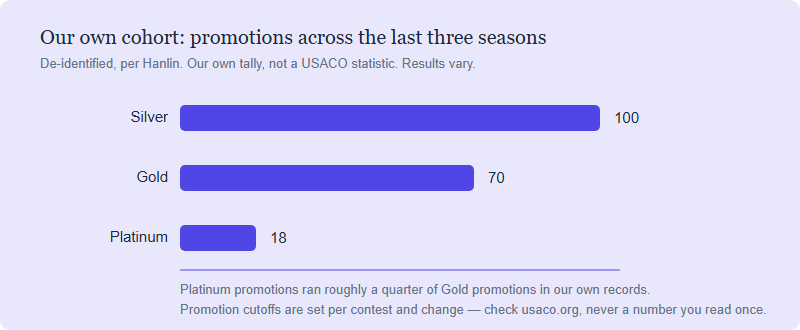
Across our last three seasons we recorded 18 Platinum, 70 Gold and 100 Silver promotions. Those are our own numbers for our own students, de-identified, and they are not a USACO statistic — but the shape is the useful part. Roughly one Platinum promotion for every four at Gold is not a sign that Platinum students are four times rarer in talent. It reflects that Gold is where a well-prepared student converts a season of focused work, and Platinum is where students arrive after several.
One number we will not print is a cutoff. Promotion works by clearing a threshold set for that specific contest, and those thresholds move between contests and between seasons. Anyone quoting you a fixed number to aim at is quoting history. Our cutoff reference page tracks what has happened previously; the live figure for the contest in front of you is on usaco.org.
Three honest tests before you commit a season to it
Chasing Platinum is a real allocation of a year. Before you make it, run these three checks. They are deliberately uncomfortable.
- The unaided test. When you attempt a Gold problem you have never seen, inside a timed four-hour block, do you finish it — or do you finish it after opening the editorial? Solving-after-reading is a legitimate learning activity, but it is not evidence you are ready for the division above. If most of your Gold successes are post-editorial, your next season belongs to Gold consolidation.
- The seasons-remaining test. Count the contest seasons you have left before applications close. For most students who reach it, Platinum is a multi-season project rather than a one-season sprint. If you have one season left and you are mid-Gold, a strong, clean Gold record with real depth elsewhere is usually the better use of the year.
- The opportunity-cost test. Platinum preparation is time-hungry in a way Gold is not, because the productive activity is thinking hard about few problems rather than covering many. Be explicit about what that year displaces — a research project, a language switch, your actual coursework — and decide with the trade-off visible rather than discovering it in February.
To be plain about something we will not claim: no division result causes a university offer, and we do not present Platinum as an admissions instrument. Chase it because the problems are the most interesting thing USACO offers, or do not chase it. That is a sound reason on its own.
If you do go: what the ladder looks like
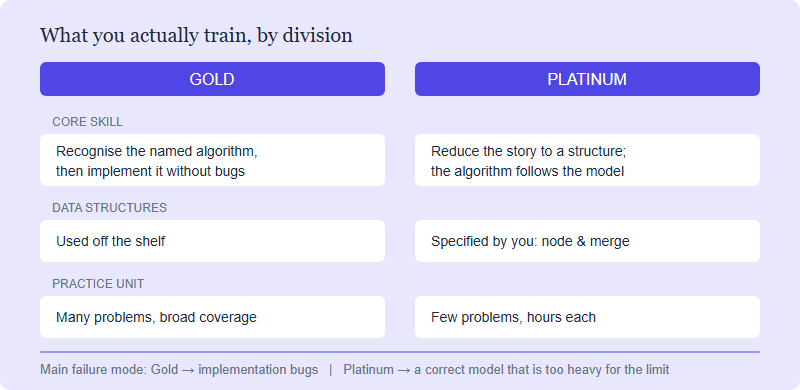
The practical consequence is that a Platinum block looks wrong if you measure it the way you measured Gold. A productive Platinum week might be four problems, two of them unsolved, with a page of notes on why the model you tried could not be made fast. A productive Gold week might be fifteen problems. If you carry the Gold metric into Platinum you will conclude you are failing while you are in fact working correctly.
Where to get material: work from full past contests rather than curated topic sets, because the recognition-free environment is the point — you need problems that do not announce their own category. Our past-contest pack is the set our teachers have gathered and organised for this, with worked solutions for some of the years rather than all of them; the exact papers and write-ups follow what your teacher sends.
Frequently asked questions
Q: How long does Gold to Platinum usually take?
There is no standard figure and we will not invent one. In our own tally Platinum promotions ran about a quarter of Gold.
Q: Do I need C++ for Platinum?
No, all four listed languages are accepted. But a heavy constant factor can cost test groups even when your algorithm is right.
Q: Is there still partial credit at Platinum?
Yes. Problems are graded across test groups and you bank points per group passed. Naive fall-backs simply tend to return less.
Q: What score do I need to be promoted to Platinum?
Thresholds are set per contest and move between seasons. Check usaco.org for the contest you are entering, not a number you read once.
Independent guide operated by Hanlin Education for China-based international-school students. Not affiliated with, endorsed by, or sponsored by USACO (the USA Computing Olympiad), the IOI or EGOI. Registration, contest rules, dates and promotion cutoffs live on usaco.org — confirm current details there before planning around anything on this page. Errors reported to our editorial desk are corrected within 7 working days.