You do not need to read a line of code to tell whether a USACO season is going well. Promotions are checkable against published cutoffs and the student’s own usaco.org account, scores are itemised rather than pass-or-fail, and the contest itself is free and taken at home. That makes almost every meaningful signal visible to a parent — provided you know which four to look at, and which three look like progress but are not.
Five facts that change how you read your child’s results
Most parental worry about USACO comes from applying school-exam intuitions to a competition that does not work like a school exam. Five structural facts do most of the reframing.
- It is free and taken online at home. There is no entry fee and no exam centre to book. Whatever a USACO season costs your family, it is coaching and time — not registration. Registration itself is done on usaco.org.
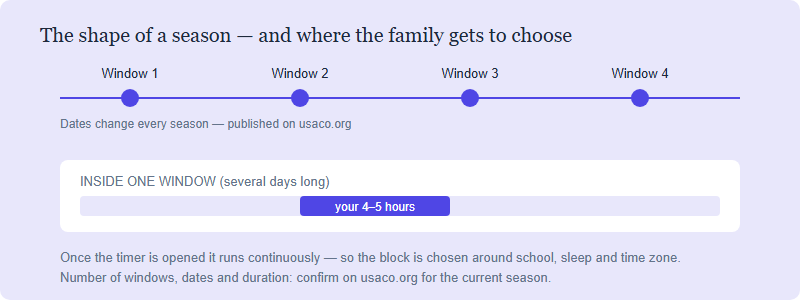
- There are several contest windows in a season, rather than one high-stakes sitting. A weak result in one window is not the end of the year. Exact dates change every season and are published on usaco.org.
- Your child chooses when to start. usaco.org states that contests are typically four to five contiguous hours in length and that a participant may take the contest during any block of time they want within the larger contest window. For a family in China, that flexibility is the single most useful feature of the format.
- Scoring is partial, not binary. Each problem is graded across multiple test groups and points accrue for each group passed. A solution that handles the smaller cases correctly still scores.
- Everyone starts at the bottom. All participants begin in the Bronze division, and those who score well enough in a contest are promoted upward. Nobody is placed by reputation or by prior coursework.
Why “he only got 300 out of 1000” is not a failure
This is the conversation we have most often with parents, and it is worth being concrete about. Because each problem is broken into test groups and credit accrues group by group, a partial score is the normal outcome, not the exception. usaco.org is explicit that it is not guaranteed that every legal dataset is perfectly solvable within the time limit — some tasks are set expecting near-optimal answers with partial credit.
So a mid-range score usually means your child solved the smaller cases of several problems correctly and could not scale one or more of them to the largest inputs. That is a specific, fixable, entirely ordinary position for a developing competitor. It is nothing like a 30% on a maths paper.
The number worth watching is not the total but its composition over time. A student who passed 3 of 12 groups in one window and 9 of 12 on comparable problems in the next has improved substantially, even if both scores would look mediocre on a school report.
Four signals that are real, and three that are not
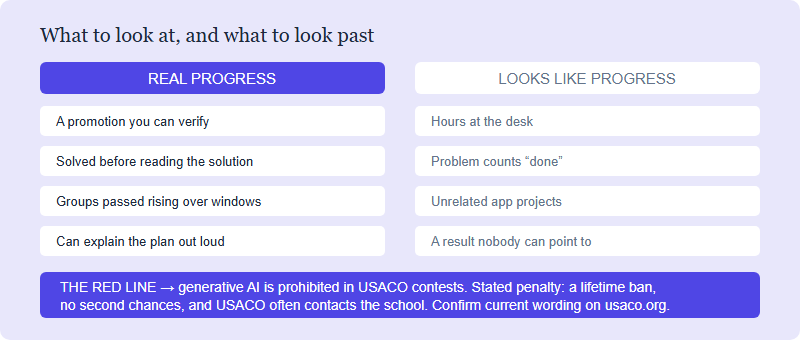
Here is the practical core of this guide. Each real signal below is either published by USACO or observable at home without technical knowledge.
| Signal | Real or noise | How a non-programmer checks it |
|---|---|---|
| Division promotion | Real — the strongest single signal | Promotions follow from published contest results. Ask which contest and which division, then verify rather than accept a summary. |
| Solving unseen problems inside a timed block | Real | Ask: “did you finish it before or after you looked at the solution?” Post-solution success is study, not yet ability. |
| Rising group counts on comparable problems | Real | Ask for groups passed out of groups available, window by window. The trend matters more than the totals. |
| Explaining the approach before coding it | Real | Ask your child to explain the plan in plain language. Fluent explanation of the method is hard to fake and precedes reliable solving. |
| Hours logged, or “problems done” counts | Noise | Reading an editorial and re-typing the solution counts as one “problem done” and teaches far less than one genuine attempt. |
| A large portfolio of unrelated coding projects | Noise for this purpose | App-building and contest algorithms are different skills. Projects may be valuable; they are not USACO progress. |
| A tutor’s claim of a result you cannot locate | Noise until verified | Contest results are published. A promotion that cannot be pointed to should be queried politely and promptly. |
The one rule you must enforce at home
Everything above is about optimisation. This section is about risk, and it is the reason we would ask a parent to read this article even if they skipped the rest.
USACO requires that contest work be the student’s own and prohibits the use of generative AI — naming services such as Copilot and ChatGPT — during its contests. The penalty is not a warning or a zero. USACO’s stated policy is that participants who violate its rules are banned for life from all USACO activities, with no second chances, and USACO notes that it often follows up on cheating by contacting a student’s teachers or school principal, and that expulsions have resulted from this in the past.
Read that last clause again, because it is the part that concerns a family rather than a competitor: the consequence can travel from the competition to the school. For a student at an international school, that is a materially worse outcome than any competition result is worth.
Two things make this a parent’s job rather than only a coach’s. First, the contest is taken at home, unproctored, at a time your family chooses — so the only person present is you. Second, an AI coding assistant that is switched on by default in an editor is not an obvious act of cheating to a fourteen-year-old; it is the tool that was already there. The household rule worth setting is simple: during a USACO contest window, assistant features are off, and there is no ambiguity about it.
One boundary to hold accurately rather than over-broadly: the prohibition we are describing is a contest rule. How AI tools may be used in ordinary study and revision outside the contest is a separate question, and the exact scope and current wording of USACO’s policy should be read on usaco.org rather than taken from us or from a tutor.
What a realistic timeline looks like
Parents reasonably want a timetable. We can offer our own numbers rather than a promise. Across our last three seasons we recorded 100 Silver, 70 Gold and 18 Platinum promotions among our students. Those are de-identified figures from our own records, not a USACO statistic, and individual results vary considerably.
What the shape tells you is that reaching Silver is a realistic goal for a committed first or second season, Gold is a genuine multi-season achievement, and Platinum is reached by a small minority of even well-prepared students. If someone offers you a fixed schedule to Gold, treat the specificity itself as the warning sign — and be equally wary of a promised score target, because promotion thresholds are set per contest and move from season to season. Our cutoff reference page records what has happened before; the live figure is on usaco.org.
On the question of when to start — which grade, which prior experience — our coaching team has a view based on the students we teach, and we would ask you to weigh it as exactly that: a practitioner’s judgement, not a USACO statement. USACO does not publish a recommended starting age, and our division guide sets out what each division assumes rather than who is allowed to attempt it.
Four questions worth asking
- To a prospective coach: “Which contest and which division was that promotion, so I can look it up?” A straightforward answer takes seconds; hesitation is informative.
- To a prospective coach: “What does a week of work look like at my child’s current division?” Answers built around problem volume at the higher divisions suggest the wrong training unit.
- To your child, after a contest: “Which groups did you pass, and what stopped the rest?” This invites a diagnosis rather than a verdict.
- To your child, during practice: “Can you tell me the plan before you write it?” If the plan cannot be spoken, it usually cannot be coded either.
A closing note on expectations. We do not claim, and would ask you not to accept from anyone, that a competition result produces a university outcome. USACO is worth doing because it teaches a genuinely difficult kind of thinking under time pressure, and because your child may enjoy it. Those reasons hold up on their own. For the mechanics of what students outside the United States can and cannot enter beyond the contests themselves, the authority is usaco.org.
Frequently asked questions
Q: Does USACO cost money to enter?
No. The contest is free and taken online, so a family’s cost is coaching and time rather than entry fees. Registration is on usaco.org.
Q: Can my child in China take part?
Yes, USACO contests are open to participants worldwide and registration is done directly on usaco.org. Confirm current requirements there.
Q: My child scored well below 1000. Should I worry?
Not by itself. Partial credit is normal because problems are graded in groups. Watch whether groups passed rise across windows.
Q: What happens if a student uses ChatGPT during a contest?
USACO prohibits generative AI in contests and states violators are banned for life with no second chances, and that it often contacts the school.
Independent guide operated by Hanlin Education for China-based international-school students. Not affiliated with, endorsed by, or sponsored by USACO (the USA Computing Olympiad), the IOI or EGOI. Registration, contest rules, dates and promotion cutoffs live on usaco.org — confirm current details there before planning around anything on this page. Errors reported to our editorial desk are corrected within 7 working days.