USACO contests run over a multi-day window — but how much of that window is genuinely yours depends on your division. At Bronze and Silver you choose your own contiguous block; at Gold and Platinum the problems are not released until a fixed time on the Saturday, and the US Open is proctored. Whichever applies to you, the block itself is four hours (five at the US Open), and the planning discipline is the same: convert the announced times correctly, avoid a start that lands at 3 a.m., and rehearse the mechanics before contest week. Most points lost to logistics are lost before the first problem is opened.
What “a window” actually means
At Bronze and Silver, a USACO contest is not a fixed sitting where everyone starts together: within the announced window you decide when to begin. Once you begin, your personal clock runs for the allotted period and you work through roughly three problems worth 1000 points in total. Because the block is contiguous, you should plan as though the clock cannot be paused for dinner, a phone call, or a router reboot.
Two consequences follow immediately, and both are strategic rather than technical:
- At Bronze and Silver you are choosing your own peak. Nobody is forcing you to compete when you are tired. If you routinely think best on Saturday morning, that is your slot — the window is long enough to make that choice possible.
- You cannot borrow time back. A late start eats into your buffer at the end, which is exactly when you want spare minutes for resubmissions.
Gold, Platinum and the US Open do not work this way
That freedom is a division-level rule, not a universal one, and getting this wrong is the single most expensive mistake in this article. USACO states that problems in the Gold and Platinum divisions are first released at 12:00 ET on the Saturday of the window — roughly 01:00 on the Sunday in Beijing during a winter contest, or midnight if the contest falls after US daylight saving has begun — so there is nothing to open before that moment, however long the window looks on the calendar. USACO also publishes a certified-start rule tied to that release: as worded, US students who want a certified score in those divisions must start at the release, inside the 12:00–12:15 ET slot — and certified status is what carries weight for promotion and camp selection. That wording is specific and it changes; if you are competing at Gold or Platinum from China, read the current contest page on usaco.org and check exactly how the certified-start rule applies to competitors outside the United States before you plan anything. The US Open is a separate case again: it is listed as proctored and runs as a single sitting rather than a slot you pick.
The season keeps its broad shape, but the dates move materially from year to year and no month should be treated as fixed: three online contests in the winter window — the 2025-26 season ran them from January to February, with no December round — followed by a proctored US Open in late March, with divisions running Bronze, then Silver, then Gold, then Platinum. Entry is free and open to students worldwide, including students based in China, and everything — account, window, submissions, results — happens on usaco.org. The exact dates, the exact block length and the operational rules for each contest are published there for that season; treat the summary on our guide page as orientation, and confirm the 2026-27 schedule officially before you plan a training cycle around it.
The two-zone problem — and the March trap
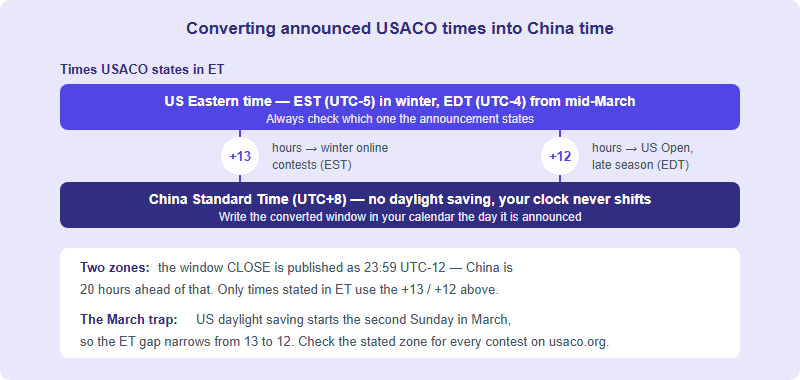
USACO does not state every contest time in the same zone, and that is the detail which catches students out. The close of the window is published as 23:59 UTC-12 — deliberately the westernmost zone on Earth, so that every competitor worldwide gets an equal last opportunity. Other times, such as the Gold and Platinum problem release, are stated in US Eastern instead. China Standard Time is UTC+8 and — importantly — China does not observe daylight saving, so your local clock never shifts. The United States does, and that is the second trap.
| What USACO publishes | Stated zone | Offset | China is ahead by | Applies to |
|---|---|---|---|---|
| The close of the contest window | UTC-12 | UTC-12 | 20 hours | Every contest — a close of 23:59 UTC-12 is 19:59 the following day in China |
| Times stated in US Eastern, early November to early March | EST | UTC-5 | 13 hours | The winter online contests — check the zone stated for each |
| Times stated in US Eastern, mid-March to early November | EDT | UTC-4 | 12 hours | The US Open, which falls near the end of the season |
Worked example, using invented clock times purely to show the arithmetic: a time given as 18:00 US Eastern in January (EST, +13) is 07:00 the following morning in China. The same 18:00 Eastern in late March (EDT, +12) would be 06:00 the next morning in China. One hour of drift does not sound like much until it moves your planned start from “before school” to “during first period.” Note that this arithmetic applies only to times stated in Eastern — the window close is +20 from UTC-12, not +13 from Eastern, and confusing the two moves your deadline by several hours in the wrong direction.
Three habits prevent every version of this error. First, write the converted window into your own calendar in China time the day it is announced, not the night before. Second, note which zone each announced time uses — UTC-12 for the close, EST or EDT where Eastern is stated — rather than assuming. Third, if the contest sits near the second Sunday in March, check the Eastern offset twice — that single weekend is where the 13 becomes a 12.
Choosing your block at Bronze and Silver, with school on Monday
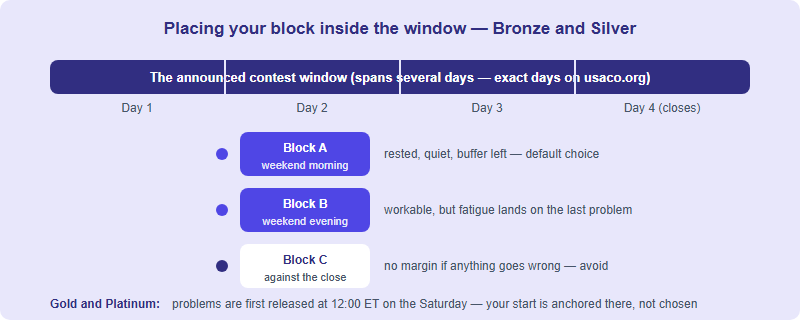
This section applies to Bronze and Silver, where the start really is yours to choose. If you are in Gold or Platinum your start is anchored to the Saturday release instead, so read the subsection above and plan around that fixed point rather than around the table below. Once the window is in China time, you are picking between a handful of realistic blocks, and the trade-offs are predictable enough to plan in advance.
| Block choice | Best for | Watch out for |
|---|---|---|
| Weekend morning, starting after breakfast | Most students. You are rested, the house is quiet, and you finish with the day still ahead for a break | Requires going to bed early the night before, which means deciding on Friday, not Saturday |
| Weekend afternoon | Students who genuinely wake up slowly | Finishing near dinner time; family interruptions; the post-lunch energy dip landing in the middle of your hardest problem |
| Weekend evening | Students with an immovable morning commitment | Ending late and sleeping badly; fatigue mistakes concentrate in the final hour, which is when partial credit is usually won |
| Late night or overnight | Almost nobody | Choosing this because you left the conversion until the last minute. If the only remaining slot is 2 a.m., you planned too late |
Two further points worth deciding in advance. Do not schedule your block so it ends exactly at the window's close — leave real margin, because a technical problem in the final minutes has nowhere to go. And do not sit the contest immediately after a full school day if you can avoid it; the block is long, and problem three is where tiredness costs you points.
The pre-flight checklist: the hour before you start the clock
Everything here is done before your personal clock begins, which is exactly why it is free points.
- Confirm you can log in. Sign in to your account on usaco.org the day before, not at the moment you intend to start. Password resets are slow and cross-border email can lag.
- One machine, one editor, one compiler. Decide now. Contest day is not the time to discover your compiler flags differ from what you practised with.
- Start from an empty file. USACO does not allow pre-written code or templates, so there is no skeleton to open: your input reading, output writing and fast-I/O lines are typed from memory once your clock is running. Practise them in the weeks before until they take about a minute and come out without typos, and switch off editor snippets and AI completion so nothing in the editor writes code for you.
- Prepare a local testing habit. Keep a scratch file for sample input so you can run against the samples in one keystroke rather than retyping data.
- Read the statement for I/O. Check on each official statement whether the problem uses standard input and output or named files, and match it exactly. This is stated on the problem itself; do not assume it from older practice problems.
- Clear the room. Tell your family the block is fixed and cannot be paused. A four-hour contiguous block (five at the US Open) needs to be treated like a real exam.
During the block: submission discipline and partial credit
With around 1000 points across roughly three problems, the students who underperform are usually not the ones who lacked an idea — they are the ones who spent three hours on one problem and never wrote a submission for the others. Three rules of thumb hold up well:
- Submit early, not once. A partially working solution that banks points is worth more than a perfect solution you never finish. Submit when something works, then improve it.
- Rotate deliberately. Read all the problems in the first fifteen minutes. If a problem has resisted you for a long stretch with no new idea, move; you can come back with fresh eyes.
- Trust the feedback, then verify locally. Results and per-test outcomes are reported through the official system. When something fails, reproduce it on your own machine with your own edge cases rather than resubmitting hopefully.
Promotion between divisions comes from clearing a scoring cutoff on a given contest — recent cutoffs have sat in roughly the 650–750 range out of 1000, varying by contest — so banking a solid partial score across several problems is frequently the route up, not a single heroic full solve. Historical context is on our cutoff overview; current figures come from usaco.org.
The connectivity question, honestly
Students competing from China work over a cross-border connection, and connection quality varies by location, network and time of day. This is not a reason for anxiety, but it is a reason to plan:
- Test your access to the official site several days ahead, at roughly the hour you intend to compete — not only at a random time.
- Have a second route available, such as a different network or a mobile hotspot, so a single failure is an inconvenience rather than a lost contest.
- Keep every source file saved locally as you go. If a submission does not go through, you want the code safe on disk, not only in a browser tab.
- Do not leave your final submission to the last two minutes. Submit the working version, then keep improving; a resubmission is cheap, a missed submission is not.
A seven-day countdown
| When | Do this |
|---|---|
| Day -7 | Convert the announced times into China time; confirm the zone stated for each (UTC-12 for the close, EST or EDT where Eastern is used); at Gold or Platinum, note the Saturday release; put it all in your calendar |
| Day -5 | Sit one full past contest under real conditions, in your contest language, in your chosen time slot |
| Day -3 | Log in to the official site; verify account access; test your connection at the planned hour |
| Day -1 | Switch off editor snippets and AI completion; prepare your desk; tell your family; sleep properly |
| Day 0 | Start on time, read all problems first, submit early and often, keep margin before the window closes |
| Day +1 | Upsolve every problem you did not finish while the ideas are still fresh |
Frequently asked questions
Can students in China take part in USACO?
Yes. USACO is free and open to students worldwide, and you register and compete directly on usaco.org rather than through an agent or local centre.
Do I choose when to start within the window?
At Bronze and Silver, yes: you pick your own contiguous block inside the announced window. At Gold and Platinum you cannot, because problems in those divisions are first released at 12:00 ET on the Saturday, and USACO publishes a certified-start rule running from that release — certified status is what counts for promotion and camp selection, so confirm the current wording, including how it applies outside the US, on usaco.org. The US Open is proctored. Either way, plan it as an exam sitting that cannot be paused.
How many hours ahead of US Eastern is China?
Thirteen hours while the US is on EST, and twelve once US daylight saving begins in mid-March. China itself has no daylight saving. Note that this applies only to times USACO states in Eastern: the close of the contest window is published in UTC-12, and China is 20 hours ahead of that.
What if my internet fails mid-contest?
Keep your code saved locally, switch to a backup network, and never leave your only submission until the final minutes of your block.
This is an independent guide operated by Hanlin Education for China-based international-school students. It is NOT affiliated with, endorsed by, or sponsored by USACO (the USA Computing Olympiad). Contest windows, block lengths, operational rules and cutoffs are set by USACO and change between seasons — always confirm current details on usaco.org, where registration and participation take place. If you spot an error in this article, we will correct it within 7 working days.