Problem 1. Sleepy Cow Herding Problem 2. The Great Revegetation Problem 3. Measuring Traffic
Category: Blogs
2019 USACO Silver December Contest Problems
2019 USACO Platinum December Contest Problems
2019 USACO Gold December Contest Problems
2019 USACO Bronze December Contest Problems
Qualified for the IOI National Team! 42 Students Promoted to USACO Platinum Level! Full-System Curriculum Supports Academic Advancement in Computer Science
In the era of rapid AI development, computer science has become one of the most competitive fields in global university applications. High-level international computing competitions have become a key way for students to strengthen their academic profiles and gain admission to top universities worldwide. Over the years, Hanlin International Education has been deeply engaged in computer science competition training, helping countless students achieve outstanding results and demonstrating its strong teaching capabilities through proven outcomes.
1. Competition Achievements | Consistent Success on the International Stage
With years of dedicated development, Hanlin students have continued to achieve breakthroughs in top global competitions such as USACO, IOI, and Kaggle, earning numerous prestigious honors:
- In the International Olympiad in Informatics (IOI), student Y successfully qualified for the 2025 New Zealand IOI national team, reaching the highest level of international informatics competition.
USACO Achievement Summary (2020–2024)
- 42 students reached Platinum (highest level)
- 133 students reached Gold level
USACO Promotion Statistics by Season
| Season | Platinum | Gold | Silver |
|---|---|---|---|
| 2024–2025 | 5 | 25 | 38 |
| 2023–2024 | 8 | 32 | 37 |
| 2022–2023 | 10 | 29 | 71 |
| 2021–2022 | 8 | 29 | 53 |
| 2020–2021 | 11 | 18 | 25 |
2. Exclusive Curriculum | A Complete System for Competitive Advancement
To address the lack of unified official teaching materials in international computing competitions, Hanlin has developed a complete educational system consisting of:
- Exclusive compiled teaching materials
- Step-by-step structured courses
- Full-cycle academic mentoring support
This system is designed to support students at different learning levels and competition stages.
2.1 USACO & CCC Exclusive Teaching Materials
Hanlin’s teaching team has developed specialized materials for both USACO and CCC competitions, covering all levels and major programming languages.
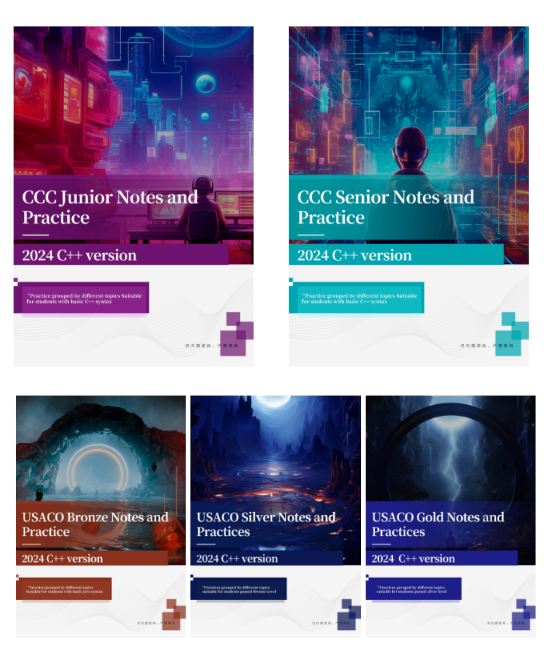
Key features:
- Tiered structure design
- CCC: Junior / Senior levels
- USACO: Bronze / Silver / Gold / Platinum levels
- Multi-language support
- C++
- Java
- Python
- Exam-driven learning system
- Each topic is explained using real competition problems
- Practice problems are selected from past contest questions
- Solutions include full code templates for implementation learning
2.2 Python Full-Level Programming Curriculum
To help beginners transition into competitive programming, Hanlin offers a structured Python learning system divided into two stages:
Python Programming Foundation Course
| Item | Details |
|---|---|
| Total Hours | 30 |
| Structure | Programming Basics + Algorithm Introduction |
| Target Students | Ages 7–12, beginners, CCC/USACO entry-level students |
This course uses project-based learning to develop coding logic and algorithmic thinking.
Python Advanced Creative Course
| Item | Details |
|---|---|
| Total Hours | 30 |
| Language | Bilingual (Chinese & English) |
| Modules | Graphics Drawing, Application Development, Python Game Design |
This course strengthens students’ practical development skills and engineering thinking.
2.3 Tiered Competition Class System
Hanlin provides structured courses for both USACO and CCC competitions, guided by professional instructors.
USACO Course System
| Course | Class Size | Hours |
|---|---|---|
| USACO Bronze | 3–8 students | 40H |
| USACO Bronze | 10–16 students | 60H |
| USACO Silver | 3–8 students | 50H |
| USACO Gold | 3–8 students | 60H |
| USACO Platinum | 3–8 students | 60H |
CCC Course System
| Course | Class Size | Hours |
|---|---|---|
| CCC Junior Full Program | 3–8 students | 40H |
| CCC Senior Full Program | 3–8 students | 120H |
In addition, instructors provide continuous monitoring, real-time feedback, and personalized learning guidance to ensure optimal progress.
3. Elite Teaching Team | World-Class Academic Background + Industry Experience
Hanlin’s computer science teaching team is composed of graduates from top institutions such as Tsinghua University and Ivy League universities. All instructors hold master’s or doctoral degrees, and many have extensive industry and research experience.
Instructor Highlights
- Mr. He
- Cambridge University Master’s in Technology Policy
- AP certified instructor
- Proficient in Java, Python, and C++
- Author of multiple USACO teaching materials
- Achieved a 100% AP CSA score of 5 among students in 2022
- Mr. Jiang
- East China Normal University (top-tier direct master’s admission)
- Former Alibaba senior engineer with 16 years of experience
- Holds 7 national patents
- Developed the “Algorithm Thinking Decomposition Method”
- Helped students progress from Bronze to Gold in as little as 8 weeks
- Mr. Wei
- Tsinghua University Master’s in Software Engineering
- Led student to IOI national team qualification (2024–2025 NZOI)
- Multiple students promoted to USACO Platinum and Gold
- Mr. Luo
- University of California, Riverside (BS & MS in Computer Science)
- 10 years of overseas experience
- Helped 2 students reach USACO Platinum in 2023
- 100% AP CSA full-score rate across multiple cohorts
- Mr. Hong
- Columbia University Master’s in Data Science
- Extensive international teaching experience
- Focuses on building scientific thinking and student motivation
Final Notes
Hanlin’s USACO full-tier curriculum and Python programming system continue to enroll students. From beginner-level programming to elite international competition training, the program supports students throughout their entire academic development journey in computer science.
USACO / CCC Trial Class + Intensive Training Available (Starting at $9.9)
From Bronze → Silver → Gold, taught by elite instructors
Scan to learn more about course details

2026 USACO Contest 1 Recap: Problems, Solutions, and Expert Analysis
2026 USACO Contest 2 Recap: Official Solutions and Video Explanations Released
2026 USACO February Contest (Round 3) Recap: Solutions and Video Explanations Released
The third round of the 2026 USACO season has officially concluded. At the same time, results for the second contest—previously delayed due to academic integrity reviews—have now been fully released.
In the second contest of the 2026 USACO season, students from Shenzhen Foreign Languages School International Division, Affiliated High School of South China Normal University International Division, BASIS Guangzhou, Soong Mei-ling School, Chengdu Tianli School, and Westover School achieved strong results. One student advanced to Platinum, three to Gold, and eleven to Silver. Additionally, two Bronze-level students achieved perfect scores and were promoted to Silver. More results are still being updated.
For Round 3, instructors Jiang and Wei from Hanlin Computer Science provided in-depth breakdowns of the Bronze, Silver, and Gold divisions, covering key concepts and detailed walkthroughs of the official problems. Let’s dive into the analysis.
Immediately following each competition, Hanlin mentors provide a prompt analysis of the exam, producing a comprehensive package of [Video Explanations + Suggested Answers] for every set of questions. This resource is designed to help you prepare more effectively for future competitions. Students and parents interested in obtaining these materials can scan the QR code to claim them for free!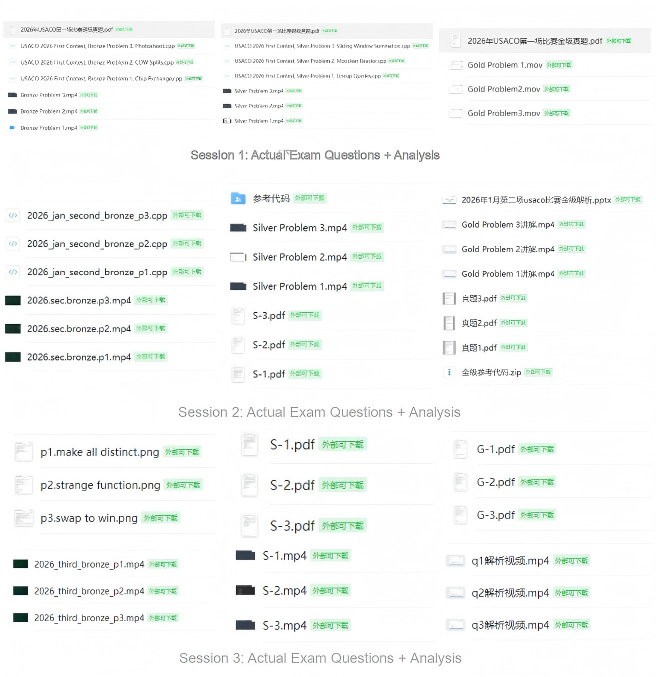
Scan with WeChat to Claim for Free
Bronze Division Analysis
Score Trends
The official cutoff for Round 3 has not yet been announced. Based on historical data and this contest’s difficulty, the cutoff is expected to be around 700–750.
Difficulty Overview
This Bronze round was slightly easier than the first two contests of the season. Problems 1 and 3 followed relatively standard approaches, while Problem 2 required deeper observation and pattern recognition. Notably, recent Bronze problems have increasingly involved binary-related thinking. Given past cutoff trends, most participants should find it manageable to reach promotion scores.
Key Problem Insights
Problem 1: Greedy + Sorting
This problem involves modular arithmetic. By grouping numbers based on their remainder modulo K, we observe that only numbers with the same remainder can potentially become equal after adding K repeatedly. Within each group, we sort the quotients and apply a greedy strategy to ensure they form a strictly increasing sequence with minimal operations. Whenever a conflict occurs, incrementing by exactly one step ensures optimality.
Problem 2: Ad Hoc Pattern Discovery
This problem asks for the minimum number of operations to reduce a large number x to zero under specific rules. Direct simulation is infeasible due to the size constraint (up to 10^(2×10^5)). The key insight is transforming the number into a binary-like structure. From there, the total number of operations can be simplified to a formula:
total operations = val + floor(val / 2).
This reduces a complex iterative process into a straightforward mathematical computation. The challenge lies in recognizing the pattern through small-scale simulations.
Problem 3: Greedy + Simulation
This is a string transformation problem involving two types of swaps: within a string and between two strings. The solution processes the string from left to right, always choosing the lowest-cost operation first. Each position can be fixed in at most two operations, making the greedy approach both efficient and optimal.
Summary
The Bronze division tested a mix of mathematical reasoning, greedy strategies, and simulation skills. Problem 2 especially highlights the importance of discovering hidden patterns rather than relying on standard templates.
Scan with WeChat to Claim for Free
Silver Division Analysis
Score Trends
The expected cutoff remains around 700–750 based on previous contests.
Difficulty Overview
The difficulty level is similar to the second contest. While fewer classic algorithms were required, the problems demanded strong logical reasoning and flexible use of data structures. Achieving full scores was slightly harder than in the previous round.
Key Problem Insights
Problem 1: Greedy + Simulation + Data Structures
This problem combines multiple techniques, including priority queues, queues, prefix sums, and binary search. The main challenge is avoiding timeouts by identifying cycles in the simulation. Once a repeating pattern is detected, the simulation can be optimized into two phases: entering the cycle and processing within the cycle. Prefix sums and binary search are then used to compute results efficiently.
Problem 2: Math + Segment Tree
This problem revolves around modeling water flow across buckets with periodic flipping behavior. By deriving recurrence relations for each bucket’s flipping time and start time, we can compute the total water flow mathematically. Due to dynamic updates, a segment tree is required for efficient recalculation. While full implementation is complex, partial solutions can still earn significant points.
Problem 3: Greedy + Parity Constraints
This problem focuses on constructing valid pairings under parity constraints. By segmenting values and analyzing odd-even properties, we determine feasible matching ranges. The final step involves combining results from two dimensions and verifying both range coverage and parity consistency.
Summary
Silver problems continue to emphasize pattern recognition, greedy construction, and logical reasoning rather than heavy algorithmic implementation. Future preparation should focus on these areas alongside core algorithms.
Scan with WeChat to Claim for Free
Gold Division Analysis
Score Trends
The expected cutoff is likely around 700–750.
Difficulty Overview
This round was notably challenging, emphasizing mathematically driven algorithm design. Problems 2 and 3, in particular, required deep logical reasoning and abstraction.
Key Problem Insights
Problem 1: BIT + Greedy + Rotation
This problem involves analyzing a permutation under cyclic shifts. A Binary Indexed Tree (Fenwick Tree) is used to efficiently compute inversion-related metrics. The key idea is converting dynamic rotation effects into static contribution changes using difference arrays, then finding the optimal shift via a greedy scan.
Problem 2: Shortest Path + Logical Inference
A highly complex graph problem involving reachability constraints and logical validation. The solution builds distance structures using BFS or Dijkstra and applies reverse reasoning to determine valid states. This problem requires precise control over graph traversal and condition handling.
Problem 3: Tree Combinatorics + Modular Arithmetic
This problem combines tree structures with combinatorics. By precomputing factorials and modular inverses, and analyzing subtree sizes, the solution derives a counting formula for valid configurations. This type of problem demands strong mathematical intuition and familiarity with tree-based dynamic programming.
Summary
The Gold division tested a broad range of advanced skills:
- Problem 1 focused on data structure optimization.
- Problem 2 emphasized complex graph modeling and logical reasoning.
- Problem 3 required deep understanding of combinatorics and tree algorithms.
Overall, the contest highlights a shift toward evaluating mathematical abstraction and problem modeling rather than just implementation skills.
Content and Video Explanations by Hanlin Computer Science Instructors
The above analysis and video explanations were prepared by Instructor Wei and Instructor Jiang from Hanlin Computer Science.
Instructor Wei
Hanlin Computer Science Instructor
- Master’s Degree in Software Engineering, Tsinghua University
- Bachelor’s Degree in Software Engineering, Nanjing University
Instructor Wei is known for being patient and highly responsible with students. His teaching style simplifies complex concepts and adapts to individual learning needs. He communicates actively with students, adjusts teaching pace in real time, and focuses on key learning priorities to maximize outcomes within limited time.
Teaching Achievements (Selected)
- One-on-one student advancement rates:
- Silver: 85%
- Gold: 60%
- Platinum: 25%
- Coached a 7th-grade student to advance to USACO Gold
- Guided a student to join the New Zealand national team within one year
Recent Results:
- 2024–2025 USACO Season:
- 16 students advanced to Silver
- 14 students advanced to Gold
- 2 students advanced to Platinum
- 2023–2024 USACO Season:
- 14 students advanced to Silver
- 9 students advanced to Gold
- 1 student advanced to Platinum
- 2022–2023 USACO Season:
- 11 students advanced to Silver
- 5 students advanced to Gold
Instructor Jiang
Hanlin Computer Science Instructor
- East China Normal University
- Combined Bachelor’s and Master’s Program in Computer Science (Top 4 direct admission)
Instructor Jiang integrates ACM and USACO problems with industry-level coding standards. His teaching includes:
- A dynamic difficulty adaptation system that identifies student weaknesses in real time and adjusts training plans accordingly
- A structured approach to algorithmic thinking
- Competition psychology training tailored for IOI and USACO formats
Teaching Achievements (Selected)
- 2024 Season Results:
- 3 students advanced to Gold (including 2 middle school students)
- 5 Gold-level students all successfully advanced further
- Developed a unique “Algorithm Thinking Decomposition Method”
- Helped students progress from Bronze to Gold within 3 months
- Fastest improvement achieved in just 8 weeks
Struggling with USACO Preparation? Hanlin Can Help
Hanlin has many years of experience in USACO competition training.
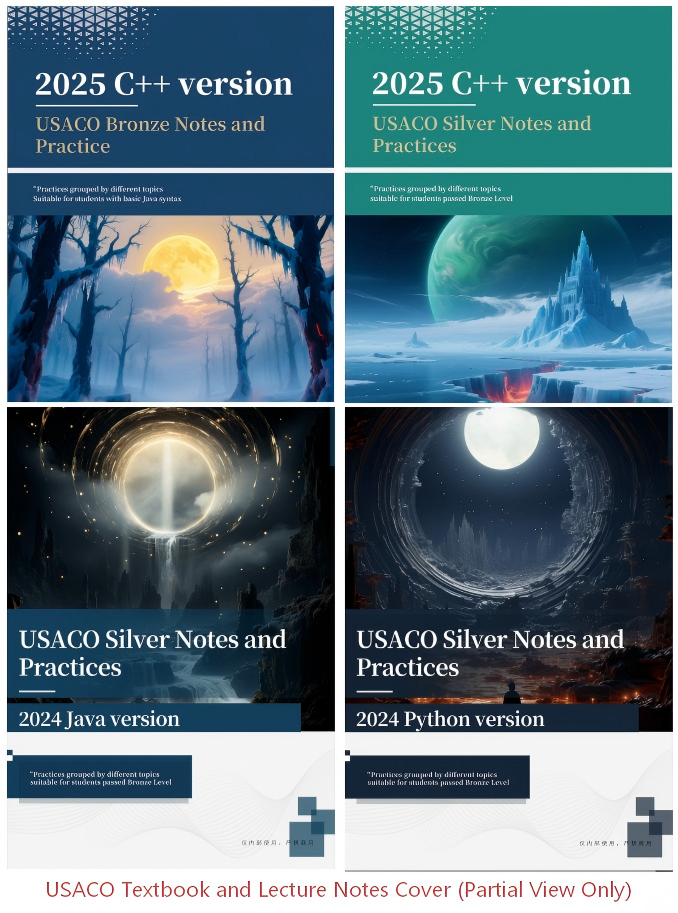
The curriculum is independently developed and continuously updated by the Hanlin academic team. It supports C++, Python, and Java, and covers past USACO problems categorized by topic. Each concept is paired with example problems and exercises, with explanations that progress from basic to advanced levels.
Past contest problems are also organized into five difficulty tiers, enabling students to systematically improve their problem-solving skills step by step.
USACO Course Offerings
In addition to one-on-one coaching, Hanlin offers a variety of small-group classes:
Pre-USACO Foundation Course
- Class size: 3–8 students
- Total hours: 30
- Start date: March 7
USACO Bronze Full Course
- Class size: 3–8 students
- Total hours: 40
- Start date: March 2
USACO Silver Full Course
- Class size: 3–8 students
- Total hours: 50
- Start date: March 7
USACO Gold Full Course
- Class size: 3–8 students
- Total hours: 60
- Start date: March 7
Enroll in Hanlin’s official USACO courses to receive the full set of course materials for free.
Contact us today to learn more or reserve your spot.