Most Bronze points are lost before a single line is written. Bronze is the entry division, where fundamental problem-solving techniques are first learned — and the fundamental technique is recognition: seeing, within roughly two minutes, which of a small number of recurring problem shapes you are holding. Get that right and the code is short. Get it wrong and four hours will not save you.
Why recognition beats technique at Bronze
At the higher divisions you are often rewarded for knowing an algorithm your opponent does not. At Bronze that is rarely the situation. The techniques in play are few and none of them are exotic; our division guide summarises Bronze as simulation, sorting and brute force. Nobody loses Bronze points because they had never heard of sorting.
What they lose points to is misclassification — attacking a sort-and-scan problem as a simulation, or writing a clever partial insight for a problem that simply wanted every possibility enumerated. The wrong shape leads to code that is longer, buggier and slower than the problem needed, and by the time that becomes obvious an hour has gone.
Two features of the contest format make this expensive. First, you see only one sample test per problem during the contest, so a mis-shaped solution that happens to produce the right answer on that one example gives you no warning at all. Second, contests run a fixed four to five contiguous hours once you begin, so an hour spent down the wrong road is an hour you do not get back on the other problems.
The mitigating news is that misclassification is not usually a zero. Problems are graded across multiple test groups with credit accruing per group, so a solution built on the wrong shape often still clears the small cases. That is a safety net, not a plan.
The five shapes
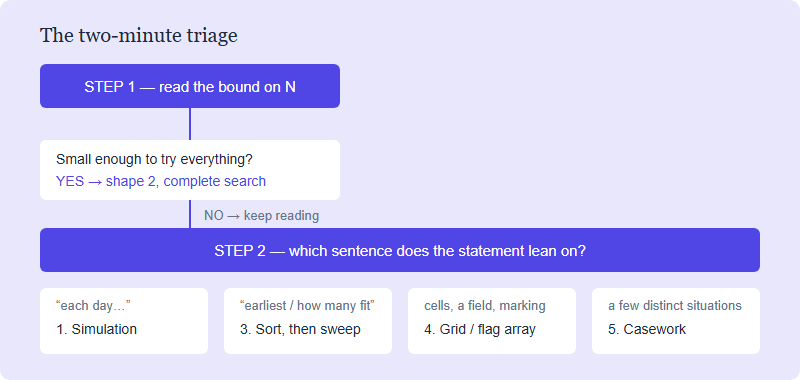
The taxonomy below is our coaching team’s teaching framework, built from working through past Bronze contests with students. It is not a USACO classification — USACO publishes division descriptions rather than a topic syllabus, and problems frequently blend two shapes. Treat it as a first-pass sorting tool, not as a set of boxes every problem must fit.
| Shape | Tell-tale phrasing | What you actually write | Where it goes wrong |
|---|---|---|---|
| 1. Simulation | “Each day…”, “the process repeats until…”, “after every move” | The loop the statement literally describes, with state updated step by step | Off-by-one at the boundaries, and reaching for literal simulation when the step count is far too large to walk through |
| 2. Complete search | Small explicit bound — a handful of items, a short string, a modest coordinate range | Nested loops or recursion over every candidate, testing each one | Enumerating the wrong thing. Very often you should enumerate the answer or the pair, not the raw input order |
| 3. Sort, then sweep | “earliest”, “how many fit”, “maximum overlapping”, “in order of…” | Sort by a chosen key, then one pass keeping a running value | Sorting by the wrong key. Sorting by start time and by end time give different answers to different questions |
| 4. Grid or flag array | An N×N field, cells, marking or painting, “how many distinct…” | A 2-D array or a boolean marker array, filled and then counted | Array bounds, and mixing 1-indexed statement labels with 0-indexed code |
| 5. Casework / ad hoc | A small number of distinct situations described in prose; no obvious structure | An explicit enumeration of the cases, each handled on its own terms | A missed case — and the one visible sample will usually not be the case you missed |
The constraint line is your fastest tell
If you take one habit from this article, take this one: read the constraints before you finish reading the story.
The bound on the input size is the single most informative sentence in a Bronze problem, because it silently rules shapes in and out. A bound small enough that every pair of items can be examined is an invitation to complete search — the setter chose that bound deliberately. A bound large enough that examining every pair is hopeless is telling you the intended solution sorts, sweeps or counts instead. Neither fact is stated in prose; both are stated in the constraints.
This is also where the shape question meets the clock. usaco.org notes that for most contests the limit is 2 seconds per input case for C and C++ and 4 seconds for Java and Python, while adding that individual contests or problems may use slightly different limits. Those seconds are what convert “my approach is correct” into “my approach is correct and finishes” — and the constraint line is where you find out which one you have, before you have written anything.
A drill that trains recognition specifically
Recognition is a separate skill from solving, and it responds to a separate drill. Most students never train it directly because every practice session they run is a solving session — which trains recognition at a rate of about one repetition per hour.
The drill we use is deliberately incomplete, and that is the point:
- Open twenty past Bronze problems. Do not solve any of them.
- For each, spend no more than thirty seconds: read the constraint line, skim the statement, and write down a shape number from one to five plus the single phrase that decided it.
- Total elapsed time is about ten minutes for twenty repetitions — roughly what twenty solving sessions would have given you in twenty hours.
- The next day, take five of the twenty and actually solve them. Check whether the shape you assigned was the shape the solution used.
- Keep a tally only of your misclassifications, with the phrase that misled you. Within a few rounds you will find your errors cluster into one or two recurring confusions, and those are what to study.
In our experience the most common confusion at Bronze is between shape 1 and shape 3: a problem describes a process unfolding in time, so the student simulates it step by step, when the question only asks about the final ordering and a sort answers it in a fraction of the code. The second most common is enumerating the input in shape 2 when the answer itself was the thing to enumerate.
For material, work from complete past contests rather than topic-labelled exercise sets. A problem filed under “sorting” has already told you the answer to the only question this drill is asking. Our past-contest pack is the collection our teachers have gathered and organised, with worked solutions for some of the years rather than every year; the exact papers and write-ups follow what your teacher sends you.
What recognition does not save you from
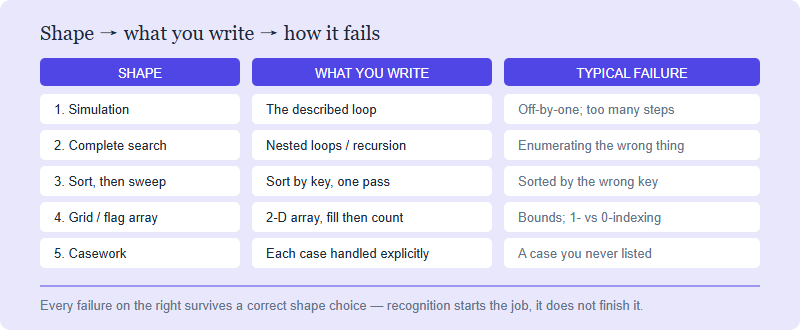
Two honest caveats. Recognition gets you pointed in the right direction; it does nothing about the bug classes in the right-hand column, and each shape carries its own. The grid shape will keep punishing index confusion no matter how quickly you identify it.
And the shapes are a starting frame rather than a complete map. Real Bronze problems blend them — a casework problem whose cases each require a small sweep is entirely normal, and a simulation whose state is a grid is common. If a problem does not fit cleanly, that is information about the problem, not a failure of your classification. The value of the frame is that it gives you a fast, structured first guess and, more importantly, a fast way to notice when your first guess was wrong — at minute ten rather than minute seventy.
If you want to go further with the part recognition cannot fix, the natural next step is the arithmetic of whether a chosen approach fits inside the time limit at all, which is where a correctly shaped Bronze solution most often still loses groups. Start from our USACO guide home for the rest of the Bronze material.
Frequently asked questions
Q: Are these five shapes an official USACO categorisation?
No. They are our coaching team’s teaching framework. USACO publishes division descriptions, not a topic syllabus, and problems often blend shapes.
Q: What if I pick the wrong shape in a contest?
You usually still score something, since problems are graded in groups and credit accrues per group. But you lose the time, which is the real cost.
Q: Why read the constraints before the story?
The bound on the input rules approaches in or out. The setter chose it deliberately, and it is the fastest signal in the statement.
Q: How many Bronze problems are in a contest?
usaco.org states a contest typically has three or four problems, taken in a four to five hour contiguous block. Confirm the current format there.
Independent guide operated by Hanlin Education for China-based international-school students. Not affiliated with, endorsed by, or sponsored by USACO (the USA Computing Olympiad), the IOI or EGOI. Registration, contest rules, dates and promotion cutoffs live on usaco.org — confirm current details there before planning around anything on this page. Errors reported to our editorial desk are corrected within 7 working days.