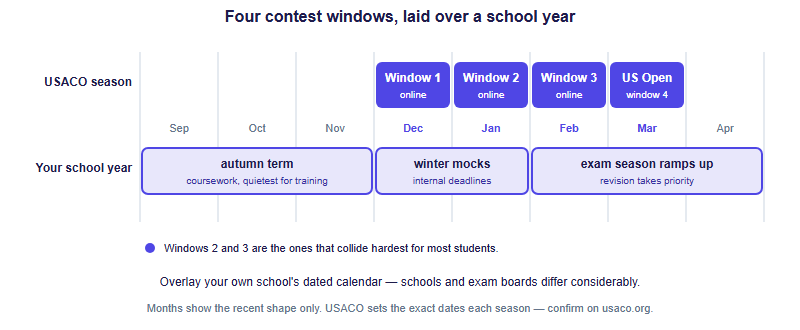
A USACO season is four contest windows: three online contests plus the US Open. In recent seasons they have fallen roughly across December, January and February, with the US Open in March, though USACO sets the exact dates each year. That is the same stretch of the school calendar as winter mocks and the run-up to spring exams. You do not have to enter every window — but you should decide which ones in September, not in the week one opens.
The collision nobody plans for
Most students discover the clash the hard way. They train through the autumn, enter the first contest with real ambition, then find the second window opening in the middle of mock exams and the third arriving while coursework deadlines stack up. What follows is predictable: two rushed contests, a bad score they read as evidence they are not good at this, and a season that quietly ends in February.
None of that is a competence problem. It is a calendar problem, and calendar problems are solvable in advance. The single most useful thing you can do for your season is spend twenty minutes in September putting the USACO windows and your own school calendar on the same page.
The two mechanics that make this schedulable
Before deciding anything, understand the two features of the format that give you room to manoeuvre. Both are frequently misunderstood by students who assume USACO works like a school exam.
First, each contest is a multi-day window, not a fixed hour. Inside the window you choose your own contiguous block of roughly four to five hours and start when you want. This is the single most important scheduling fact about USACO: you are picking a day and a start time, not being assigned one. A contest that appears to land in the middle of a bad week may still have a workable Saturday morning in it. Check the length and the window for each specific contest on usaco.org, since USACO sets both.
Second, promotion happens per contest. You clear a cutoff in a particular contest and division, and each window is an independent chance to do that. There is no season-long aggregate score to protect and no penalty for a weak result in one window. Cutoffs are set per contest and move between contests, so check the cutoff reference rather than planning against a fixed figure.
Put together, those two facts kill two bad instincts at once. You do not need to enter a window just because it exists — skipping one costs you nothing but the chance. And you do not need to fear a poor score dragging down a season total, because there is no season total to drag down.
Why “enter everything” and “wait until I am ready” are both wrong
Students tend to fall into one of two failure modes, and the honest answer sits between them.
The enter-everything student treats all four windows as compulsory. The cost is not the contest time itself — four to five hours is one Saturday — it is the recovery day either side, and the fact that a contest entered unprepared, in a bad week, produces a score that teaches nothing and dents confidence at exactly the wrong moment. Four badly-timed entries produce less than two well-timed ones.
The wait-until-ready student holds back for the perfect moment and often never enters at all. This is the more expensive mistake, for a concrete structural reason: promotion is per contest, so every window you skip is one fewer chance to clear a cutoff this season. A student who enters window 1 and promotes then spends the rest of the season competing in the higher division and learning from harder problems. A student who waits for window 3 to feel ready has thrown away two chances to do the same.
The resolution is a rule rather than a feeling: enter the first window you can enter having done at least one full timed rehearsal on a past contest. That is a checkable condition, unlike readiness. If you have sat one four-to-five-hour block on old problems and know how your own testing and submission routine works, you are ready enough to score. Our past-contest resources exist for that rehearsal.
Three realistic season shapes
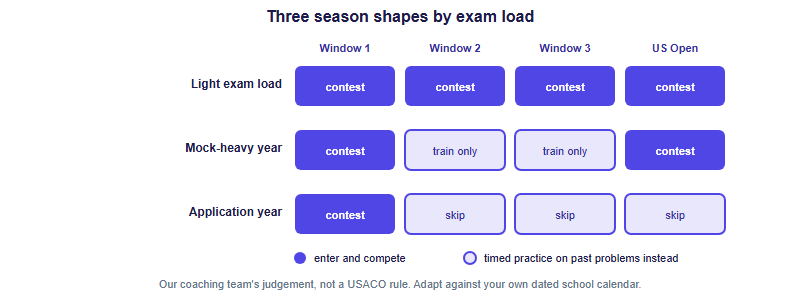
The framing below is our coaching team's judgement from working with international-school students in China, not a USACO rule or recommendation. USACO does not tell you how many windows to enter. Read these as templates to adapt against your own dated calendar.
| Your year | Contest | Train only | Why |
|---|---|---|---|
| Light exam load (often Grade 9–10) | All four windows | — | No mock or exam pressure worth protecting. Maximum chances to promote, and four real contests teach more than any practice set |
| Mock-heavy year (often Grade 11) | Window 1 and the US Open | Windows 2 and 3 | Window 1 lands before the worst of the mock season; by the US Open the mocks are behind you. Use the two middle windows as timed practice on past problems instead of entering |
| Application year (often Grade 12) | Window 1 only, or nothing | The rest | Applications and final exams both peak here. One early entry is realistic; a four-window campaign is not, and results this late change little in an application already submitted |
| First season, any grade | The earliest window you can rehearse for | — | Your first contest is mostly about learning the format. Getting that out of the way early makes every later window more productive |
Booking the day inside the window
Once you have chosen your windows, the remaining decision is which day and hour inside each one. Students underrate this. A four-to-five-hour block of hard thinking is not something you slot into whatever gap remains after a full school day.
- Take a weekend morning if the window contains one. Fresh, unhurried, and long enough that you are not watching a clock for a reason unrelated to the contest.
- Never start after a full school day plus a test. You will spend the first hour of the contest recovering. If the only slot is a weekday evening, treat that as a reason to consider skipping the window rather than a reason to push through.
- Check the window against your own timezone before you plan. USACO publishes window opening and closing times, and a window that looks comfortable in one timezone can end awkwardly in another. Confirm the times on usaco.org and convert carefully.
- Protect the day before and after. One evening of light revision beforehand, and no major deadline the morning after. The contest is not the only cost of the contest.
- Tell your family the date in advance. Several of the interrupted contests we hear about were interrupted by something entirely avoidable that nobody had been told about.
What to tell your parents about the trade
It is worth being straightforward about cost and benefit, because this is usually the conversation that decides whether a season happens at all.
The cost is real but bounded. USACO itself is free to enter and open to students worldwide, including students at schools in China, and registration takes place directly on usaco.org. The genuine cost is time: each contest is four to five hours plus a recovery day, and meaningful preparation over an autumn runs to a few hours a week. A two-window season is a manageable commitment alongside a demanding curriculum. A four-window season with serious training is not, in a year with heavy exams.
On the benefit side, be careful about what is being claimed. Working through a real contest format builds algorithmic thinking, English technical reading and the ability to hold a hard problem for hours — capacities that transfer well beyond the contest. A division promotion is a legible, externally-verified signal of programming ability. But no contest result guarantees any admissions outcome, and anyone telling you otherwise is selling something. Our division guide sets out what each level actually demands, which is a better basis for the conversation than a prediction nobody can make.
Across our own last three seasons of coaching, our de-identified tally records 18 Platinum, 70 Gold and 100 Silver promotions among students we worked with. That is our own count rather than a USACO statistic, and individual results vary widely. The pattern our coaches see in the students who keep progressing across multiple years is unglamorous: they plan the season in September, they enter fewer windows than they could, and they finish the ones they enter.
How many contests are there in a USACO season?
Four: three online contests plus the US Open. Exact dates are set each season by USACO — confirm them on usaco.org.
Do I have to enter every contest window?
No. Promotion happens per contest, so each window is an independent chance. Skipping one costs you that chance and nothing else.
Can I choose when to sit the contest?
Yes. Each contest is a multi-day window and you pick your own contiguous block of roughly four to five hours inside it.
Is USACO free to enter from China?
Yes. USACO is free and open to students worldwide, and registration happens directly on usaco.org.
This is an independent guide operated by Hanlin Education for China-based international-school students. It is not affiliated with, endorsed by, or sponsored by USACO (the USA Computing Olympiad). Contest windows, dates, format, promotion cutoffs and rules are set by USACO and change from season to season — always confirm current details on usaco.org, where registration and participation take place. School and exam-board calendars vary; check your own school's dated calendar. Cohort figures are our own de-identified tally, not a USACO statistic, and individual results vary. Any factual error brought to our attention is corrected within 7 working days.