Between the US Open in spring and the first contest of the new season, USACO goes quiet. That gap is not downtime — it is the only stretch of the year long enough to genuinely move you up a division. Once contests start, roughly a month apart, you are in survival mode. Here is how to structure the quiet months into four blocks that build on each other.
Why the off-season is the only time your division really changes
A USACO season runs as a short sequence of online contests plus the US Open, spread over a few months — commonly December through March, though the calendar is published fresh each year and you should confirm the dates on usaco.org rather than assuming last season repeats. Between contests you have perhaps four weeks. That is enough time to patch a specific weakness that a contest exposed. It is not enough time to learn a new family of algorithms, get fluent enough to write it under pressure, and build the pattern recognition to know when to reach for it.
In-season improvement is therefore mostly tactical: you sit a contest, you find out you cannot implement a particular technique quickly enough, you drill that one thing. Off-season improvement is structural. It is where the actual promotion is manufactured, and then the contest simply reports it.
This is worth saying plainly because the failure mode is so common. Students disappear over the summer, return in November, cram for three weeks, sit the opener in the same division they were in last year, and conclude that they have plateaued. They have not plateaued. They skipped the block of the calendar where the work happens.
The rule that shapes everything: you cannot bring a template
Most training advice for competitive programming is imported from platforms where you arrive with a personal library — a header file of utilities, pre-written data structures, a snippet folder. USACO does not work that way. As set out on our rules summary, the only references contestants may consult are ones describing their language’s syntax, library functions and input/output; pre-written code and templates are not permitted, and neither are generative AI tools; you also may not share any technical information or code about a contest with anyone for as long as the contest window is open — not just during your own timed session. Confirm the exact current wording on usaco.org, since this is the sort of rule that gets tightened.
The training consequence is large and most students never draw it. If you cannot paste your union-find implementation, then "I understand union-find" is not a useful state to be in. The useful state is "I can type a correct union-find from memory in four minutes without looking anything up." Those are different skills, and only one of them scores points at minute 150 of a contest.
So the off-season is not primarily about learning new concepts, at least not after your first year. It is about converting concepts you already half-know into things your hands can produce under time pressure. Almost every block below is designed around that conversion.
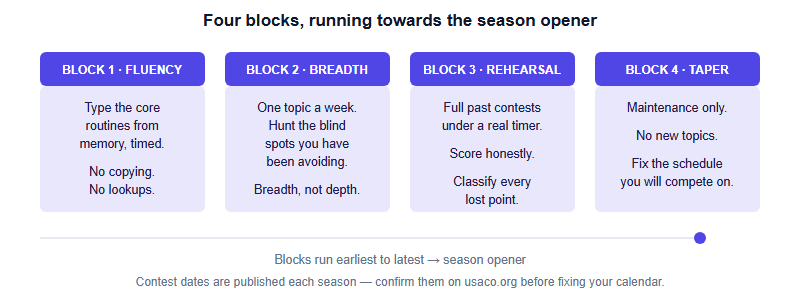
Block 1 — Fluency: get your language into your fingers
USACO accepts C, C++, Java and Python. Whichever you have chosen, the first block is about removing friction rather than adding knowledge. The measurable goal: you can implement your division's bread-and-butter routines from a blank file, correctly, without looking at anything except language syntax documentation.
Build a short list — for most students six to ten items is plenty — of the routines you actually need at your level. Then run them as timed drills. Blank editor, stopwatch, write it, test it on a case you invent, record the time. Repeat the ones that are slow or wrong a few days later, not immediately; spacing them out is what moves them into durable memory.
Two markers tell you the block is done. First, your times stop improving. Second, and more tellingly, you stop needing to think about the structure of the code and start thinking only about the problem. That second one is the whole point. Every second you spend recalling syntax during a contest is a second not spent on the actual difficulty.
Block 2 — Breadth: one topic a week, aimed at your blind spots
The second block is where you widen coverage, and the operating principle is deliberately uncomfortable: work on what you are worst at. Students naturally practise what they enjoy, which means they get steadily better at the things they were already good at, and arrive at the contest with the same holes as last year.
Structure a week around a single topic. Read enough theory to understand it, implement it once from scratch, then spend the rest of the week on problems that use it — including problems where you are told in advance which topic applies, because at this stage recognition is not yet the skill you are training. Move on at the end of the week whether or not you feel finished. Breadth is the objective here; depth arrives in block three when the topic reappears inside a real contest and you have to identify it yourself.
Our resources page and the division guide set out which topic families sit at each level, which is a more reliable way to choose your weekly list than working through a general competitive-programming syllabus that may be aimed at a different competition entirely.
Block 3 — Rehearsal: full contests, real timer, honest score
This is the block students skip, and skipping it is why so many people practise well and then perform badly.
Solving three problems across a relaxed weekend is a different activity from solving three problems in one continuous four-hour block, with no idea which techniques apply, while deciding in real time what to abandon. The second activity is the one you are actually being tested on, and it has to be practised as a whole.
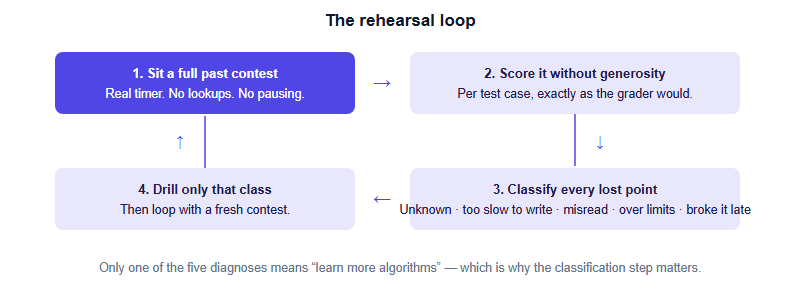
So: take a full past contest from your division, start a timer, and sit it properly — phone elsewhere, no external help, no pausing to look something up you would not have been allowed to look up. Then score yourself without generosity. The review afterwards is where the value is, and the crucial move is to classify every lost point rather than simply fixing the problem in front of you. The categories are usually few and very repetitive: did not know the technique; knew it but could not implement it in time; misread the statement; solved it but exceeded the limits; had it working and broke it late.
Each of those five diagnoses points at a completely different fix, and only one of them means "learn more algorithms." The detailed method for reviewing an individual problem you failed is a topic of its own; what matters at the calendar level is that the simulation happens often enough to generate the diagnosis. Two or three full rehearsals with proper reviews will teach you more than twenty casual practice problems.
Block 4 — Taper: stop learning, start arriving in good condition
The final weeks before the opener should be quieter, not louder. Introducing a new technique days before a contest reliably produces the worst of both worlds: not fluent enough to use it, but distracting enough to displace something you were fluent in.
The taper has three jobs. Keep your fluency drills ticking over at low volume so nothing goes rusty. Sit one final full rehearsal, then stop rehearsing. And fix the practical details of contest day — when in the window you intend to start, what time that is where you live, whether that slot is genuinely free of school commitments, and whether your machine and compiler behave. Working out your submission logistics during the contest is an expensive way to discover a problem.
| Block | Goal | Typical weekly volume | You are done when… | Common mistake |
|---|---|---|---|---|
| 1. Fluency | Core routines typed from memory, correctly and fast | 3–4 short timed sessions | Your times plateau and you stop thinking about syntax | Reading code instead of writing it |
| 2. Breadth | Eliminate blind spots across the topics at your level | One topic per week, several problems | No topic at your level makes you flinch | Practising favourites; skipping the uncomfortable topic |
| 3. Rehearsal | Perform the whole four-hour task, then diagnose | One full contest + a full review | Your score stops being wrecked by clock decisions | Solving past problems casually and calling it a mock |
| 4. Taper | Arrive fluent, rested and logistically ready | Light maintenance, one last mock | Contest day contains no surprises | Cramming a new technique in the final fortnight |
Fitting the four blocks around an international-school workload
The plan above assumes a student who also has IB or A Level coursework, and it is built to survive that. None of the blocks requires daily hours. Fluency drills are twenty minutes. Breadth weeks are a few problems. The expensive item is the rehearsal, because it needs one genuinely uninterrupted four-hour slot, which for most students means a weekend morning that has to be defended in advance.
What does not survive is irregularity. Three intense weeks followed by a six-week gap will leave you roughly where you started, because fluency decays and the whole design here is a fluency ladder. If your term gets heavy, shrink the volume rather than pausing the plan — one drill a week and one problem a week keeps the ladder standing, and you can widen again when the term eases.
Frequently asked questions
When does the USACO season actually start?
The season is a short run of online contests plus the US Open, commonly across December to March. Dates are published each season, so confirm them on usaco.org.
Can I prepare a code template to paste in during the contest?
No. Pre-written code and templates are not permitted, and neither are generative AI tools. That is why off-season training focuses on writing routines from memory.
How many full mock contests should I sit?
Two or three properly reviewed rehearsals beat many casual practice sessions. What matters is the honest scoring and the diagnosis afterwards.
Should I learn a new language over the off-season?
Only if you have a full off-season to spare. Switching languages close to the opener costs fluency exactly when fluency is what scores points.
This is an independent guide operated by Hanlin Education for China-based international-school students. It is not affiliated with, endorsed by, or sponsored by USACO (the USA Computing Olympiad). Contest dates, rules on permitted resources and division requirements are set by USACO and change from season to season — always confirm current details on usaco.org, where registration and participation take place. Any factual error brought to our attention is corrected within 7 working days.