Yes, a student in Shanghai or Shenzhen can register for USACO, sit the same contests as everyone else, be scored on the same test cases and promote all the way to Platinum. No, that student cannot be selected as a finalist for the training camp or take a Team USA place at the IOI. Knowing exactly where that line sits changes how you should set targets.
The short answer, before the detail
USACO is unusually open. There is no entry fee, no school sponsorship requirement, no national qualifying round you must pass first, and no restriction on who may compete online. That puts it in a different category from several American olympiads that quietly limit entry to students physically enrolled in US schools, which is why students in China so often find USACO to be the one major US competition they can simply join.
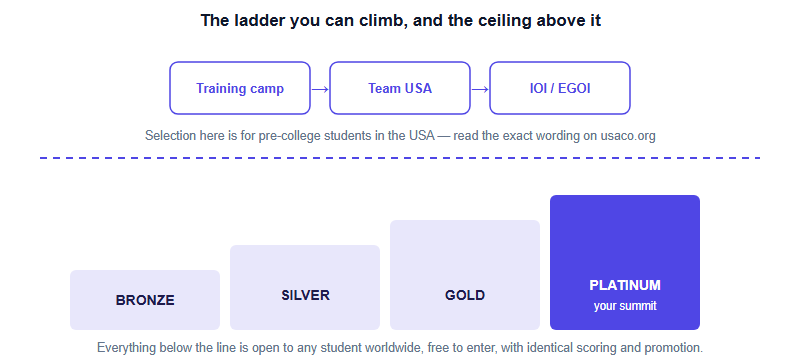
The restriction sits further up. Competing is open; being selected is not. Camp finalist selection and the USA IOI/EGOI team places are for pre-college students in the USA. The precise wording — including how citizenship and residency are treated, and the point in the school year at which residency is assessed — is published by USACO, and you should read it on usaco.org rather than relying on any summary, including this one, before making plans around it.
So there is a ceiling. It is worth understanding early, not because it makes USACO pointless for you, but because students who do not know about it tend to set a goal they cannot reach, then read their eventual result as a personal failure rather than a rulebook boundary.
What "open to anyone worldwide" actually gets you
Quite a lot, in fact. Below the ceiling, you are not a second-class participant with a restricted version of the contest. You get the full thing:
- The same contests. Same problems, same self-chosen four-to-five-hour timer inside the multi-day window, same roughly three problems and 1,000 points.
- The same grading. Per test case, with immediate feedback, scored identically to every other contestant.
- The same promotion machinery. Everyone starts in Bronze. You move up by clearing the cutoff on a contest, and the cutoff applies to you exactly as it applies to a student in California. Recent cutoffs have tended to fall somewhere around 650 to 750 out of 1,000, but the figure is set per contest and varies; our cutoff history shows the spread, and usaco.org is the authority for any particular contest.
- The same four divisions. Bronze, Silver, Gold and Platinum are all reachable. Platinum is not walled off.
- The same cost. Zero.
That last point deserves more weight than it usually gets. A serious, internationally recognised, properly graded algorithmic competition that any student can enter for free, several times a year, is a rare thing. Most competitions with this level of rigour are gated by fees, school registration, or a national selection process.
Where the ladder stops, itemised
It helps to see the boundary as a list rather than a vague sense that "international students are limited." Most of the things students care about are on the open side.
| What you might want | Available to you? | Notes |
|---|---|---|
| Register and compete from China | Yes | Free, no school sponsorship, registration on usaco.org |
| Sit the same problems as everyone else | Yes | Same window, same timer, same paper |
| Be scored and see your result | Yes | Per test case, out of 1,000 |
| Promote Bronze → Silver → Gold | Yes | Clear the cutoff on a contest; cutoffs vary per contest |
| Reach Platinum | Yes | The top division is open; it is a genuine summit to aim at |
| Be selected as a camp finalist | No | Selection is restricted; citizenship and US residency both feature — confirm on usaco.org |
| Take a Team USA place at the IOI or EGOI | No | Same restriction; check exact wording on usaco.org |
Read that table again and notice how much sits in the top half. The restriction bites in exactly one place: national-team selection. Everything that constitutes the actual competition — entering, competing, being scored, progressing through four divisions — is fully open.
Platinum is your summit, and it is a serious one
If camp is off the table, Platinum becomes the top of your accessible ladder, and it is worth being clear-eyed that this is not a consolation prize. Reaching Platinum means you have cleared three separate promotion cutoffs and are being handed problems built for the strongest pre-college contestants in a very deep field.
The step into Platinum is where the character of the competition changes. In the lower divisions, recognising the right technique is usually most of the battle; once you have seen it, the implementation is short. In Platinum the technique is frequently obvious and the difficulty is everything after that — the modelling, the heavier data structures, the state design, the constant factor. Problems stop rewarding recall and start rewarding invention. Our division guide sets out the topic families at each level in more detail.
Practically, that means a student who reaches Platinum has done something that stands entirely on its own, regardless of what the camp rules say. And there is no asterisk on it: your division, your scores and your progression are recorded on the same terms as everyone else's.
If the IOI is the real goal, USACO is training, not the route
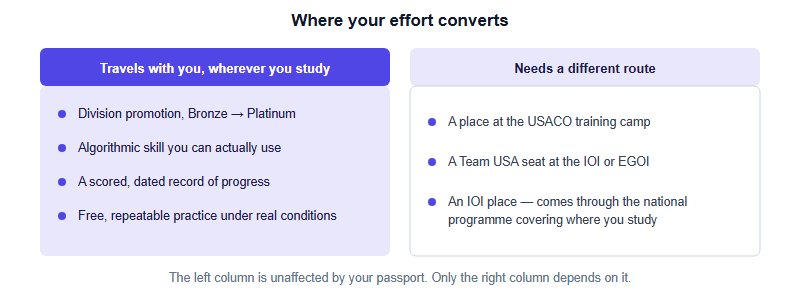
Some students want USACO specifically because they want to reach the International Olympiad in Informatics. If that is you, be clear about the mechanics: an IOI place comes through the national or regional programme that covers where you study, and each of those programmes sets its own selection process, eligibility and calendar. USACO is the route for the United States. It is not a back door into the IOI for anyone else, and no amount of Platinum performance changes that.
What USACO does give you, if that is your ambition, is excellent and free preparation on the same kind of problems, several times a year, with real grading and a real clock. Plenty of strong contestants use it exactly that way. So the sensible structure is: find out directly what the national programme where you study requires, treat that as your competitive pathway, and treat USACO as high-quality training with a public scoreboard attached. Do not swap them round.
Setting targets that the rulebook can actually deliver
Once the ceiling is clear, target-setting becomes straightforward. Make your division the scoreboard, because division is the thing you control and the thing that is genuinely open to you.
A workable multi-year shape for a student starting in middle school or early high school looks like this: spend the first season learning what a contest feels like and clearing Bronze; spend the second consolidating Silver and building the algorithmic breadth that Gold assumes; then push at Gold with the expectation that it may take more than one attempt, because it usually does. Platinum, if it comes, tends to come later and to students who kept going through a season where nothing promoted. Attach no deadline to it. The seasons are short and the number of promotion opportunities per year is small, so patience is structural rather than optional.
Two things not to do. Do not measure yourself against camp finalists — they are competing for something you are not eligible for, and the comparison tells you nothing useful. And do not treat a season without promotion as evidence of a ceiling; cutoffs move contest to contest, and plenty of promotions arrive on the second or third attempt at a division.
Whether and how any of this belongs on a university application is a separate question with its own answer, and it deserves more care than a paragraph here. The competitive question is simpler: the ladder is four divisions high, all four are open to you, and the work you put in converts into skill and a scored record no matter which passport you hold.
Frequently asked questions
Can students in China register for USACO?
Yes. Entry is open to anyone worldwide and free of charge, with no school sponsorship required. Registration takes place on usaco.org.
Can an international student be selected for the USACO training camp?
No. Camp finalist selection and IOI/EGOI team places are restricted, and both citizenship and US residency feature in the criteria. Check the exact wording on usaco.org.
Can international contestants reach Platinum?
Yes. All four divisions are open, with identical promotion cutoffs. The restriction applies only to camp and national-team selection.
Does USACO lead to the IOI for a student outside the US?
Not directly. An IOI place comes through the national programme where you study. USACO is excellent free training, not the selection route.
This is an independent guide operated by Hanlin Education for China-based international-school students. It is not affiliated with, endorsed by, or sponsored by USACO (the USA Computing Olympiad). Eligibility, camp and team selection rules, promotion cutoffs and contest dates are set by USACO and may change — always confirm current details on usaco.org, where registration and participation take place. Any factual error brought to our attention is corrected within 7 working days.