In USACO, a program that produces the right answer too slowly earns the same as a program that produces the wrong answer: nothing on that test. The fix is not typing faster or switching language — it is reading the constraints before writing code and choosing an algorithm whose growth rate fits the input size. That single habit is what separates students who stall at Bronze from students who clear Silver.
Correct is necessary. It is not sufficient.
A contest gives you roughly three problems and 1000 points in a four-hour block (five at the US Open). Your score is decided by how your program behaves on the official test data, and that data is built deliberately: small cases to check that your logic is right, and large cases to check that your approach was the intended one. A brute-force solution typically sails through the small tests and dies on the large ones — which is why students so often report “it worked on the samples.”
It helps to name the two failure modes separately, because they demand different responses:
- Wrong answer means your logic is broken. You need a counter-example — an input where you can hand-compute the truth and watch your program disagree.
- Time limit exceeded means your logic may be perfect but your approach does not scale. Rewriting the same idea in a faster style rarely rescues it; you generally need a different algorithm class.
Confusing the two wastes hours. If a solution fails only the larger tests while passing every small one, that is a complexity problem, and no amount of micro-optimisation inside the same nested loops will reliably fix it.
Read the constraints first — they are the problem setter telling you the answer
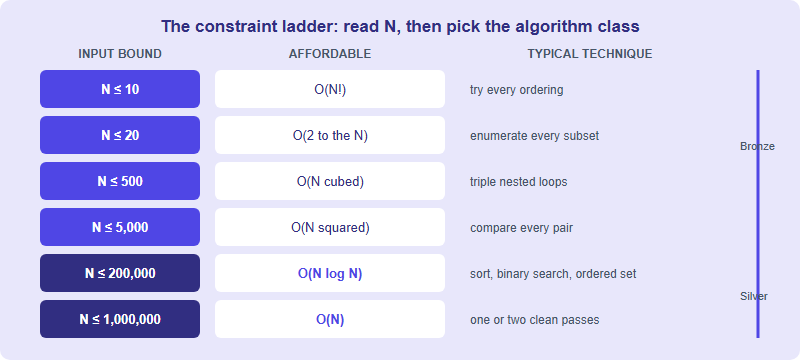
Every problem statement bounds its input. Experienced competitors read that bound before the story, because it eliminates most possible approaches immediately. The reasoning is a rough budget: modern judging hardware performs on the order of a hundred million simple operations per second, so you can estimate whether a candidate approach is even in range before writing a line.
Treat the table below as a planning heuristic used across competitive programming, not as an official USACO rule. Actual time limits are stated on each official problem, vary by problem and language, and are the only authoritative figure — confirm them on usaco.org.
| If the bound is about… | You can afford roughly… | Which usually means |
|---|---|---|
| N ≤ 10 | O(N!) | Try every ordering — full permutation search |
| N ≤ 20–25 | O(2N) | Enumerate every subset |
| N ≤ 500 | O(N3) | Triple nested loops are still fine |
| N ≤ 5,000 | O(N2) | Compare every pair — the classic Bronze comfort zone |
| N ≤ 200,000 | O(N log N) | Sort, binary search, ordered set — the Silver signature |
| N ≤ 1,000,000 or more | O(N) or O(N log N) with a small constant | One or two clean passes; prefix sums, counting, two pointers |
Used properly, this table is a filter you apply in the first two minutes. If the bound is 200,000 and your instinct is to compare every pair, that instinct is already dead — you would be asking for something like twenty billion operations. Knowing that before you write ninety lines is worth an hour.
What really changes between Bronze and Silver
Students often describe Silver as “harder problems.” It is more precise to say Silver problems are frequently the same shape of question with a bigger bound. The story about counting cows in a field may be nearly identical; what changed is that N went from a few thousand to a few hundred thousand, and with it the entire set of acceptable approaches.
That reframing is useful because it tells you what to study. Moving up the ladder — Bronze, then Silver, then Gold, then Platinum — is less about learning exotic topics early and more about acquiring a small toolkit that converts quadratic instincts into log-linear solutions. If you can look at a bound of 200,000 and immediately think “sort it, or prefix-sum it, or two-pointer it,” you are thinking at Silver level.
Four upgrades that resolve most Bronze-to-Silver timeouts
Almost every timeout at this level is one of four patterns in disguise. Learn these as substitutions — recognise the slow shape, apply the fast replacement.
| Slow shape you wrote | Fast replacement | Why it works |
|---|---|---|
| Re-summing a range inside a loop | Prefix sums | Pre-compute cumulative totals once; every later range query becomes one subtraction |
| Nested loops looking for a matching pair in sorted data | Two pointers / sliding window | Both indices only move forward, so the whole scan is linear instead of quadratic |
| Testing every possible answer value one by one | Binary search on the answer | When “is X achievable?” is monotone, you halve the search space each step |
| Scanning a list to ask “have I seen this?” | Set or map lookup | Membership becomes near-constant or logarithmic instead of a full pass |
A concrete illustration of the first, without reference to any specific contest problem: suppose you must answer many questions of the form “what is the total between position i and position j?” The naive loop costs one pass per question. Build a running total array once, and each answer becomes a single subtraction of two stored values. The idea is unchanged; the cost collapses from the product of two large numbers to their sum.
Sorting deserves a special note. Many students treat sorting as something you do when a problem asks for order. In practice, sorting is often the enabling move — it creates the monotonic structure that makes two pointers, greedy choices and binary search legal in the first place. If you are stuck on a large-N problem, “what if this were sorted?” is one of the highest-yield questions you can ask.
Write the brute force anyway — it pays twice
Counter-intuitively, the slow solution you know will not pass is often worth writing first, for two reasons.
It banks points. Scoring is distributed across test data, so a solution that handles the smaller cases correctly can still record partial credit rather than zero. Because promotion depends on clearing a scoring cutoff on a contest — recent cutoffs have sat around 650–750 out of 1000, varying contest to contest — partial scores across several problems are frequently the route upward rather than one perfect solve. Historical context sits on our promotion cutoff overview; current figures come from usaco.org.
It is a correctness oracle. Once you write the fast version, you can generate small random inputs, run both programs, and compare outputs automatically. Any disagreement is a genuine counter-example handed to you with no thinking required. This technique — stress testing — is the single most effective debugging habit a Silver-level student can build, and it works entirely offline on your own machine.
The practical contest sequence, then, is: read constraints, decide the target complexity, write the brute force if it is quick to write, submit it, then build the efficient version and validate it against the brute force before resubmitting.
How to train this specific skill in the off-season
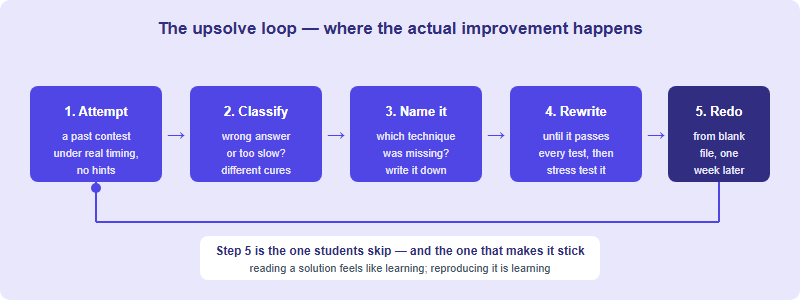
Complexity budgeting is trainable in short, cheap sessions — you do not even need to solve the problems. Take ten past problems and, for each, spend two minutes doing nothing but this: read the constraints, state the target complexity out loud, and name the technique you would reach for. Then check whether the accepted approach matches your guess. Ten problems takes twenty minutes and builds the reflex faster than solving two problems slowly.
Then run the full loop on complete past contests under timed conditions, using our practice archive and the topic breakdowns on our resources page. The goal for the season is simple and measurable: by your first contest, you should never again write ninety lines of code before you have decided what complexity you were aiming for. Registration and participation remain on usaco.org; the practice material itself is ours — a collected past-contest set with worked solutions for many of the years — so ask us if you want the compiled pack.
Frequently asked questions
Why does my solution pass the samples but score zero?
Samples are small. The official data includes large cases designed to reject brute force, so a correct but slow approach fails on running time.
Is time limit exceeded fixed by writing faster code?
Rarely. Micro-optimisation cannot rescue the wrong complexity class. You normally need a different algorithm, not a tidier version of the same one.
Should I submit a brute force I know is too slow?
Usually yes. It can bank partial credit and doubles as a reference implementation for checking your faster solution against random inputs.
How do I know what complexity a problem wants?
Read the input bound first and work backwards, using the constraint ladder as a heuristic. Official time limits appear on each problem statement.
This is an independent guide operated by Hanlin Education for China-based international-school students. It is NOT affiliated with, endorsed by, or sponsored by USACO (the USA Computing Olympiad). Contest formats, time limits, scoring and promotion cutoffs are set by USACO and change between seasons — always confirm current details on usaco.org, where registration and participation take place. If you spot an error in this article, we will correct it within 7 working days.