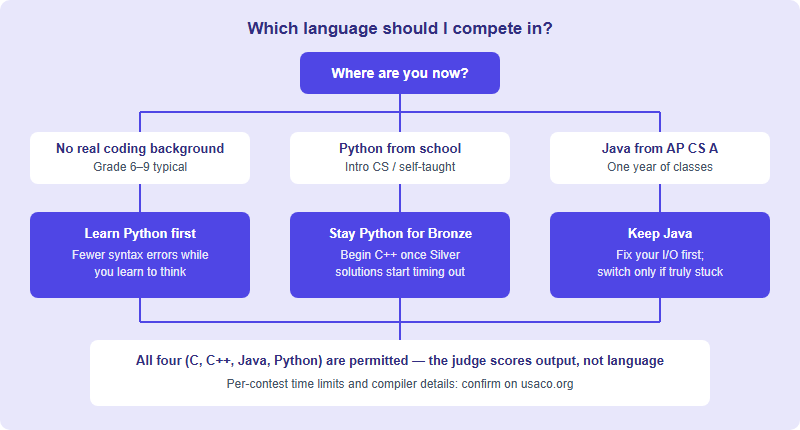
USACO accepts C, C++, Java and Python, so you may compete in whichever you know best — the judge does not award points for language choice. In practice most students should start in the language they already write fluently, and plan a move to C++ before Gold, because at higher divisions the same correct algorithm has to run inside the same time limit with far less headroom.
What USACO actually allows — and what it does not tell you
The official position is simple: the contest is language-agnostic within a permitted set of C, C++, Java and Python. There is no separate Python division, no bonus for writing C, and no penalty for using a language your school taught you. USACO is free to enter and open to students worldwide, including students based in China, and registration is handled entirely on usaco.org — not through any third party.
What the permitted-language list does not tell you is the thing students actually need: how much running-time headroom each language gets on a given problem. Compiler versions, per-language time limits and any allowances for slower languages are decided per contest and stated in the official material, and they can change between seasons. Do not assume a rule you read on a forum three years ago still holds — read the problem statement and the current rules on usaco.org before contest day, and check the site's own rules summary for orientation.
| Language | Realistic ceiling | Biggest strength | Biggest liability |
|---|---|---|---|
| C++ | Platinum and beyond | Standard library (sort, set, map, priority_queue, vector) plus a small constant factor | Steeper syntax; undefined behaviour bites beginners |
| Java | Comfortably through Gold for most students | Strong collections, clear error messages, no manual memory | Verbose I/O; naive input reading is a classic time sink |
| Python | Bronze reliably; Silver with care | Fastest to write and debug; least code per idea | Interpreted overhead on tight loops; recursion depth limits |
| C | Technically any division | Maximum control | No standard containers — you rebuild what C++ gives free |
Why C++ takes over at the top — it is the constant factor, not the algorithm
Students often misread the advice “use C++” as “C++ lets you solve harder problems.” It does not. A binary search is a binary search in every language. What changes is the constant factor: how much work the machine does per logical step. An interpreted loop carries per-iteration overhead that a compiled loop does not. When a problem sits comfortably inside the limit, that overhead is invisible. When a problem is designed so that the intended solution uses most of the available time, the overhead is the difference between full marks and nothing.
This is why the language question is really a division question. At Bronze, tasks generally reward careful case analysis and simulation over heavy computation, so a clean Python solution usually has room to spare. Moving up the ladder — Bronze, then Silver, then Gold, then Platinum — the intended solutions get heavier, input sizes grow, and the headroom shrinks. Somewhere in that climb, a solution that is algorithmically correct starts failing on running time alone.
The second C++ advantage is the standard library. Sorting, ordered sets, hash maps, priority queues and dynamic arrays are all one line away and all fast. In C you would write them yourself; in Python you get them but pay interpretation overhead on every access inside a tight loop. That library convenience is why C++, not C, is the practical top-division default.
Where Python is genuinely fine — and the three places it breaks
Do not let anyone shame you out of Python at the start. Python has a real competitive advantage that matters more than raw speed for a first season: you write less code, so you make fewer mistakes, and you debug faster under time pressure. In a four-hour contest block (five at the US Open) with about three problems, the ability to get a working solution down quickly is worth a lot.
Python breaks down predictably in three places, and knowing them is more useful than a blanket rule:
- Deep loops over large input. Once your solution needs to touch hundreds of thousands of elements several times over, per-iteration overhead becomes the bottleneck even though your algorithm is right.
- Recursion depth. CPython caps recursion by default, so a deep depth-first search on a long path can raise a runtime error rather than a wrong answer. Raising the limit with
sys.setrecursionlimithelps but is not free; rewriting the traversal iteratively with an explicit stack is the durable fix. - Naive input reading. Reading a large input line by line with
input()is markedly slower than reading the whole stream at once. Usesys.stdinand parse in bulk.
Note that the second and third of these are properties of Python itself, not USACO rules — which means you can test them on your own machine today, without waiting for a contest.
If you already take AP Computer Science A, you are further ahead than you think
A fair number of students arrive at this question from the other direction: they are already writing Java because their school runs AP Computer Science A, and they want to know whether that counts for anything here. Our teaching team’s view, from running both, is that it counts for a great deal at the entry division — and for more than the obvious reason.
The obvious reason is that the language is literally the same one. The College Board describes AP Computer Science A as a course in which you “design and implement computer programs using a subset of the Java programming language”, and Java is on the permitted list here, so you are not maintaining two sets of syntax habits in the same year. For a student whose timetable is already full, that alone is worth something.
The less obvious reason is that the AP course happens to build the exact toolkit a Bronze round asks for. Bronze is simulation and careful brute force: read a grid, walk it, count something, handle the edges without an off-by-one. The AP syllabus spends its time on arrays, 2D arrays, nested selection and iteration, and writing and debugging your own methods — which is that toolkit, taught properly, over a school year. A student who has finished AP Computer Science A and sits Bronze is usually not learning new machinery. They are learning to apply machinery they already have, under a clock, to a problem statement written in unfamiliar English. That is a real head start, and it is why we normally tell AP CSA students to enter rather than to spend another season preparing.
Be clear-eyed about where it stops, though. The overlap thins sharply at Silver. Silver wants a complexity estimate made before you start typing, sorting used as an argument rather than a utility, prefix sums, binary search on the answer, and graph traversal — none of which is on the AP syllabus, because none of it is what that course is for. The same goes for input and output fast enough not to waste a correct algorithm: AP CSA never has to care, and a Silver round does.
| What AP CSA already gave you | Where it takes you | What you still have to add |
|---|---|---|
| Java syntax you no longer think about | Every division | — |
| Arrays, 2D arrays, nested loops | Most of Bronze | Reading the statement fast enough |
| Writing and debugging your own methods | Bronze, and it keeps paying | Decomposing under a fixed clock |
| Testing habits | Bronze upward | Complexity estimated before you type |
| — | Silver onward | Sorting as argument, prefix sums, binary search, graph traversal, buffered I/O |
The practical consequence: if you are taking AP Computer Science A, enter your first season in Java rather than pausing to learn a contest language first — you are closer to Bronze than the syllabus difference suggests. Keep the buffered input and StringBuilder discipline from the start, and treat the move to C++ as a between-seasons decision if and when the constant factor starts costing you points, never as a mid-season rescue.
Fix your input and output before you change language
A surprising number of “I need to switch to C++” moments are actually “my I/O is slow” moments. Before you rewrite your toolkit, rewrite your reading and writing:
| Language | Slow habit | Fast habit |
|---|---|---|
| Python | input() in a loop; printing inside a loop |
sys.stdin bulk read and split; build a list, print once with '\n'.join |
| Java | Scanner for large input; System.out.println per line |
BufferedReader with StringTokenizer; accumulate in StringBuilder |
| C++ | Unsynchronised mixing of C and C++ streams | ios_base::sync_with_stdio(false) and untied cin, or use scanf/printf |
One contest-day detail deserves emphasis: check on the official statement whether the task reads from standard input or from named files, and match it exactly. A solution that is perfect but reads from the wrong place scores nothing, and this is entirely avoidable by reading the statement rather than reusing an old template on autopilot.
How to migrate to C++ without losing a season
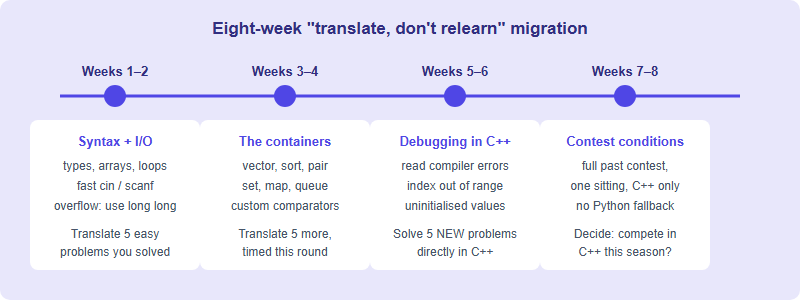
The mistake we see most often in coaching Chinese international-school students is treating the switch as “start over.” You are not relearning problem solving; you are relearning notation. Students who accept that finish the transition far faster than students who go back to printing triangles of stars.
The method that works is translate, do not relearn: take problems you have already solved in Python and rewrite them in C++. You know the answer, so any failure is purely a language failure, and the feedback loop is immediate. Doing twenty such translations teaches more usable C++ than a month of tutorials.
The one rule that overrides everything: do not switch inside a season
Language migration is a training-period activity. The worst possible time to change toolkit is the week before a contest, and the second worst is between the first and second contests of a season, when you are mid-climb and every result counts toward where you sit next time.
Because promotion works by clearing a scoring cutoff on a given contest — recent cutoffs have sat in roughly the 650–750 range out of 1000, and the exact figure varies contest to contest — a half-finished migration can cost you a division promotion that your algorithmic ability had already earned. Check the historical picture on our promotion cutoff overview, and confirm every current figure on usaco.org.
The clean calendar looks like this: migrate in the off-season, when there is nothing to lose; arrive at the first contest of the season with one language you can write without thinking. If you are mid-season and your solutions are timing out, the right move is usually not a new language but a better algorithm — fix the complexity first, and use our past-contest practice archive to test whether the rewrite actually holds up under contest conditions.
Frequently asked questions
Can I use Python and still get promoted?
Yes. Python is permitted at every division and many students clear Bronze and Silver cutoffs with it. The pressure grows as intended solutions get heavier.
Do I have to know C++ to enter USACO?
No. C, C++, Java and Python are all permitted. Enter in whichever you write fluently and register on usaco.org.
Is Java too slow for Gold?
Java is generally workable through Gold for most students, provided you use buffered input and build output in a StringBuilder rather than printing line by line.
Can I write different problems in different languages?
Submissions are per problem, so mixing is technically possible, but it splits your practice. Pick one contest language and stay with it for the season.
This is an independent guide operated by Hanlin Education for China-based international-school students. It is NOT affiliated with, endorsed by, or sponsored by USACO (the USA Computing Olympiad). Contest formats, permitted languages, time limits and cutoffs are set by USACO and change between seasons — always confirm current details on usaco.org, where registration and participation take place. If you spot an error in this article, we will correct it within 7 working days.