The USACO season runs roughly from December to March and is built from three online contests plus a final US Open. Each contest opens a multi-day window in which you pick your own contiguous four-to-five-hour block to compete, and you can promote between divisions mid-season by clearing a cutoff. Below is the reliable season shape plus an estimated 2026-27 calendar. Treat every specific date as provisional and confirm it on usaco.org.
The Reliable Shape of a USACO Season
Even before exact dates are published, the structure of a USACO season is remarkably consistent from year to year, which makes planning possible. A typical season contains four contests: three online contests, held roughly in December, January, and February, followed by the US Open around March.
Every contest shares the same core format. You get about three problems worth 1000 total points, and you solve them inside a single self-chosen contiguous window of roughly four to five hours that sits within a longer multi-day access period. That windowed design is what makes USACO practical across time zones, because a student in China does not have to compete at an inconvenient fixed hour. Confirm the exact per-contest window and rules on usaco.org, since the organisers set them each season.
The 2026-27 Estimated Timeline
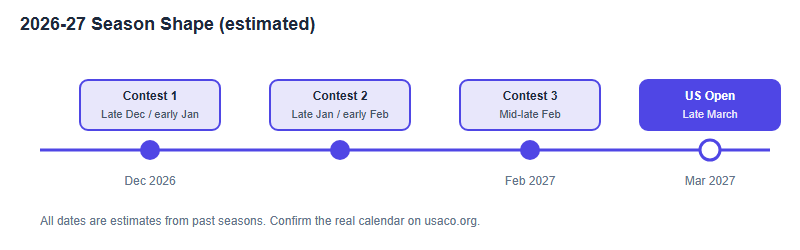
The table below projects the 2026-27 calendar from the pattern of past seasons. These are estimates, not official dates. USACO publishes the real schedule on usaco.org, and it is the only source you should rely on when booking your own contest window.
| Contest | Estimated window (provisional) | Format | Status |
|---|---|---|---|
| Online Contest 1 | Late Dec 2026 / early Jan 2027 | ~3 problems, 1000 points, self-chosen 4-5h | Estimate — confirm on usaco.org |
| Online Contest 2 | Around 30 Jan – 2 Feb 2027 | ~3 problems, 1000 points, self-chosen 4-5h | Estimate — confirm on usaco.org |
| Online Contest 3 | Mid-to-late Feb 2027 | ~3 problems, 1000 points, self-chosen 4-5h | Estimate — confirm on usaco.org |
| US Open | Late March 2027 (proctored) | Season championship | Estimate — confirm on usaco.org |
Why publish estimates at all? Because planning a practice schedule requires a rough timeline. If you know the season likely begins in late December, you can work backwards to decide when to finish your fundamentals and start timed practice. Just never treat a projected date as a booking; check the official calendar before every contest.
How Divisions and Promotion Fit the Calendar
USACO has four divisions in a fixed order: Bronze, then Silver, then Gold, then Platinum. Everyone starts in Bronze, and the calendar and the ladder interact in a way that rewards a strong start to the season.
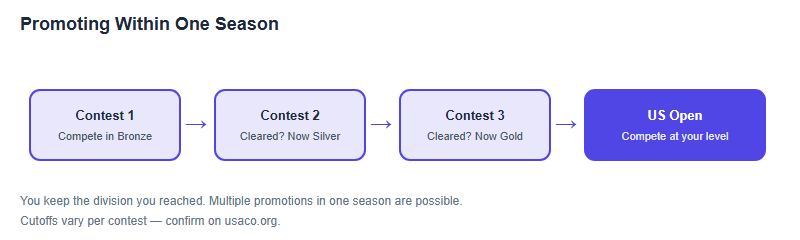
Promotion happens through the contests themselves. If you clear a division's promotion cutoff during a contest, you move up, and crucially you can promote more than once in a single season. A student who clears Bronze in Contest 1 might compete in Silver for Contest 2, and if they clear Silver too, move to Gold for Contest 3. That is why beginning the season well prepared matters: an early promotion gives you more contests at the higher level. Recent cutoffs have often fallen around 650 to 750 of 1000, but they vary per contest, so check our promotion cutoff reference and confirm against usaco.org.
What If You Miss a Contest?
One of the calmest features of the USACO calendar is that no single contest is make-or-break. Because a season contains several contests, missing one — whether through illness, a school clash, or a scheduling mistake — is not fatal; you simply aim for the next one. This is a genuine advantage of the multi-contest structure over a once-a-year exam, and it lowers the pressure on any individual date.
What matters is that promotion happens by clearing a cutoff in any contest, so steady readiness across the whole December-to-March span serves you better than peaking for one fixed day. Exactly how a missed contest interacts with your standing, and whether and how your division carries between contests and seasons, is a detail to confirm on usaco.org rather than assume, since these administrative rules are set by the organisers and can change.
What the US Open Is and Why It Is Different
The US Open closes the season and functions as its championship. It is more heavily proctored than the routine online contests, reflecting its higher stakes. For the vast majority of international students, the US Open is simply the final and most prestigious contest of the year, and a strong Platinum result there is a genuinely elite achievement.
Beyond the online season, the very top scorers are invited to a training camp, from which the four-member Team USA is selected to represent the United States at the International Olympiad in Informatics (IOI). That national-team pathway is specific to the USA, but the online contests and the US Open are open to everyone, which is what makes USACO such a widely used global benchmark of programming skill.
Before Contest 1: A Pre-Season Checklist
Because the season likely opens in late December, the autumn months are your real preparation window. Contest day should be about solving problems, not fighting logistics, and the checklist below removes the avoidable friction before it can cost you points.
- Create your usaco.org account early. Registration is free and globally open, so set up and verify your login weeks ahead rather than scrambling on contest day.
- Lock in your language and your I/O. Decide whether you will use C, C++, Java, or Python, and make sure you can reliably read input and print output in the exact format the grader expects. A correct algorithm that mishandles input scores nothing.
- Run a full-length timed mock. Sit at least one complete four-to-five-hour practice session before the real thing so the endurance and pacing feel familiar. Most beginners misjudge how quickly the window passes.
- Prepare your environment. A stable editor and compiler, a reliable internet connection, and a genuinely quiet block of time all matter. Interruptions during a long window are costly.
- Read the current rules on usaco.org. Confirm whether a given contest is open or proctored (the US Open is proctored), what resources are allowed, and how submissions work. Rules can change between seasons.
- Choose your window in advance. Look at the multi-day access period and pick your four-to-five-hour block ahead of time, accounting for the China time difference so you compete when you are rested rather than at 3 a.m.
None of this is glamorous, but the students who handle it early consistently outperform equally skilled students who leave it to the last hour.
How to Plan Your Season From China
Three practical moves turn this calendar into a workable plan.
- Register early and for free on usaco.org. USACO is globally open with no nationality restriction, so there is no barrier to signing up well before Contest 1.
- Use the windowed format to your advantage. Because each contest spans several days and you pick your own four-to-five-hour block, you can schedule around school and choose a time when you are rested. This is the single biggest logistical advantage USACO offers international students: there is no fixed global start time to clash with a school day or an exam. Confirm each window on usaco.org.
- Practise between contests, not just before the first. The gaps between contests are where promotions are won. Work through past problems by division; you can request our gathered practice pack via the site footer contact and see how each season is organised on our past contests page.
A workable weekly cadence during the season looks like this: in the days right after each contest, review the problems you could not finish while the experience is fresh; in the middle weeks, drill the specific topics that tripped you up; and in the final days before the next contest, do a light timed set to stay sharp without burning out. This loop — compete, review, drill, sharpen — is what steadily converts effort into promotions across a season rather than a single lucky contest.
Plan around the reliable December-to-March shape, keep the estimated dates in pencil, and let usaco.org have the final word on every specific detail. If a season ever adds, moves, or reformats a contest, the official calendar will reflect it long before any third-party guide does.
Frequently Asked Questions
How many contests are in a USACO season?
Typically four: three online contests around December, January, and February, plus the US Open around March. Confirm the exact count and dates on usaco.org.
Are the 2026-27 dates official yet?
No. The dates in this guide are estimates from past seasons. USACO publishes the official schedule on usaco.org, which is the only source to book your contest window against.
Can I promote more than once in a single season?
Yes. If you clear the promotion cutoff in successive contests, you can move up multiple divisions within one season. Cutoffs vary per contest, so confirm on usaco.org.
Does the multi-day window mean I can compete anytime?
You choose one contiguous four-to-five-hour block inside the contest window, not unlimited time. Check the current window and rules on usaco.org.
This is an independent guide operated by Hanlin Education for China-based international-school students. It is not affiliated with, endorsed by, or sponsored by USACO (the USA Computing Olympiad). Competition facts such as dates, cutoffs, and rules vary year to year; always confirm current details on usaco.org. Any error will be corrected within 7 working days of notice.