Yes, a motivated grade 6-8 student can genuinely start USACO. The USA Computing Olympiad is free, globally open, and carries no nationality or minimum-age rule, so a student at an international school in China can register directly on usaco.org and compete from the Bronze division. Bronze rewards careful problem-reading and clean, basic code far more than advanced mathematics, which makes it a realistic first target for younger beginners. Here is the full zero-to-Bronze roadmap.
Why Grade 6-8 Is a Genuine Starting Line
Many families assume competitive programming is a high-school-only pursuit. It is not. USACO sets no minimum age or grade, so the only real barrier is coding skill, not a birthday. Bronze exists precisely as an on-ramp division, and complete beginners routinely enter there.
The contest format is also friendlier for younger students than a traditional sit-down exam. Each USACO contest opens a multi-day window, and inside that window you choose your own contiguous block of roughly four to five hours to compete. There is no single fixed national timeslot that clashes with school or sleep. (Always confirm the exact window and current rules for each contest on usaco.org, because these details can change season to season.)
Starting early also buys the most valuable resource in competitive programming: time. A student who begins in grade 6-8 can spend a season or two absorbing fundamentals with no pressure, long before the years when applications and exams compete for attention. That head start, not raw talent, is what most separates students who eventually reach the higher divisions.
How the Division Ladder Works
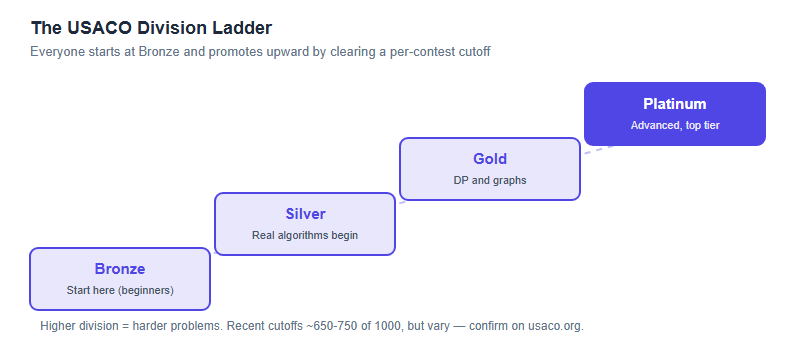
USACO has four divisions in a fixed order: Bronze, then Silver, then Gold, then Platinum. Everyone starts in Bronze. You move up by clearing a per-contest promotion cutoff during a contest itself, which means promotion happens through performance, not an application.
Each contest gives you about three problems and 1000 total points, to be solved inside your self-chosen four-to-five-hour window. In recent seasons, promotion cutoffs have often landed somewhere around 650 to 750 out of 1000, but they are set per contest and vary, so treat any single number as indicative only. You can review historical figures on our promotion cutoff page, and always confirm the current season against usaco.org.
What Bronze Actually Tests
The biggest surprise for beginners is how little advanced knowledge Bronze demands. It is not a mathematics olympiad in disguise. Instead, Bronze rewards students who read carefully, translate a problem into exact steps, and handle the awkward edge cases. The table below breaks down the core skill areas.
| Skill area | What it means in plain English | Typical Bronze task |
|---|---|---|
| Careful simulation | Do exactly what the statement says, step by step | Simulate a process or game over N steps |
| Complete search / brute force | Try every reasonable possibility and check it | Test every pair or every small combination |
| Sorting and arrays | Order data, then index into it cleanly | Sort values, then scan for a condition |
| Ad-hoc reasoning | Spot a simple rule or pattern | Count, group, or match items by a rule |
| Edge-case handling | Cover boundaries and unusual inputs | Handle N equal to 1, ties, or size limits |
Notice what is not on that list: advanced dynamic programming, heavy graph theory, segment trees, and hard number theory. Those techniques matter at Silver, Gold, and Platinum, but a Bronze problem almost never needs them. A younger student who writes correct, careful code will beat an older student who reaches for a clever algorithm that the problem never called for.
The Zero-to-Bronze Roadmap
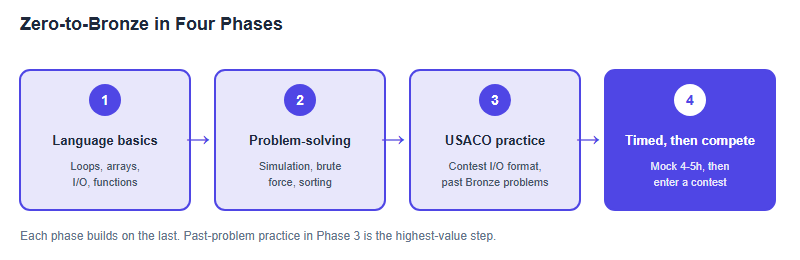
Progress is fastest when you treat learning as ordered phases rather than a scramble. Each phase below builds directly on the one before it, and none should be skipped.
- Phase 1 — Language fundamentals. Variables, loops, conditionals, arrays or lists, functions, and above all reading input and printing output. You cannot solve anything until you can reliably get data in and results out.
- Phase 2 — Problem-solving basics. Practise simulation, brute force, sorting, and simple counting on many small problems. Volume matters here; solving thirty easy problems teaches more than staring at one hard one.
- Phase 3 — USACO-specific practice. Learn the exact contest input/output format, then work through past Bronze problems by topic. Practising old Bronze problems is the single highest-value activity in this entire roadmap.
- Phase 4 — Timed practice, then compete. Do at least one full mock in a four-to-five-hour block so the real contest feels familiar, then register and enter a live contest during its window.
For Phase 3, practising old problems by topic is where most of the improvement happens. We keep a gathered pack of past USACO problems organised by division and theme; you can request it through the contact details in the site footer, and browse how contests are structured on our past contests overview.
Picking Your First Language
USACO accepts C, C++, Java, and Python. For a grade 6-8 beginner, the practical choice usually comes down to Python versus C++.
- Python has the gentlest syntax and lets a young student focus on logic instead of fighting the language. It is an excellent place to start.
- C++ is the long-run standard in competitive programming because it runs fast, which starts to matter at Gold and Platinum where tight time limits can reject a slow but correct solution.
A simple rule: if you just want to begin, pick Python. If you are fairly confident you will pursue USACO seriously for several years, learning C++ early pays off. Either choice is completely valid for Bronze, because Bronze problems are small enough that language speed rarely decides the outcome. What matters far more is writing correct code and testing it.
A Realistic First-Season Expectation
Set expectations honestly. Do not assume you will promote in your first contest. Many strong students spend one or two full seasons in Bronze, and that is a normal, healthy pace rather than a sign of failure. At this stage, success means finishing problems fully and correctly, not reaching for impressive techniques.
The most common beginner mistakes are avoidable with discipline: not reading the entire statement before coding; ignoring the exact input/output format the grader expects; skipping edge-case testing; and over-reaching for an advanced technique a Bronze problem never required. Fix those four habits and Bronze becomes very approachable. For a broader view of how the whole pipeline fits together, our USACO guide hub maps every division and season stage.
A useful habit from the very first week is keeping a simple log of every problem you attempt: the topic, whether you solved it, and, if not, what stopped you. Over a month that log turns vague frustration into a clear list of gaps — perhaps you consistently forget an edge case, or you are strong at simulation but shaky at sorting. Younger students who track their own patterns improve faster than those who simply grind problems at random, because they spend their limited practice time on the weaknesses that actually hold their scores back.
How Much Time Should a Beginner Commit?
There is no official required study time for USACO; what follows is coaching guidance rather than a rule. For a grade 6-8 beginner, consistency beats intensity by a wide margin. A sustainable rhythm of a few focused hours across the week — for example, two shorter problem-solving sessions plus one review session — usually produces more durable progress than a single exhausting weekend marathon. Younger brains in particular absorb new patterns better through short, frequent repetition.
Structure each week around two activities: solving new problems slightly above your comfort level, and carefully reviewing problems you could not finish. The review is where most learning happens, because understanding why a solution works is far more valuable than adding another unsolved problem to the pile. Aim to fully understand one or two past Bronze problems each week rather than skimming ten.
Progress is also non-linear, which is worth telling a young student in advance. You can spend weeks feeling stuck and then have a concept suddenly click, after which a whole cluster of problems becomes solvable. The season's natural rhythm helps here, because a contest arrives roughly once a month from December to March (confirm the calendar on usaco.org), giving built-in checkpoints. Above all, guard against burnout: at grade 6-8 the real goal is building a durable habit and genuine curiosity, not chasing the fastest possible promotion. A student who still enjoys problem-solving after two seasons is in a far stronger position than one who promoted quickly and then quit.
Frequently Asked Questions
Can students in China register for USACO directly?
Yes. USACO is free and globally open with no nationality limit, so you register directly on usaco.org. Confirm the current rules and windows on the official site before each contest.
Is grade 6 too young to start USACO Bronze?
No. There is no minimum age or grade requirement. The only real barrier is coding skill, and Bronze is designed as a beginner on-ramp.
Which programming language should a beginner choose?
Python is the easiest to start with; C++ is the long-term standard for higher divisions. C, C++, Java, and Python are all accepted for every division.
How long does it usually take to clear Bronze?
It varies widely. Many students spend one or two seasons in Bronze. Steady practice on past problems matters far more than trying to rush a promotion.
This is an independent guide operated by Hanlin Education for China-based international-school students. It is not affiliated with, endorsed by, or sponsored by USACO (the USA Computing Olympiad). Competition facts such as dates, cutoffs, and rules vary year to year; always confirm current details on usaco.org. Any error will be corrected within 7 working days of notice.