For many students preparing for the USA Computing Olympiad (USACO), encountering a Time Limit Exceeded (TLE) error while using Python can be demoralizing. The immediate assumption is often that Python is too slow for competitive programming, leading to a premature switch to C++ or Java. That diagnosis is frequently incomplete. A USACO Python TLE does not automatically mean the language is incapable of solving the problem. It often means the specific implementation has hidden inefficiencies, or the chosen algorithm scales poorly with the input constraints.
Understanding the root cause requires separating two distinct factors: algorithmic complexity and language overhead. Algorithmic complexity describes how the number of operations grows as the input size increases, such as O(N²) versus O(N log N). Language overhead describes the constant-factor cost of executing each operation in Python compared with compiled languages such as C++. If your algorithm is fundamentally wrong for the constraints, no amount of micro-optimization will save it. If your algorithm is asymptotically correct but written inefficiently, switching languages may be unnecessary work. This article gives a structured diagnostic workflow so you can identify which factor is actually causing the TLE.
Why “Python Is Too Slow” Is an Incomplete Diagnosis
The statement “Python is too slow” is a heuristic, not a fact. USACO lists C, C++, Java, and Python among supported contest languages. C++ generally has lower per-operation overhead than Python, but there is no official rule banning Python or guaranteeing failure. The practical question is not whether Python exists as an option. The practical question is whether this particular algorithm, with this particular implementation, fits the problem’s constraints.
When a Python solution TLEs, the failure usually comes from one of three sources: incorrect complexity analysis, inefficient input or data-structure choices, or accidental nested loops that increase the effective operation count beyond what was intended. Before blaming the interpreter, verify that your solution’s theoretical performance matches the constraints. If a problem allows N up to 100,000 and your solution runs in O(N²), it may TLE in any language. If your solution runs in O(N log N) but still TLEs in Python, then Python constant factors become a relevant suspect.
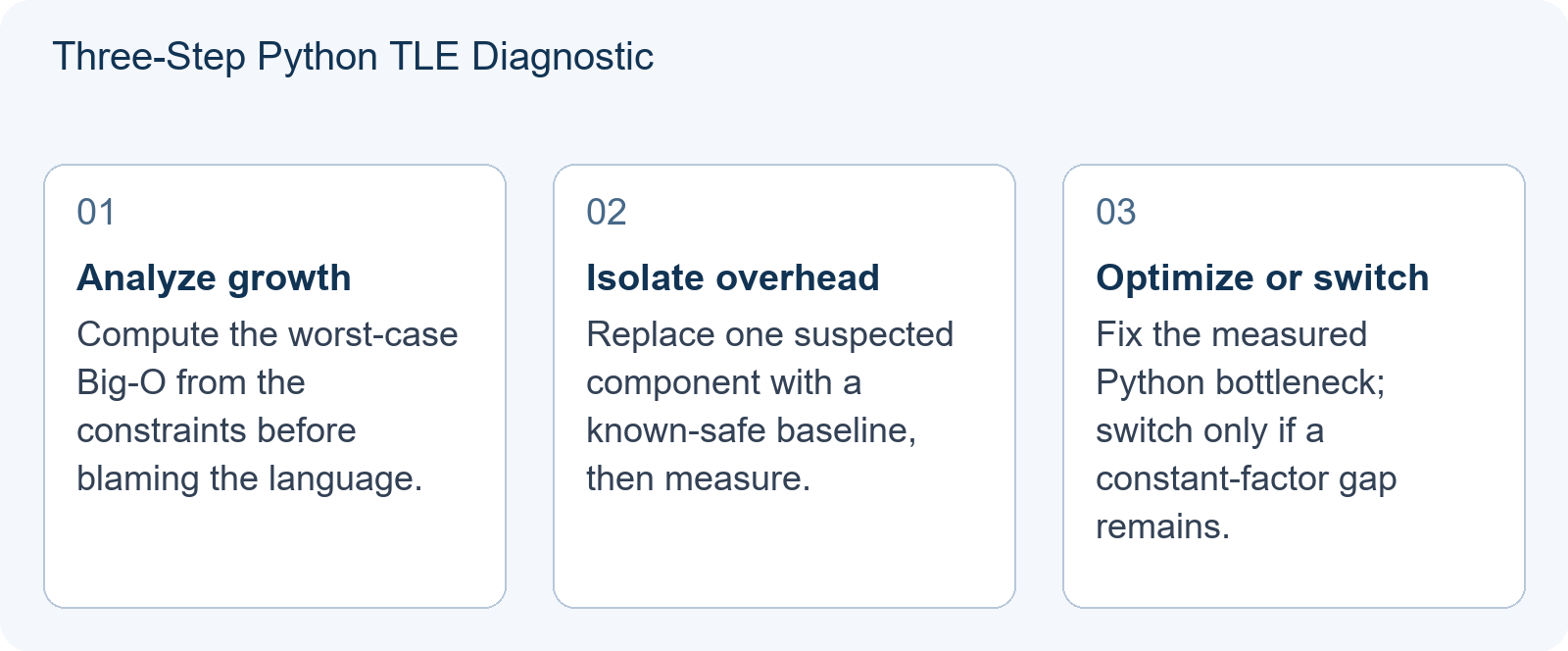
Step 1: Compute Worst-Case Growth From the Constraints
The first step is to calculate the worst-case number of operations your code performs, expressed in Big-O notation relative to the input size N. Do this independently of the programming language. Read the constraints in the problem statement, such as N ≤ 10^5, and estimate how many basic steps your algorithm takes at that maximum size.
Consider a clearly labelled teaching illustration. Suppose N = 100,000. An O(N²) algorithm performs about 100,000 × 100,000 = 10,000,000,000, or 10^10, basic iterations. An O(N log N) algorithm using log base 2 performs about 100,000 × 17 = 1,700,000 iterations; using the more exact log₂(100,000) ≈ 16.61 gives about 1.66 million. With the rounded 1.7 million figure, the O(N²) count is roughly 5,900 times larger. This illustration is hypothetical and is not an official USACO time limit. Its purpose is to show scale: if your code contains nested loops over the full input range, you have identified an algorithmic bottleneck. No Python micro-optimization can close a 5,900× gap.
At this stage, write down two numbers: the maximum input size from the problem statement and your estimated operation count at that size. If the estimated count is far beyond what your local machine can handle in the time available to you, the algorithm must change. This is also where many Bronze and Silver students discover accidental O(N²) behavior inside what looked like a linear scan. For a broader treatment of constraint math, see Why Your Correct Solution Scores Zero: Complexity Budgeting for USACO Bronze and Silver.
Step 2: Test With a Known-Safe Complexity Baseline
Once you have analyzed the current approach, test whether the TLE persists when you replace the suspected core component with a known-safe version. For example, if you suspect your sorting method is the issue, replace it with Python’s built-in sorted(), which is implemented in C and highly optimized. If the TLE disappears, your original implementation had excessive overhead or a worse hidden complexity. If the TLE remains, the problem likely lies in the surrounding logic or in the fundamental choice of algorithm.
This isolation technique prevents a common waste of time: rewriting the entire program in C++ only to discover that the new version also TLEs because the underlying algorithm was still O(N²). By verifying that a theoretically efficient algorithm passes in Python, you confirm that the language itself is not the primary barrier for that specific problem type.
The baseline does not need to be a full alternative solution. It can be a library primitive, a simpler reference approach, or a smaller part of the code that you replace temporarily. The key is to change one major component at a time and observe whether the runtime changes. If the runtime barely changes, the bottleneck is elsewhere. If it drops dramatically, you have found the part of the program that deserves attention.
Step 3: Isolate Python-Specific Overhead and Optimize the Measured Bottleneck
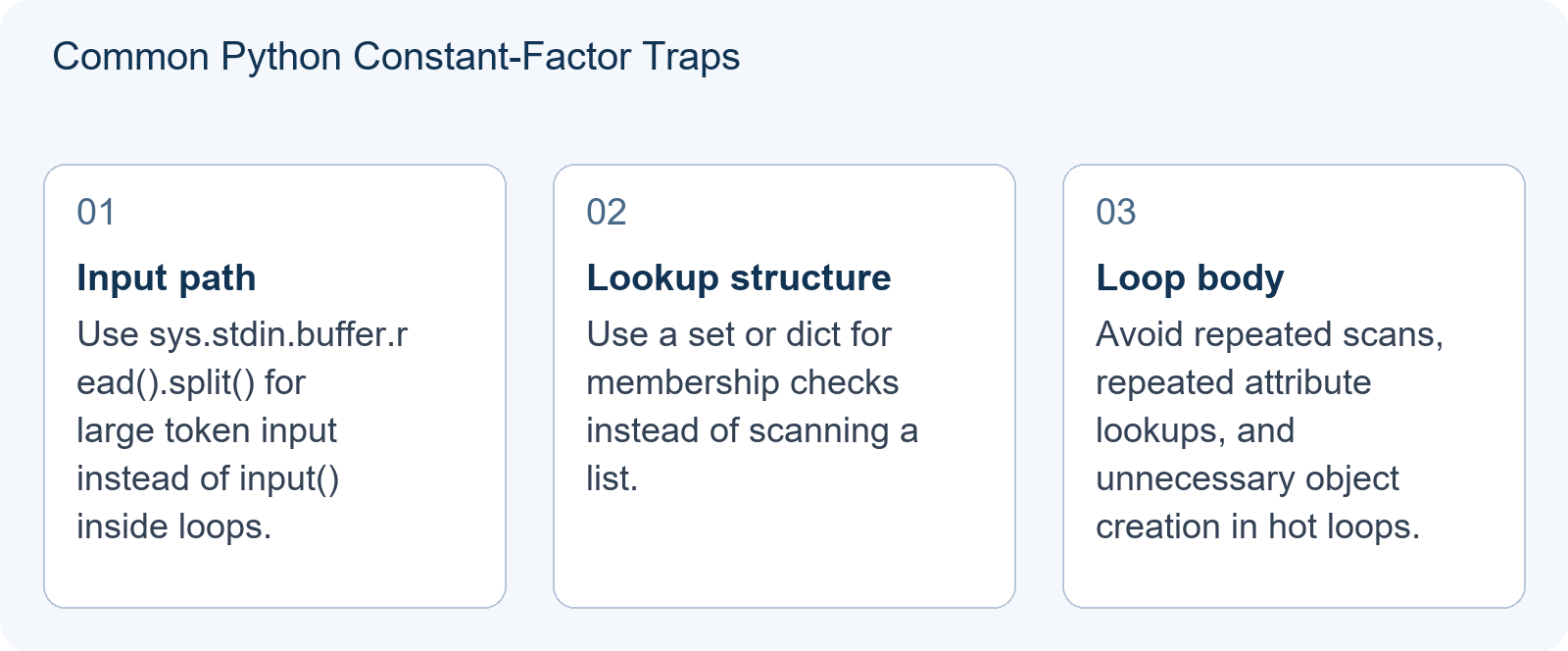
If your algorithm is theoretically sound, such as O(N log N), but still TLEs, examine common sources of Python overhead. These include inefficient input reading, excessive function calls, object creation in tight loops, and repeated list scans. Do not optimize by guesswork. Measure the effect of each change on worst-case local tests.
Input handling. Using input() inside a loop for large datasets adds Python-level overhead for every line. Reading all tokens at once with sys.stdin.buffer.read().split() can significantly reduce input time. This is a constant-factor optimization, but constant factors matter when the operation count is already high.
Function calls and recursion. Python function calls are relatively expensive. If you have deep recursion or many small function calls in a hot loop, consider iterative alternatives or local variable binding. Also remember that exceeding the recursion limit usually produces a runtime error, not a TLE, so treat that as a different diagnosis.
Data structures. Checking membership in a list with x in my_list is O(N), while checking in a set or dictionary is O(1) on average. Accidentally using lists for lookups inside nested loops can turn an O(N) solution into O(N²). Always verify that your data structure choices match the access pattern required by the algorithm.
Repeated scans and object creation. If you scan the same list multiple times inside a loop, or create many temporary objects, the constant factor grows. Move invariants outside the loop, use local variables for repeated attribute lookups, and avoid building unnecessary lists. These changes are worth doing only after you have identified the bottleneck. For nested-loop diagnosis specifically, see USACO Bronze Exhaustive Search: Bound the Work Before Writing Nested Loops.
After each change, re-run a worst-case local test. Use time.perf_counter() or a similar timer, and generate input at the maximum constraint size rather than relying on the sample test. Sometimes fixing one bottleneck reveals another. Iterative refinement ensures you address the actual limiting factor rather than chasing ghosts.
Decision Rule: Keep Optimizing Python or Switch to C++
There comes a point where further Python optimization yields diminishing returns. For many Bronze and Silver tasks, Python is sufficient if the algorithm is correct and input handling is efficient. In any division, when the measured runtime gap is mostly constant-factor overhead, a compiled language may provide more headroom. As a teaching guideline, consider switching to C++ if you have exhausted Python optimizations and still face a tight margin.
Switch to C++ if:
- You have verified that your algorithm is optimal or near-optimal for the constraints.
- You have minimized Python overhead through fast I/O, efficient data structures, and removal of repeated scans.
- Your local worst-case timing remains far above what you can reasonably expect to fit, and the remaining gap is a constant-factor gap rather than an asymptotic one.
Stay with Python if:
- Your algorithm is suboptimal. Fix the algorithm first.
- The TLE is caused by obvious inefficiencies such as slow input or list lookups.
- You are still learning complexity analysis and need to build the diagnostic habit before adding a second language.
For a general language-choice comparison, see C++, Python or Java for USACO? Choosing Your Contest Language — and When to Switch. The goal is not to prove that one language is universally better. The goal is to understand why a particular solution fails and whether the remaining cost is algorithmic or linguistic.
How to Use This Workflow in Training
Selecting appropriate algorithms, evaluating complexity, and writing/debugging within limited resources are long-term training priorities. That is exactly the skill this workflow builds. When you review a TLE, write a short diagnostic record: the problem constraints, your estimated complexity, the known-safe baseline you tried, the Python overhead you measured, and the final decision. Over time, these records reveal patterns. Some students discover they consistently underestimate nested loops. Others discover that their algorithms are correct but their input path is slow. The diagnosis matters more than the language label.
If you seek feedback from a coach or peer, bring the same evidence: your code, the constraints, your estimated complexity, the local test results, and the specific changes you tried. That turns a vague question about Python speed into a precise code-review question. It also keeps the conversation focused on the next useful change rather than on an emotional debate about programming languages.
Frequently Asked Questions
Is Python a supported USACO language?
Yes. USACO lists C, C++, Java, and Python among its supported contest languages.
Can switching to C++ always fix a TLE?
No. If the algorithm has poor complexity, such as O(N²) for a large N, switching languages will not fix the TLE. You must first correct the algorithm.
What Python overhead should I check first?
Check inefficient input and output first, then list-versus-set membership checks, then repeated scans or object creation inside hot loops.