Many students can read a USACO problem statement, recognize the likely algorithm family, and still fail to write correct code. They may know BFS, binary search, or prefix sums by name, yet freeze on the page when the story refuses to resemble a textbook example. The bottleneck is rarely syntax or library knowledge; it is the gap between a narrative description and a formal computational model. If you cannot explicitly state what changes, what stays fixed, and what must be remembered, your code will drift from the problem’s intent. This article presents a repeatable USACO problem modeling drill that closes that gap — long before the first line of code.
Why Modeling Is the Bottleneck After Technique Recognition
Once a student has mastered basic data structures, the natural shortcut is pattern matching: “this looks like BFS,” or “this needs dynamic programming.” Pattern matching only works when the story actually fits the template. USACO problems, especially from Silver upward, introduce small variations in constraints or state definitions that quietly break a standard template. A graph problem may carry a time dimension. A dynamic-programming problem may require a second axis for a resource budget the statement mentions in passing. If you jump straight to coding from the visual pattern, you can miss those dimensions entirely and still believe you wrote a correct solution.
The missing skill is abstraction: turning the scenario into variables, transitions, and rules that an algorithm can process. A 2026 Hanlin course-account article argued that while generative AI increasingly writes template code, “problem modeling + algorithm decision-making” remains the core capability AI cannot replace. Whether or not you use AI tools, that framing is worth adopting for practice: the durable skill is modeling, and the mechanical part is what shrinks.
USACO runs four divisions in sequence — Bronze, Silver, Gold and Platinum — with multiple online contests per season and automatic judging on every submission, so the modeling discipline matters at every level. The cost of a shaky model simply grows with division, because the state spaces and constraint tolerances become less forgiving.
Read for Entities, Operations, Quantities, and Constraints
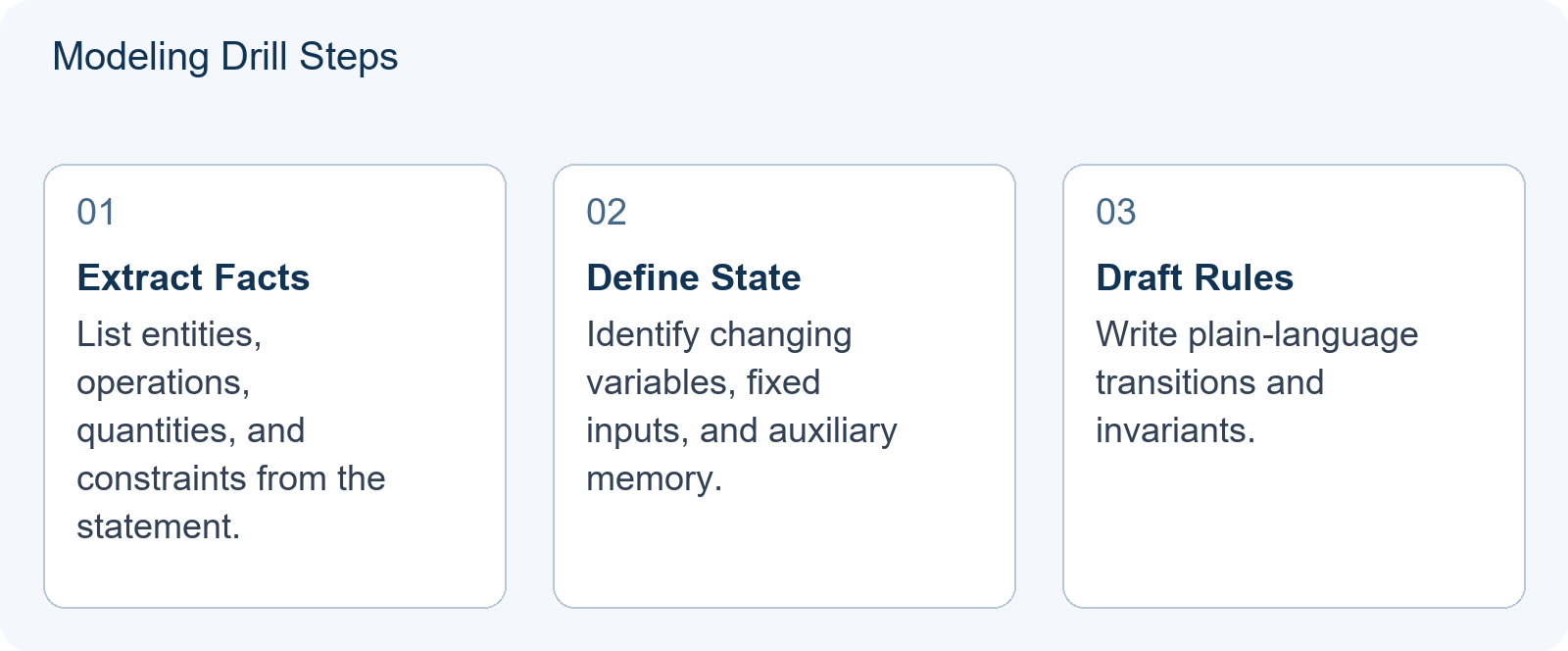
Before thinking about code, perform a structured extraction of the problem statement. Four categories cover nearly everything you need:
- Entities: the objects in the story — cows, fields, edges, intervals, schedules, players, sensors.
- Operations: the actions that change the system — moving, merging, querying, adding, deleting, jumping, waiting.
- Quantities: the numbers that matter — distances, costs, counts, indices, times, capacities.
- Constraints: the limits that decide feasibility — sizes such as N up to 10^5, time and memory limits, index base (0-based or 1-based), and whether a value can be negative or zero.
This step prevents a specific class of error: misreading the problem’s physical world. A common trap is ignoring whether indices start at zero or one and then carrying that mistake into every loop bound. Another is assuming the input is sorted when the statement never says so. By listing the four categories explicitly on paper or in a comment block, you create a checklist that later informs variable declarations and boundary conditions. The same reading order the site lays out in its How to Read a USACO Problem Statement in English: The Reading Order, and the Words That Change the Answer feeds directly into this modeling step — but reading comprehension alone does not finish the job. The model is what you build after the read.
Define State: What Changes, What Stays Fixed, What Must Be Remembered
The heart of modeling is the state: the minimal set of information needed to determine what can happen next. Ask three questions and answer each in a single sentence.
- What changes? These become mutable variables — current position, remaining energy, accumulated sum, chosen count.
- What stays fixed? These are constants or pre-computed inputs — map layout, initial positions, alphabet size, row count.
- What must be remembered? These are auxiliary structures — a visited array, parent pointers, a prefix-sum array, a running maximum, a queue.
If you cannot articulate the state, any algorithm choice is premature. In a shortest-path problem, the state may be just the node identifier. But if edges depend on time or on which resources have already been consumed, the state becomes a tuple — (node, time) or (node, resource mask). Defining the tuple precisely avoids a subtle bug class in which the algorithm treats two genuinely distinct states as if they were the same. It also exposes when a naive search would revisit the same configuration repeatedly and therefore needs memoization or a different strategy altogether.
Write Update Rules in Plain Language
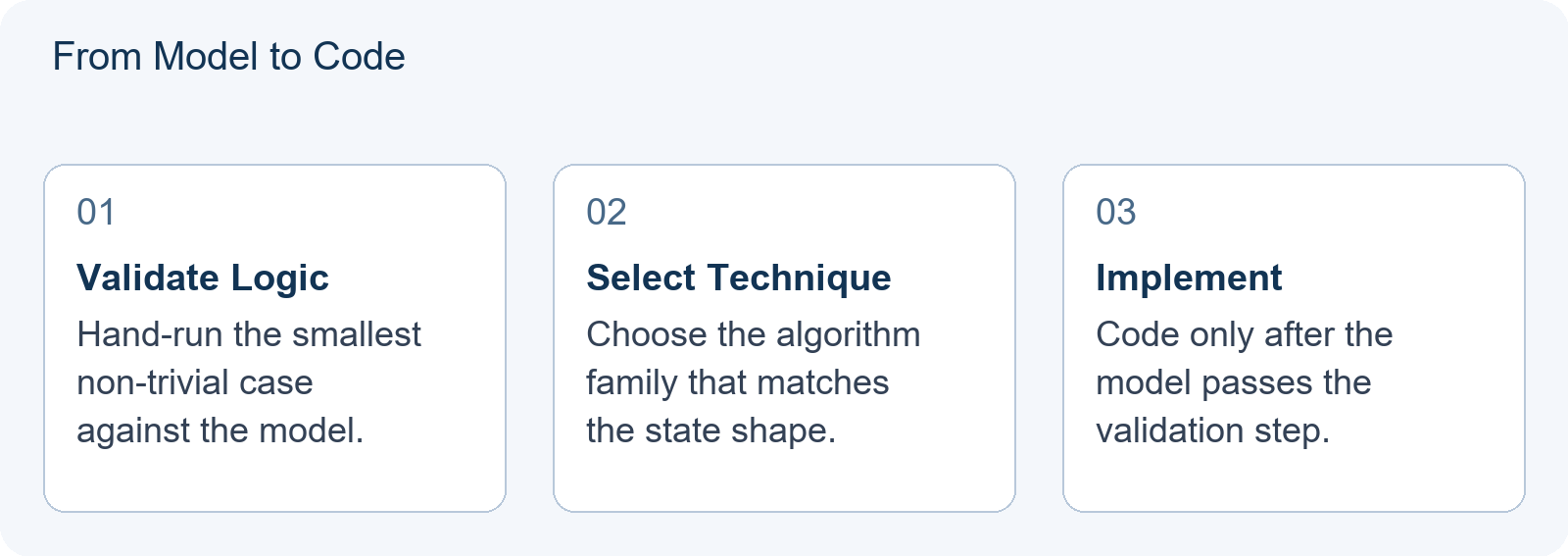
With the state defined, describe how it transitions. Do not write code yet. Use full English sentences of the form: “If I move right, my x-coordinate increases by one and my energy decreases by the cost of that edge.” Then test those sentences against the smallest cases the problem provides. If your verbal rules produce the sample outputs by hand, you have a validated model. If they do not, refine the rules — not the code. This step forces the algorithmic structure to match the problem’s semantics before implementation complexity blurs the picture. It also surfaces required preconditions, such as checking a boundary before accessing an index or refusing to spend a resource you no longer have.
Two tests make this step sharper. First, the dry-run test: pick the smallest non-trivial input and walk through your rules one command at a time, writing down the state after each step. Second, the invariant test: name the quantity that must never violate its limits — battery never negative, position never outside the line, count never exceeds N — and confirm every rule preserves that invariant. When both tests pass, you have earned the right to move to code.
Worked Teaching Illustration: A Hypothetical Simulation
Note: the scenario below is a teaching illustration written for this article. It is not an official USACO contest problem and its parameters are arbitrary.
Consider a hypothetical Bronze-level scenario. A robot starts at position 0 on an infinite number line. It receives a command string C whose characters are ‘L’ (move left), ‘R’ (move right), or ‘S’ (stay). Each ‘L’ or ‘R’ consumes 1 unit of battery; ‘S’ consumes none. The robot begins with B units of battery. If battery is 0 when a move command is read, the robot stops processing the remaining commands. Output the final position.
Applying the drill:
- Entities: robot, battery, command sequence.
- State: a pair (position, remaining_battery), both integers.
- Fixed: starting position 0, the command string, the rule that only ‘L’ and ‘R’ cost battery.
- Update rules: for each character in C — if remaining_battery > 0 and the character is ‘L’, position decreases by 1 and battery decreases by 1; if remaining_battery > 0 and the character is ‘R’, position increases by 1 and battery decreases by 1; if the character is ‘S’, no change to either value; otherwise (battery is 0) stop processing.
- Constraints and invariants: battery is never allowed to drop below 0; the loop must terminate when commands are exhausted or the robot stops early.
Test the model on a small complete case. Let B = 3 and C = “RLSR”.
- Start: (position = 0, battery = 3).
- Read ‘R’: battery > 0, so position = 1, battery = 2.
- Read ‘L’: battery > 0, so position = 0, battery = 1.
- Read ‘S’: no change, so position = 0, battery = 1.
- Read ‘R’: battery > 0, so position = 1, battery = 0.
- Final output: 1.
Now a second case that exercises the early-stop rule. Let B = 2 and C = “RRL”.
- Start: (0, 2). Read ‘R’: (1, 1). Read ‘R’: (2, 0). Read ‘L’: battery is 0, so the loop stops.
- Final output: 2.
Both traces are hand-checkable. Notice that the model produced the answer without a single line of code. Also notice how a naïve reading — “every command consumes a battery unit” — would change the first trace: after the ‘S’ the battery would already be 0 at position 0, so the final ‘R’ could never be executed and the answer would come out as 0 instead of 1. The plain-language rules caught the mistake before it reached the editor.
This model then translates almost directly into a single pass over the string with two integer accumulators and one early-exit condition. That is the whole algorithm. Because the state was defined first, no additional data structure was needed and no boundary case was overlooked.
Translate the Model Into Algorithm Families
Only after the state and update rules are stable should you commit to an algorithm. The model dictates the technique; the technique does not dictate the model. A short mapping helps:
- If the state advances sequentially without branching, the model is a simulation — a single loop with a small tuple of integers.
- If the state branches and you need every reachable configuration, the model is a graph search (BFS for shortest, DFS for existence) or a DP over the same state tuple.
- If the model needs repeated range aggregates over a fixed array, the state includes a running summary — prefix sums or a segment tree are natural.
- If the model needs monotone feasibility over a parameter, the state supports a binary-search-on-answer pattern.
- If the model is greedy, it must be defended by an exchange argument, not by intuition.
This decision process is more robust than keyword guessing. For a broader set of Bronze-side patterns, the site’s The Five Shapes of a USACO Bronze Problem: How to Tell Which One You Are Looking At in Two Minutes is a useful companion to the modeling drill you have just practised.
A Five-Minute Modeling Checklist Before Coding
Use this short audit before opening your editor. Each line should have a one-sentence answer in your own words.
- Have I listed every entity, operation, quantity, and constraint the statement names?
- Can I write the state as a tuple of variables, and say why each element must be remembered?
- Have I written the transition rules in plain English, one move at a time?
- Does every rule preserve the invariants — no negative battery, no out-of-range index, no unused resource?
- Does my hand-run of the smallest non-trivial case reproduce the sample output exactly?
If any answer is “no,” do not code. Refine the model. In practice this discipline reduces debugging time sharply because most logic errors originate in a flawed model, not in a syntax typo. For the debugging step that follows a failed submission, the site’s How to Practise With Past USACO Problems: The Upsolving Loop That Actually Builds Skill is the natural next read.
Putting the Drill to Work
USACO problem modeling is not a mysterious talent; it is a sequence of small, visible decisions that you can practise in five minutes per problem. Extract the four categories. Name the state tuple. Write the update rules in English. Hand-check the smallest case. Only then open your editor. Students who can already code but freeze on unfamiliar stories usually benefit most from an ordinary modeling audit — reviewing one solved problem for state definition, invariant choice, and edge-case reasoning — rather than more raw problem volume. That audit is a teaching suggestion you can run on yourself with a notebook, or ask a coach to run with you on a single past problem you already understand.
Reader takeaway: stop jumping to code. Define your state and update rules in plain language first, validate them against the smallest sample, and only then pick the algorithm that fits the model.
Frequently Asked Questions
Is this modeling drill useful at Bronze level, or only at higher divisions?
It is useful at every division, including Bronze. Simple simulations still benefit from explicit state definition, because off-by-one errors and missing early-stop conditions usually come from an unstated model rather than from syntax.
How long should the modeling step take before I start coding?
A few minutes per problem. Aim for clarity, not perfection. If you cannot write the update rules in one or two plain sentences, the model is not ready and extra time spent on prose is cheaper than time spent debugging code.
Does this replace learning algorithms and data structures?
No. It complements them. You still need to know which algorithms fit which state shapes, but the modeling step tells you which of those algorithms is even relevant before you commit to an implementation.