The useful question is not which computing competition is hardest. It is which ones you can actually enter, who has to register you, and where each one stops for a student sitting in a Shanghai or Shenzhen classroom. Almost every route in this space is wide open at the entry gate and firmly closed at the advancement gate — and knowing which gate is which changes what you should plan for.
Two gates, not one
Students and parents tend to picture a competition as a single ladder: enter, do well, keep climbing. In practice there are two separate gates, and they have different rules.
The entry gate asks: may you sit this contest at all, and who arranges it? Some contests you register yourself in a browser. Others require a school to register on your behalf, which means the answer depends on your school’s willingness as much as your own.
The advancement gate asks: how far up the structure can your result actually take you? This is where nationality and school location usually appear, because the top of most of these pyramids is a national team, and national teams are national by definition.
The mistake worth avoiding is reading a closed advancement gate as “this competition is not for me.” For a student in China, the thing you are collecting from any of these routes is a result you can show — a division reached, a level cleared, a score. The national-team ceiling caps the trophies. It does not cap the result.
USACO: open at the entry gate, closed at the top
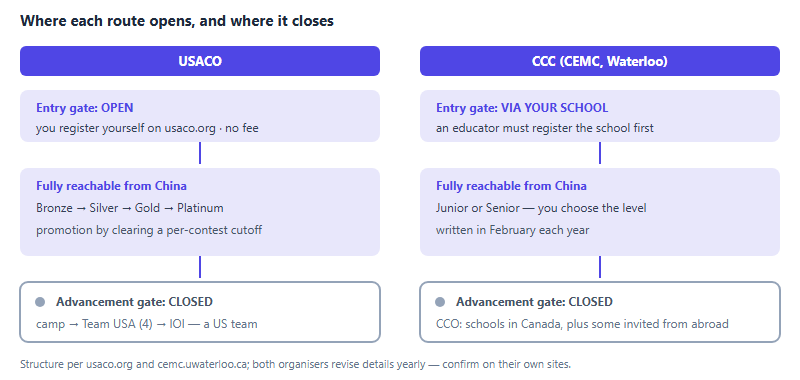
USACO is unusually clean on the entry side, and it is the reason it dominates among international-school students in China:
- You register yourself on usaco.org. No school registration, no authorised test centre, no teacher signature. If your school is uninterested, you can still compete.
- There is no fee. Anyone worldwide may enter the online contests and use the training material.
- It runs online, in a window you choose. Contests open for a multi-day window inside which you take one contiguous block of roughly four to five hours on your own timer — workable around a Chinese school timetable without asking anyone for a room.
- Four divisions. Bronze, Silver, Gold, Platinum. You start at Bronze and promote by clearing a per-contest cutoff; recent seasons have sat somewhere around 650–750 out of 1000, but that figure is set per contest and moves, so check usaco.org.
- Four contests a season. Three online rounds plus the US Open, spread across winter and spring; dates are published each year and change.
The advancement gate arrives above Platinum. Top performers are invited to a training camp, from which four students are selected as Team USA for the IOI. That selection is a United States team, and USACO sets its own eligibility rules for camp invitation and IOI team selection — check the current wording on usaco.org before assuming where the route ends for you. Our division guide sets out the full structure, and the official version lives on usaco.org.
So the honest summary is: everything from registration through Platinum is genuinely open to you; the last step is not. That is a very high ceiling before the gate.
CCC: the same shape, with your school in the middle
The Canadian Computing Competition, run by the CEMC at the University of Waterloo, is the other North American route that international-school students in China regularly ask about. Structurally it rhymes with USACO, but the two gates sit in different places.
Per CEMC’s own description on cemc.uwaterloo.ca — and this is the sort of thing that is revised annually, so confirm it there rather than here — any full-time student may participate regardless of where they are in the world. There are two levels, Junior and Senior, and a participant chooses their level rather than being assigned one by grade. The contest is written in February.
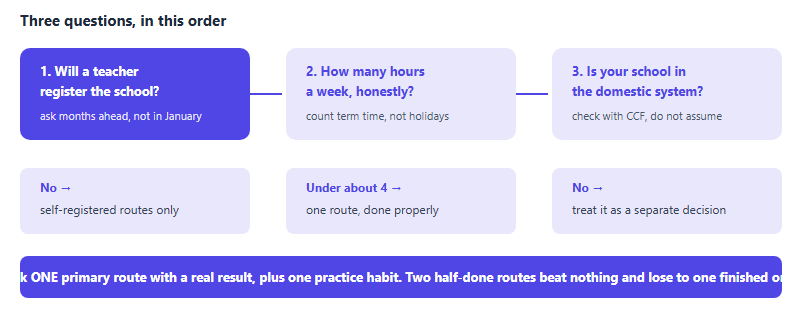
The entry gate, though, runs through a school. An educator supplies the school’s CEMC number, students create accounts on the CCC online grader, and teachers approve the registrations. That is a meaningfully different situation from USACO: if nobody at your school will act as the contact, the route is closed to you no matter how good you are. Ask early — a teacher has to do administrative work months before you sit anything.
The advancement gate is narrow and geographic in the same way USACO’s is. CEMC describes approximately twenty of the top official Senior participants from schools in Canada as being invited to the Canadian Computing Olympiad. Writing the CCC from Beijing is permitted; being routed into the Canadian olympiad from Beijing is not the normal path, though CEMC adds that outstanding participants, including Canadian citizens and permanent residents attending school outside Canada, may also be invited. Again: confirm the current wording with CEMC, because official-participant status carries criteria that CEMC republishes each year.
The domestic ladder, and the honest answer about eligibility
China has its own informatics competition system. Per the China Computer Federation’s own published materials, it is organised by CCF and runs as a ladder from the CSP-J and CSP-S certifications through the provincial and national olympiad stages towards IOI selection — confirm the current structure on CCF’s channels.
Here is where we stop giving you specifics, deliberately. Whether a particular international-school student in China can enter that ladder, at which stage, and through which channel, depends on rules set by CCF and on your school’s relationship with the domestic system. Those rules are published on CCF’s own channels, they are revised, and they are exactly the kind of thing that gets mangled when a guide site repeats what a forum said two years ago. Ask your school’s academic office and check CCF directly — do not assume either that you can enter or that you cannot.
What we can say without touching the rules is strategic, and it matters more than most families expect. The domestic informatics track is a full-intensity ecosystem: students in it typically train inside a school programme built around it, over years, against a very deep national field. It is not a thing you add to an IB or A-Level timetable in your spare evenings. If your school is not already inside that system, the realistic comparison is not “which is more prestigious” but “which one can I actually train for at the volume it demands.”
Ratings platforms and Kaggle are a different kind of object
Students frequently list Codeforces or AtCoder ratings, or Kaggle results, alongside USACO as if they were the same species. They are not, and the difference is worth being precise about.
Codeforces and AtCoder give you a continuous rating from a public platform. Anyone can register, there is no gate at either end, and the number moves every contest. That is excellent for training volume and for honest self-measurement, and it is genuinely how strong competitors keep sharp. It is a weaker object to point at, because a rating is a running average of a private practice habit, not a result awarded by an organiser under contest conditions.
Kaggle is a different discipline altogether — data science and machine learning rather than algorithmic problem solving — with its own tiers and medals, globally open, no eligibility gate. Useful and legitimate; simply not a substitute for an algorithms result, and it should not be presented as one.
| Route | Who registers you | Reachable from a China international school? | What you end up holding |
|---|---|---|---|
| USACO | You, on usaco.org, free | Yes, up to Platinum | A division reached, per contest |
| CCC (CEMC) | A teacher at your school | Yes to write; CCO invitations go to schools in Canada, with CEMC noting some participants abroad may also be invited | A Junior or Senior score |
| Domestic CCF ladder | Per CCF’s rules and your school | Verify with CCF and your school — we do not state it | Certification / olympiad standing |
| Codeforces / AtCoder | You, free | Yes, no gate anywhere | A continuous rating |
| Kaggle | You, free | Yes, no gate anywhere | Tiers and medals, in a different discipline |
What two routes do inside an application
The reason to think about this as a portfolio rather than a single choice is that an admissions reader does not evaluate any one line in isolation. They cross-check. A USACO division sits next to your computer science grade, next to whatever your activity list claims you do with your time, next to what your essay sounds like. Where several independent things point the same way, the file becomes believable; where one line has nothing supporting it, that line is the one that gets discounted.
That has two practical consequences. First, a second route is worth most when it corroborates rather than duplicates — a Silver result and a solid CCC score are two independent organisers observing the same student under contest conditions, which is a stronger pattern than one result plus a self-reported rating. Second, breadth without depth does the opposite: four routes at entry level reads as shopping, not as commitment, and it consumes the hours that would have produced one real result.
Nothing here guarantees an outcome at any university, and we publish no admissions statistics of our own. What we are describing is how the pieces of a file relate to each other. If you are choosing where to start, the self-registered, free, four-division route is the one with the fewest people between you and a result — the format and rules are set out on our rules page and, authoritatively, on usaco.org.
Frequently asked questions
Q: Can a student in China enter USACO directly?
Yes. Registration is free, individual and worldwide on usaco.org. No school, centre or fee is involved.
Q: Can I write the CCC from a school in China?
CEMC states any full-time student may participate regardless of location, but a teacher must register the school. Confirm on cemc.uwaterloo.ca.
Q: Am I eligible for the domestic CSP or NOI route?
That is set by CCF and depends on your school. Check with CCF and your academic office — we do not state eligibility here.
Q: Is a Codeforces rating equivalent to a USACO division?
No. A rating is a continuous platform measure; a division is a result under contest conditions from an organiser.
Independent guide operated by Hanlin Education for China-based international-school students. Not affiliated with, endorsed by, or sponsored by USACO (the USA Computing Olympiad), the IOI or EGOI, and not affiliated with CEMC or the China Computer Federation. Registration, contest rules, dates and promotion cutoffs live on usaco.org — confirm current details there, and confirm other organisers’ rules on their own sites, before planning around anything on this page. Errors reported to our editorial desk are corrected within 7 working days.