A USACO club works precisely because USACO does not need one. Entry is free, you register yourself on usaco.org, contests run in a window you choose, and nobody scores you as a team. So a club is purely a training vehicle — and the only structure that survives past October is one that puts a Bronze beginner and a Gold veteran in the same room, on the same problem, with different finish lines.
Why USACO suits a school club better than most contests do
Most school competition clubs are built around an administrative bottleneck: a teacher has to register the school, order papers, book an invigilated room on a fixed morning, and often pay an entry fee per head. That bottleneck sets the club’s ceiling. If the teacher is busy in November, nobody competes.
USACO removes almost all of it. Four facts from the contest format do the work:
- It is free and globally open. Students in China register directly on usaco.org rather than through a school or an authorised centre. Your club does not need a budget line, and it does not need the school’s permission to exist in order for members to compete.
- Scoring is individual. There is no team registration, no minimum headcount, and no politics about who is on the A team. A club of four is viable. So is a club of forty.
- The window is multi-day and you choose your contiguous block of roughly four to five hours inside it. Members with different exam timetables, different commutes and different families can all sit the same contest without the club booking anything.
- There are four divisions. A beginner and a veteran are genuinely in the same competition, at Bronze, Silver, Gold or Platinum, which is not true of contests with one paper for everybody.
Contest formats, dates and rules are set by USACO and vary from season to season — read the current version on usaco.org and in our division guide before you plan a term around anything here.
The one rule a club breaks by accident
This is the section to read twice, because a study group is the single most likely place for an honest student to break USACO’s integrity rules without meaning to.
The rule is not “do not cheat during your own four hours.” USACO’s stated position is that you may not share technical information about a contest — approaches, hints, code, screenshots — while that contest is open. The open period is the whole multi-day window, not your personal block inside it. So the member who finished on Friday evening and the member who is starting Sunday afternoon are, as far as the rules are concerned, still in the same live contest.
What this means for a club with a group chat:
- Declare a blackout. Pin one message the day the window opens: no contest talk of any kind until the window closes. Not “is problem 2 a graph one,” not “how did everyone find it,” not a screenshot of a scoreboard.
- Give the blackout an end time, not a vibe. The window close on usaco.org is the end. Post the resumption message yourself so nobody has to guess.
- Move upsolving to after. Everything a club is good at — explaining, comparing solutions, arguing about complexity — is legitimate and valuable the moment the window shuts. It is a violation while it is open.
- Never let a stronger member “check” a weaker one’s code mid-window. This is the kindest-looking version of the violation and it is still a violation.
USACO also prohibits generative AI tools such as ChatGPT or Copilot, requires each participant to work entirely by themselves, and states that violations are punished with a lifetime ban from all USACO activities. Read the current wording yourself on usaco.org and on our rules and integrity page; the specifics are USACO’s to set and they are the only authority on it.
The mixed-level problem, and the one-problem-three-depths model
In our coaching team’s experience, school clubs tend to die the same way: a big first week, then a split between a handful who are bored and a larger group who are lost, and by around week seven only the people who were going to do USACO anyway are still coming. The cause is almost never the coach; it is running a session at one level.
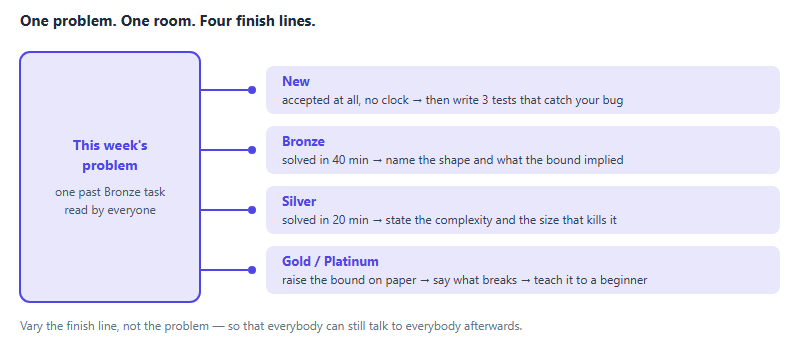
The fix that works in our experience coaching mixed groups is to stop varying the problem and start varying the finish line. One past problem per week, chosen at Bronze level, with three published exit criteria. Everyone reads the same statement, so everyone can talk to everyone afterwards.
| Member level | The finish line this week | What it trains |
|---|---|---|
| New / pre-Bronze | Get it accepted at all, with no time limit. Then write three of your own test cases that would have caught your first bug. | Reading the statement; the input/output habit; testing |
| Bronze | Solve it inside 40 minutes, then state out loud which shape it was and what the constraint bound was telling you. | Recognition speed; constraint reading |
| Silver | Solve it inside 20 minutes, then name the complexity and the input size at which your approach dies. | Implementation fluency; complexity budgeting |
| Gold / Platinum | Raise the constraint bound by three orders of magnitude on paper. Say what breaks, and what replaces it. Then teach the Bronze solution to a beginner. | Generalisation; and the fastest way to find your own gaps |
The teaching requirement in the last row is not charity. Explaining a solved problem to someone two divisions below is the cheapest diagnostic there is: the places you stumble are precisely the places your understanding is a memorised pattern rather than a reason.
The ninety-minute template
Ninety minutes is the realistic slot in most international schools: one after-school block, once a week. It is not enough time to simulate a contest, and clubs that try end up running a four-hour contest badly. Use the slot for the things that are genuinely better done in a room with other people, and leave the long solo work to the week.
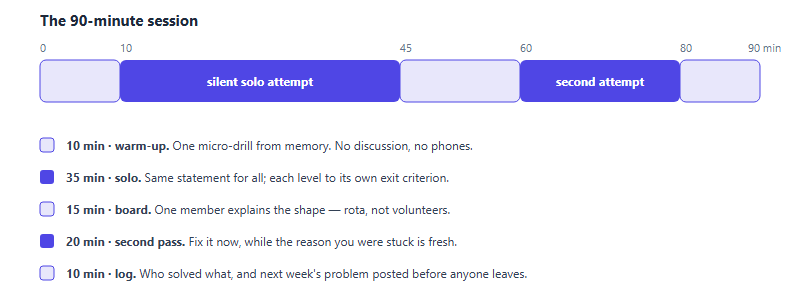
Two details do most of the work. The board slot runs on a rota, so the same confident member does not explain every week and the quiet ones never build the skill. And next week’s problem is posted before anyone leaves the room — a club that decides its problem by group chat on Wednesday night has already lost half its attendance.
Roles, and what to actually ask a teacher for
Four roles are enough, and they should rotate at least once a term:
- Convenor — owns the room booking, the calendar and the blackout announcements. This is an admin job, not the strongest coder’s job.
- Setter of the week — picks the problem, writes the three exit criteria, and has solved it in advance. Rotates.
- Archivist — keeps one shared document: date, problem, who reached which finish line, what the common bug was. This document is the club’s only real asset and it takes four minutes a week.
- Newcomer buddy — sits with anyone in their first three sessions. Clubs lose beginners in week two, not week ten.
When you pitch to a teacher, be precise about how small the ask is. You are not asking for money, a licence, a trip, or an invigilated exam. You are asking for a room, a recurring slot, and a named staff member so the club can exist on the school’s activity list. Bring one page: what USACO is, that it is free and registered individually on usaco.org, the season shape of three online contests plus the US Open, and the term’s meeting dates. Teachers say yes to specific, cheap, dated requests far more often than to enthusiasm.
The club calendar across a season
A USACO season runs roughly as three online contests followed by the US Open, spread across the winter and spring — the exact dates are published on usaco.org each year and move, so pin them the week they appear rather than assuming last year’s pattern. Around that, four club modes:
| Phase | Club mode | What the session looks like |
|---|---|---|
| Before the first contest | Build | Full 90-minute template. Heavy on recognition and on getting every member registered on usaco.org and past a first submission. |
| Contest window open | Blackout | Meet or do not meet, but no technical talk. Good week for a guest, a careers chat, or nothing at all. |
| Week after a window closes | Debrief | The single most valuable session of the term. Everyone brings their own contest, the failures get explained, the promotions get noticed. |
| After the US Open | Rebuild | Longer-horizon work: the algorithm families a division above where members sit now, and recruiting next year’s beginners before exam season swallows everyone. |
The debrief week is the one to protect. It is the only session where every member is working on a problem they personally cared about ninety minutes earlier, which is a teaching condition you cannot manufacture.
What a club honestly does inside an application
Be clear-eyed here, because students routinely overestimate this and then underuse it.
Founding a club is not itself a credential. A reader who sees “founder, competitive programming club” and nothing else has been given a job title with no evidence behind it. What the club does is make the rest of your file check out. An admissions reader cross-references: the division you reached on usaco.org, the computer science grade on your transcript, the club on your activity list, and whatever your essay says about how you actually spend your time. When those four corroborate each other — a Silver result, a strong CS grade, a club you ran for two years, and an essay that talks like someone who has debugged things at 1am — the file reads as one coherent person. When they do not, the outlier is what gets discounted.
That is the whole mechanism, and it is worth understanding properly because it changes what you should optimise. The club is worth more to you as the thing that produced a division result and two years of continuity than as a line saying you founded something. Nothing here guarantees an outcome at any university, and we do not publish admission statistics of our own; what we can say is which parts of a file support each other. For more on how a division result reads on its own, start from our USACO guide home.
Frequently asked questions
Q: Does my school have to register the club for us to compete?
No. USACO registration is free and individual on usaco.org. The club is a training group; the school is not a gatekeeper for entry.
Q: Can club members discuss a contest while the window is open?
No. USACO’s rules cover the whole open window, not just your own four hours. Run a blackout, and read the current wording on usaco.org.
Q: How do we run a club when members are three divisions apart?
Give everyone the same problem and different exit criteria. Same statement means everyone can still discuss it afterwards.
Q: How many members do we need to start?
Four is workable, because scoring is individual and there is no team registration. Continuity matters far more than headcount.
Independent guide operated by Hanlin Education for China-based international-school students. Not affiliated with, endorsed by, or sponsored by USACO (the USA Computing Olympiad), the IOI or EGOI. Registration, contest rules, dates and promotion cutoffs live on usaco.org — confirm current details there before planning around anything on this page. Errors reported to our editorial desk are corrected within 7 working days.