Less than most families expect, and a different kind. Bronze and Silver ask for careful arithmetic, exact counting and logical precision — not olympiad insight. In our own reading of past problems, genuine discrete mathematics appears at Gold and Platinum, and even there it is a minority of problems. The one piece of maths nobody escapes is estimating how many operations your idea will perform.
The short answer, before the detail
Two versions of this question arrive constantly, from opposite directions. A parent asks whether a child who is only average at school maths can realistically enter USACO. A student who trains for maths competitions asks whether that training gives them a head start.
The honest answers are: yes, comfortably, for the first two divisions; and yes but less than you expect, for the second.
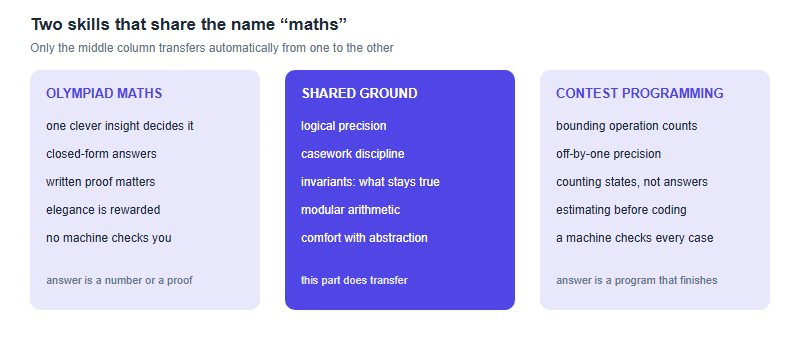
The confusion comes from the word. “Maths” in a school or olympiad context usually means finding a clever route to a closed-form answer. “Maths” in competitive programming usually means reasoning precisely about quantities — how many things there are, how many steps a procedure takes, whether a count is off by one. These overlap, but they are not the same skill, and being strong at the first does not automatically make you strong at the second.
What actually gates most students at Bronze and Silver is implementation: translating a clear plan into code that handles boundaries correctly and finishes in time. That is a programming problem wearing a maths costume.
What each division actually asks of you
USACO runs four divisions — Bronze, then Silver, then Gold, then Platinum — and you enter at Bronze and move up by clearing a per-contest promotion cutoff. The mathematical demand rises across that ladder, but far less steeply than most families assume, and it rises last rather than first.
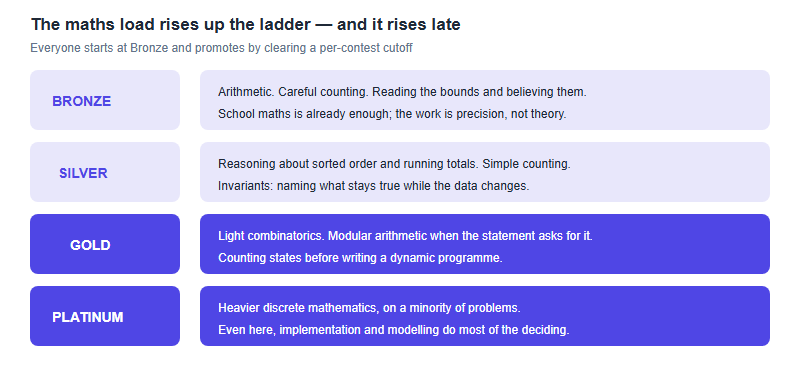
Some specifics worth stating plainly, because vague reassurance helps nobody — our own coaching characterisation rather than an official topic list, which USACO publishes on usaco.org:
| Mathematical topic | Where it first genuinely matters | What you need to know |
|---|---|---|
| Arithmetic and integer precision | Bronze | Whether a running total can exceed the range of your integer type. This is the single most common silent failure for beginners. |
| Off-by-one and boundary reasoning | Bronze | Inclusive versus exclusive ranges, 1-indexed versus 0-indexed. Not deep, but unforgiving. |
| Counting operations to estimate running time | Bronze, decisively by Silver | Multiplying bounds together and comparing the result to what a computer can do in the time limit. |
| Sorting and order reasoning | Silver | Why processing in sorted order makes a problem easier. More logic than algebra. |
| Invariants | Silver | Stating a property that remains true as the data changes. This is the one place olympiad training pays off immediately. |
| Basic combinatorics | Gold | Counting arrangements and choices, mostly to size a state space rather than to produce the final answer. |
| Modular arithmetic | Gold | Only when a statement explicitly asks for the answer modulo a stated number. It will say so; do not assume it. |
| Number theory, deeper algebra | Platinum, occasionally | A minority topic. Plenty of Platinum problems involve none of it. |
| Calculus | Nowhere, in practice | Not a prerequisite at any division. |
Note what is absent from that table. There is no requirement for proof writing, no trigonometry, no calculus, and no expectation that you can produce a clever closed-form identity under time pressure. The distribution of skill required is much flatter than the reputation of the contest suggests.
The one piece of maths nobody escapes
If you take a single thing from this article, take this: before you write code, you must be able to multiply the problem's bounds together and decide whether the resulting number of operations is survivable inside the time limit stated in the problem.
This is arithmetic, not analysis. Read the largest bound in the constraints. Ask what your intended approach does for each item — does it look at every pair? every triple? each item once? Multiply accordingly. Compare the result to a rough sense of what a program can do in the allowed time. If the number is wildly too large, the idea is dead and you should discard it before spending forty minutes implementing it.
Students who skip this step write correct programs that score nothing, because a solution that exceeds the time limit is graded the same as a wrong one. It is the most expensive habit gap at the Bronze-to-Silver boundary, and we have written about the mechanics of that budget separately — the point here is narrower. This estimation is the mathematics of competitive programming. Everything else is optional by comparison.
A second, quieter piece of arithmetic: know the range of the integer types in your language. Sums of large values overflow silently in some languages, producing plausible-looking wrong answers that pass the sample. USACO accepts C, C++, Java and Python, and the failure modes here differ sharply between them, which is one reason language choice deserves its own thought.
Two starting points: the maths olympiad student, and the student who dislikes maths
If you already train for maths competitions. Some of your training transfers immediately and some of it actively misleads you.
- Transfers well: casework discipline, comfort with abstraction, the instinct to look for an invariant, willingness to sit with a problem you cannot yet see through. Modular arithmetic, when it eventually appears, will cost you no learning time at all.
- Transfers badly: the search for a single elegant insight. Many contest problems reward a systematic, slightly inelegant procedure over a clever one. Chasing the beautiful solution when a straightforward one fits inside the bounds is a real and common way to lose a problem.
- Does not transfer at all: writing proofs, and the habit of producing an answer rather than a procedure. A grader does not read your reasoning. It runs your program on tests you cannot see.
The trap for this group is confidence. Strong maths students routinely arrive expecting Bronze to be trivial, meet a problem whose difficulty is entirely in implementation, and conclude something is wrong with them. Nothing is. They have simply met the other skill for the first time. Our published six-year cohort record shows the narrowing shape of progression up the divisions, and the students who stall are rarely stalling for mathematical reasons.
If maths is your weaker subject. The realistic message is genuinely encouraging: the first two divisions are within reach, and the things that will actually gate you are trainable and concrete.
- Arithmetic care, not arithmetic speed. Nobody is timing your mental maths. You need to be right about boundaries, not fast.
- Reading constraints accurately. A numeric bound in a statement is information, not decoration.
- Patience with the operation-counting habit above. It takes a fortnight to internalise and pays for the rest of your time in the contest.
What you can safely defer: combinatorics, modular arithmetic, and anything resembling number theory. None of it stands between you and a Bronze or Silver result. Learn it when a Gold problem forces the issue, not before, and spend the time you save on writing more code — which is what actually moves you up.
A workable six-week patch for this group looks like: two weeks on integer ranges and boundary conditions, drilled through small programs rather than worksheets; two weeks on the operation-counting habit, applied to every problem you attempt, written down before you code; two weeks of past problems at your division with no new theory at all. That is a maths plan in which almost nothing is maths, which is exactly the point. Past problems arranged by division sit on our past contests page, and topic-by-topic references are on the resources page.
Finally, the practical framing for families deciding whether to start. USACO is free to enter and open to students anywhere, including students in China, with registration on usaco.org. The cost of finding out whether the mathematical demand suits your child is close to zero — a season, some evenings, and no fee. The division guide sets out what each level covers, and the honest test is not a maths score but whether the student enjoys the debugging.
Frequently asked questions
Do I need to be good at maths to start USACO?
No. Bronze needs careful arithmetic, accurate boundary reasoning and patience. School-level maths is sufficient to enter and to promote out of Bronze.
Does AMC or olympiad training help with USACO?
Partly. Casework, invariants and abstraction transfer well. Proof writing and closed-form cleverness do not, and implementation remains the usual bottleneck.
When does modular arithmetic actually appear?
Only when a statement explicitly asks for the answer modulo a stated number, which is more common from Gold upward. The statement always says so.
Is calculus needed for any USACO division?
No. In practice it is not a prerequisite at any level. Division topics are published by USACO — confirm the current descriptions on usaco.org.
This is an independent guide operated by Hanlin Education for China-based international-school students. It is not affiliated with, endorsed by, or sponsored by USACO (the USA Computing Olympiad). Division topics, contest rules, promotion cutoffs and contest dates are set by USACO and may change — always confirm current details on usaco.org, where registration and participation take place. Any factual error brought to our attention is corrected within 7 working days.