USACO is one of the most widely recognised signals of genuine computer-science ability in university admissions, especially for students applying to CS-heavy programmes. It guarantees nothing on its own, and no activity ever does. What a documented climb through the divisions demonstrates is self-taught problem-solving under real pressure, which is exactly the trait selective CS programmes look for. Here is an honest breakdown of what USACO signals and how it fits an application.
Why Admissions Readers Recognise USACO
Three properties make USACO legible to admissions officers. First, it is globally known and standardised, so a result means the same thing whether the student is in Shanghai or Seattle. Second, it is merit-based and hard to fake, because you earn your division by clearing cutoffs in timed contests rather than by paying a fee or writing an essay. Third, the four-division ladder is a clean, ordered scale that a non-specialist reader can interpret at a glance.
One data point is often cited in this context: figures attributed to MIT admissions suggest that a large share, reported at around 76%, of admitted computer-science-track freshmen have USACO experience. Treat this as indicative rather than precise, and confirm it against official MIT sources. Crucially, it is a correlation, not a lever. Students who reach that level tend to be intensely self-driven coders, and it is that underlying drive, visible through USACO, that admissions readers value. USACO reflects the ability; it does not manufacture an offer.
What Each Division Actually Signals
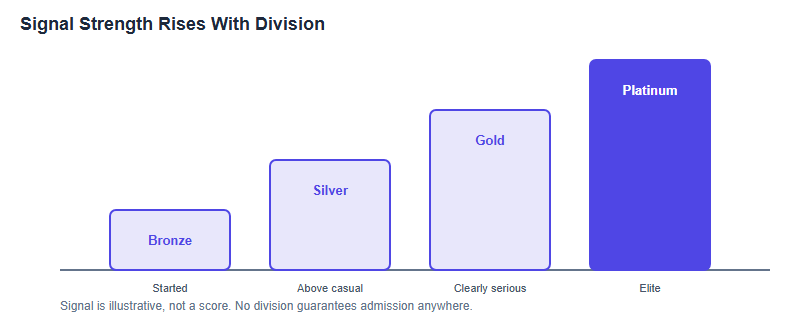
The strength of the signal rises sharply with the division. Bronze shows you started; Platinum shows genuine algorithmic depth. The table below translates each division into what it communicates to a reader.
| Division | What it demonstrates | Signal strength for CS admissions |
|---|---|---|
| Bronze | You can code and reason carefully about small problems | Entry-level; shows initiative |
| Silver | Real algorithmic thinking: sorting, searching, greedy logic | Solid; above casual interest |
| Gold | Comfort with dynamic programming and graph algorithms | Strong; clearly serious |
| Platinum | Advanced techniques and mature problem design | Elite; top-tier signal |
Beyond Platinum sits the national-team pathway, where top scorers attend a training camp and four are chosen as Team USA for the International Olympiad in Informatics. That route is specific to the United States, but the divisions themselves are open globally, and reaching Gold or Platinum as an international student is a powerful demonstration of ability regardless of nationality.
How USACO Actually Fits an Application
The honest framing is that USACO is one piece of a portfolio, not the whole picture. It contributes three things: academic rigour that is externally verified, demonstrated interest in computer science that goes well beyond a stated intention, and a concrete talking point for essays and interviews, where explaining how you thought through a Gold-level problem is far more persuasive than claiming you love coding.
It works best in combination. USACO pairs naturally with independent projects, research, open-source contributions, or a data-science portfolio, because together they show both algorithmic depth and the ability to build. What it cannot do is stand in for the rest of an application. Grades, essays, and overall fit still carry enormous weight, and reaching Platinum will not rescue a weak application any more than skipping USACO will sink a strong one. No activity guarantees admission, and any coach who promises otherwise is misleading you.
USACO Compared With Other CS Signals
Students often ask whether USACO is better than hackathons, a Kaggle profile, or a portfolio of apps. The more useful question is what each one proves, because they are complementary rather than competing.
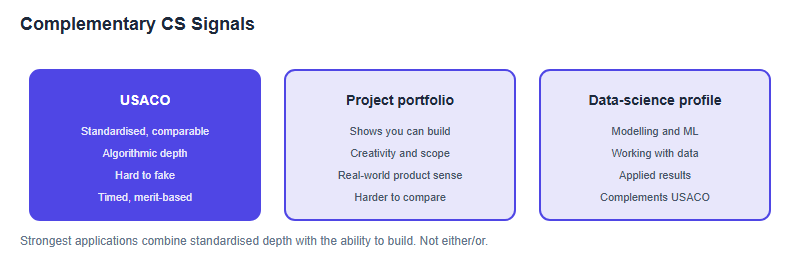
USACO's distinct advantage is comparability. A Gold or Platinum result is a fixed reference point that a reader can weigh instantly, whereas a portfolio, however impressive, requires interpretation. That is why USACO pairs so well with builder-style evidence: one supplies the standardised benchmark, the other supplies range. This comparability also travels across borders: because the divisions mean the same thing everywhere, an international student's Gold result is read on the same scale as a domestic applicant's, which is rarely true of school-specific or region-specific awards that a reader has no way to calibrate. If you want to see how the competition itself is structured before planning, our USACO guide hub lays out the divisions and season.
A Realistic Multi-Year Plan for CS Applicants
Because USACO rewards accumulated skill, the students who benefit most start early and climb steadily. A sensible arc for a serious applicant looks like this:
- Grade 6-9: learn a language, clear Bronze, and push into Silver. Early years are for building fundamentals without deadline pressure.
- Grade 9-11: aim to reach Gold, and Platinum if the ability is there. This is where the signal becomes genuinely strong for admissions.
- Application year: hold your highest division as verified evidence, and pair it with a project or research that shows range. Document your journey honestly; growth from Bronze to Gold is itself a compelling story.
Compare divisions against the current bar using our promotion cutoff reference, and remember the guiding principle throughout: USACO is a way to build and prove real ability, not a shortcut. The rigour is the point, and the signal follows from it.
How to Write About USACO in Your Application
Where you place USACO matters. The activities list is the natural home for the credential itself — your highest division and the year you reached it — because that is where a reader expects a verifiable fact. Essays and interviews, by contrast, are for reflection, and this is where USACO earns its real value.
Lead with how you think, not just what you achieved. A short, specific account of how you approached a stubborn Gold-level problem — the wrong turn you took, the insight that unlocked it, the edge case you nearly missed — tells a reader far more than the word "Platinum" ever could. It shows genuine engagement rather than a line on a résumé. Framing growth works especially well: a climb from Bronze to Gold across two years is a story of persistence that many admissions readers find more compelling than a single high result.
Two cautions. First, be scrupulously accurate about your division and never inflate it, because verifiability is part of what makes USACO valuable and a false claim is far more damaging than a modest true one. Second, remember that a reader may not know what "Platinum" means, so give a brief plain-language context rather than a jargon dump. Finally, connect USACO to your intended field and to your other activities, so the whole application reads as one coherent story of someone who both thinks rigorously and builds things, rather than a collection of unrelated trophies.
Common Misconceptions Families Have
Several persistent myths lead families to make poor decisions around USACO. Clearing them up early saves a great deal of wasted effort.
- "USACO alone gets you in." It does not. It is one piece of a portfolio, and no activity guarantees admission anywhere. Treat it as one strong signal among several.
- "It is only worth doing if you reach Platinum." Not true. Silver and Gold are meaningful results, and the growth story from a lower division is itself valuable. Most students never reach Platinum, and that is fine.
- "Start in grade 11." Starting late sharply limits how far you can climb before applications are due. Because USACO rewards accumulated skill, earlier is almost always better.
- "It is only for future computer-science majors." It is strongest for CS applicants, but the analytical rigour it demonstrates reads well for engineering, mathematics, and other quantitative fields too.
- "Enough tutoring guarantees a promotion." No one can guarantee that you clear a cutoff, because promotion is earned through your own timed performance. Good coaching can accelerate learning, but the skill has to be genuinely yours.
The healthiest mindset treats USACO as a multi-year skill-building project whose admissions value is a by-product of real growth, not the reason to start. Students who internalise that tend to both enjoy it more and, not coincidentally, climb further.
Frequently Asked Questions
Does reaching USACO Platinum guarantee admission to a top CS programme?
No. No activity guarantees admission. Platinum is a strong signal of ability, but grades, essays, and overall fit still decide outcomes.
What USACO division do admissions readers find impressive?
Signal strength rises with division: Silver is solid, Gold is clearly serious, and Platinum is elite. Even a Bronze-to-Gold climb tells a compelling story.
Is USACO useful for international students in China?
Yes. USACO is free and globally open with no nationality limit, and a Gold or Platinum result is recognised worldwide. Register on usaco.org.
Should I do USACO or build projects for a CS application?
Ideally both. USACO proves standardised algorithmic depth; projects prove you can build. They complement each other rather than compete.
This is an independent guide operated by Hanlin Education for China-based international-school students. It is not affiliated with, endorsed by, or sponsored by USACO (the USA Computing Olympiad). Competition facts such as dates, cutoffs, and rules vary year to year; always confirm current details on usaco.org. Any error will be corrected within 7 working days of notice.